You’ve watched your child lose the thread of a two-step instruction, bounce off the walls at bedtime, and melt down over something small. You’ve been handed a label, maybe a prescription, and very little explanation of why.
ADHD (Attention Deficit Hyperactivity Disorder) is a neurodevelopmental condition marked by persistent patterns of inattention, hyperactivity, and impulsivity that interfere with daily functioning and development. Every child is sometimes distracted or restless. In ADHD, those patterns are more intense, more frequent, and more disruptive than what’s typical for a child’s age, and they show up across multiple settings: home, school, and friendships.
That’s the definition. The rest of this article covers the part almost nobody explains to parents: what’s actually driving those patterns inside your child’s brain and nervous system, and why that changes what you can do about it.
What Are The Signs And Symptoms Of Adhd?
ADHD symptoms cluster into three categories, and most children show some mix of all three.
- Inattention: Difficulty sustaining focus, following instructions, and organizing tasks. Easily distracted, often loses things, appears forgetful, or doesn’t seem to listen when spoken to directly.
- Hyperactivity: Constant fidgeting, tapping, or squirming. Trouble sitting still or staying seated, excessive talking, always “on the go” as if driven by a motor.
- Impulsivity: Blurting out answers, interrupting others, difficulty waiting their turn, acting without thinking through consequences.
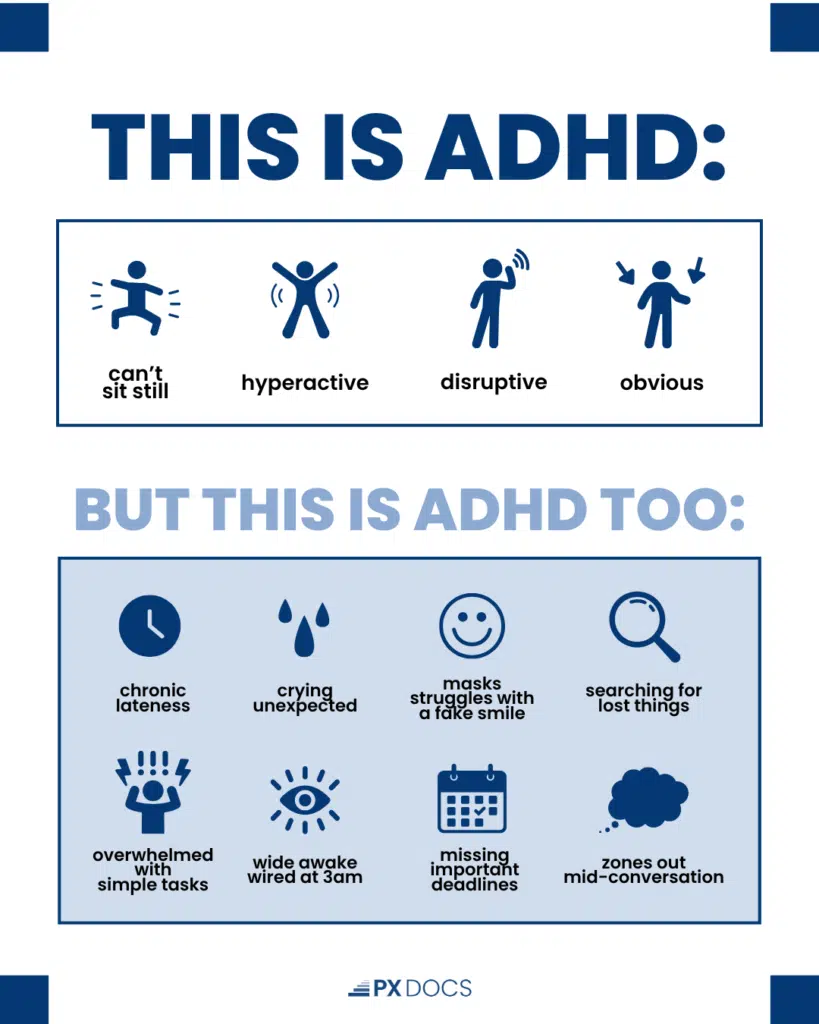
Which cluster dominates determines the presentation a doctor will name:
- Predominantly Inattentive Presentation: Mostly focus, organization, and follow-through struggles. This is what used to be called ADD, a term officially retired in 2013. If you’re sorting out the two labels, we break that down in ADD vs. ADHD.
- Predominantly Hyperactive-Impulsive Presentation: Mostly excessive movement and impulsive action, with attention struggles less obvious.
- Combined Presentation: Significant inattention and hyperactivity-impulsivity together. This is the most common pattern.
The impact reaches well past the classroom. Kids with ADHD often struggle with social connection, emotional regulation, and self-esteem. They have trouble making and keeping friends, swing hard emotionally, and carry a quiet sense that they’re constantly letting everyone down.
How Common Is ADHD In Children?
An estimated 7 million U.S. children ages 3 to 17, about 11.7%, currently have an ADHD diagnosis, according to 2024 national survey data reported by the CDC. Boys are diagnosed more often than girls (roughly 13% versus 7%), though that gap likely reflects how symptoms present rather than who actually has it. Girls tend to present as inattentive, which is quieter and easier to miss than a boy climbing the bookshelves.
ADHD also rarely travels alone. According to the previous survey, nearly 78% of children with ADHD have at least one other co-occurring condition, and about 4 in 10 have anxiety. Autism Spectrum Disorder, Sensory Processing Disorder, learning disabilities, and Oppositional Defiant Disorder show up frequently alongside it.
That clustering is a clue, not a coincidence. When one child carries ADHD, sensory struggles, constipation, and broken sleep all at once, that isn’t four unrelated problems stacked on top of each other. It’s one dysregulated nervous system producing four different symptoms. Understanding nervous system dysregulation is what finally makes the whole picture hang together.
What Causes ADHD?
For years, ADHD got blamed on poor parenting, too much sugar, or too much screen time. None of that holds up.
The explanation most parents get instead is the “chemical imbalance” theory: ADHD is essentially genetic, caused by an inherited shortage of neurotransmitters like dopamine and norepinephrine. After two decades of caring for these kids, I can tell you that theory is accurate, but incomplete. It doesn’t tell the whole story.
There is a dopamine imbalance in an ADHD brain. That part is real. But ADHD ends up as a dopamine imbalance. It didn’t begin as one. Same with the brain imaging findings: the overactive and underactive regions that show up on advanced scans. Those are real too. They’re also downstream. ADHD ends up in the brain, but it doesn’t begin in the brain.
So is ADHD a real condition, or just a personality type? Both, in a sense. The wiring is real, and it isn’t inherently a defect. Plenty of adults run successful lives on an ADHD brain. The struggle shows up when that wiring sits on top of a nervous system that has lost its ability to shift gears, and the wiring gets blamed for what the dysregulation is actually doing.
Dopamine and norepinephrine are neurotransmitters. Their one job is to transmit messages and coordinate communication for the brain and nervous system. So when a child’s brain chemistry is off, the honest next question is the one almost nobody asks: what happened to the nervous system that was supposed to be regulating that chemistry in the first place?
Genetics take generations to shift. Our children’s environment shifted in a single one. That’s where The Perfect Storm™ comes in.
The Perfect Storm™ behind an ADHD brain
The Perfect Storm™, the framework I developed, describes how neurological stress accumulates in a specific sequence long before any label appears. Three core components drive it.
1. Early neurological stress, before birth. Fertility struggles, high maternal stress and trauma during pregnancy, and birth interventions such as C-section, forceps, vacuum extraction, induction, or stalled labor. Stress hormones cross the placenta during pregnancy and shape the developing Autonomic Nervous System’s baseline. Many babies arrive already running hot. This isn’t about blame. It’s about knowing where the story actually starts.
2. Toxic load and early childhood health struggles. Environmental toxins stack with medical stressors, especially repeated antibiotics, which disrupt the gut and the gut-brain axis. This phase leaves fingerprints parents recognize and get told to ignore: colic, reflux, eczema, recurrent ear infections, chronic congestion, broken sleep, constipation, sensory overload.
3. Disrupted neuro-sensory-motor development, where it locks in. The neurological foundation doesn’t get built the way it was designed to, producing subluxation, vagus nerve dysfunction, sensory processing challenges, and altered motor development.

That third piece deserves a closer look, because with ADHD it behaves in a way most parents are never told about. Altered milestones are not always delayed milestones. Clinically, I often see the hyperactive, impulsive child move through motor milestones too fast: walking at eight to ten months, skipping crawling, climbing everything in sight. That looks like an advanced kid. It’s frequently a child so full of neurological tension that they need constant movement to settle their own brain. The inattentive child tends to run the opposite way, slower through milestones, weaker hand-eye coordination, and that same coordination gap later surfaces as trouble with reading and comprehension.
Any one of these factors on its own may not amount to much. Stacked together, they overwhelm a developing nervous system.
Two Patterns We See Clinically
Medically, both of the children below get the same ADHD label. Neurologically, they’re close to opposites, which is exactly why identical care plans produce such different results.
The first is what I call the “raging bull”: stuck in fight-or-flight, wound up, impulsive, hypersensitive, running at full speed until they crash. The second is the “drunken bull”: slowed down and grinding its gears, with cognitive and emotional processing running behind, clumsy coordination, and attention drifting without any hyperactivity attached. That second child doesn’t have the “H” in ADHD at all, and often gets read as lazy or unmotivated instead.
In practice, the two look nothing alike across a day. The raging bull child needs to move to think, does better on the soccer field than at the desk, and makes bedtime the hardest hour in the house because there’s no brake to apply. The drunken bull child doesn’t gravitate toward sports, struggles with hand-eye coordination, and teachers describe them as bright but somewhere else. Both children are dysregulated. One is stuck with the gas pedal down; the other can’t get enough pressure on the pedals at all.
Sorting out which pattern a child is running matters more than the label, because it changes what their nervous system actually needs. Our test for ADHD walks through how we tell them apart.
Why A Symptom Checklist Can’t Find The Root Cause
If you suspect ADHD, the standard path starts with an evaluation by a qualified healthcare provider, typically including:
- Interviews with you, your child, and other caregivers about symptoms, developmental history, and family background
- School records, report cards, and teacher observations
- Standardized rating scales such as the Vanderbilt or Conners
- A physical exam and lab work to rule out thyroid problems, sleep apnea, or nutrient deficiencies
- Screening for co-occurring conditions
From there, a provider decides whether your child meets DSM-5 criteria. Two of those criteria are worth knowing, because they surprise parents: several symptoms must have been present before age 12, and they have to show up in two or more settings. A child who only struggles at school, and only since fourth grade, may not meet the definition even while genuinely struggling.
This process is genuinely useful for naming what you’re dealing with. But notice what it is: there’s no blood test for ADHD. No brain scan. It’s a survey, a questionnaire, and a careful accounting of symptoms, which then becomes a category. Nothing in it measures why the nervous system is behaving this way.
That gap is why misdiagnosis and missed diagnosis are both so common. Girls in particular get overlooked because of differences in symptom presentation, showing a male-to-female ratio near 3:1 in clinical samples despite far more even rates in population studies. Adults who grew up before the condition was well recognized often went their whole childhood unnamed.
What Conventional ADHD Care Does, And Where It Stops
Medication has a real place, and for some families it buys breathing room they badly need. It also comes with trade-offs worth knowing. Stimulants commonly bring:
- Decreased appetite and weight loss
- Sleep problems and insomnia
- Irritability and mood swings
- Headaches and stomachaches
- Tics and twitches
- Increased heart rate and blood pressure
Researchers have also raised questions about prolonged stimulant use and the developing brain, including possible effects on white matter volume and connectivity. And because stimulants are pharmacologically related to drugs like methamphetamine, misuse remains a real consideration in adolescents and young adults, even though rates stay low when medication is taken as prescribed.
The deeper limitation is simpler. Medication and behavioral therapy manage what’s on the surface. Neither one asks what put the nervous system into this state, which means neither one changes it. That’s part of why so many families cycle through years of “try this, see if it helps” and still feel like they’re swimming upstream. CDC data shows nearly 2 million U.S. children with ADHD received no ADHD-specific care at all in 2022, and roughly 30% got neither medication nor behavior therapy.
Here’s the difference in approach, side by side:
| Conventional ADHD care | Neurologically-Focused Chiropractic Care | |
|---|---|---|
| Starting question | Which symptoms does this child have? | Why is this nervous system dysregulated? |
| Assessment | Questionnaires, rating scales, observation | Neurological exam plus INSiGHT Scans measuring thermal, sEMG, and HRV |
| What gets measured | Symptom frequency and severity | Autonomic function and adaptability |
| Primary target | Neurotransmitter levels and behavior | Subluxation and nervous system dysfunction |
| How progress is judged | Are symptoms quieter? | Is the nervous system measurably regulating better? |
Neither column makes the other unnecessary. Plenty of the families we see use both. The point is that the right column asks a question the left column never gets to.
What Neurologically-Focused Chiropractic Care Actually Addresses
We don’t work on ADHD. We work on the nervous system dysfunction underneath it, which is a different thing.
At the center sits the Autonomic Nervous System (ANS), which runs everything your child doesn’t consciously control: digestion, heart rate, immune response, stress recovery. It has two sides:
- The Sympathetic Nervous System, the gas pedal, running the fight-or-flight response.
- The Parasympathetic Nervous System, the brake pedal, running rest, digestion, regulation, and, importantly for ADHD, concentration.
A healthy system moves fluidly between the two. In kids struggling with ADHD, that balance is off: gas pedal stuck down, brake pedal weakened. The way I explain it to parents: the bigger the gap between those two pedals, the bigger the child’s struggle.
Driving that imbalance is subluxation, which in Neurologically-Focused Chiropractic Care means three things together, not just one:
- Misalignment in the neurospinal system
- Fixation where segments stop moving properly
- Neurological interference where that combination distorts the signals traveling between brain and body. It’s the interference that matters most.
Subluxation can be set off by physical stress like birth trauma, chemical stress like toxins, or emotional stress, and over time it pushes the system toward sympathetic dominance, dysautonomia, and full nervous system dysregulation.
The vagus nerve is central here. It runs the parasympathetic brake, originating in the brainstem and traveling through the neck and torso to the heart, lungs, and digestive system, which is exactly why a dysregulated child so often has gut and sleep problems alongside attention problems.
One honest note on the research, because the popular version overstates it: a meta-analysis of resting vagal tone did not find a reliable difference between children with ADHD and their peers. The signal shows up in flexibility rather than in any single resting number. Lower cardiac vagal activity, meaning a less adaptable ANS, predicts emotion-regulation difficulties in adolescents with ADHD, specifically a shrinking set of strategies they can actually reach for when upset. That distinction matters clinically. The problem isn’t a low number. It’s a system that has lost the ability to shift gears. We go deeper on this in the ADHD nervous system.
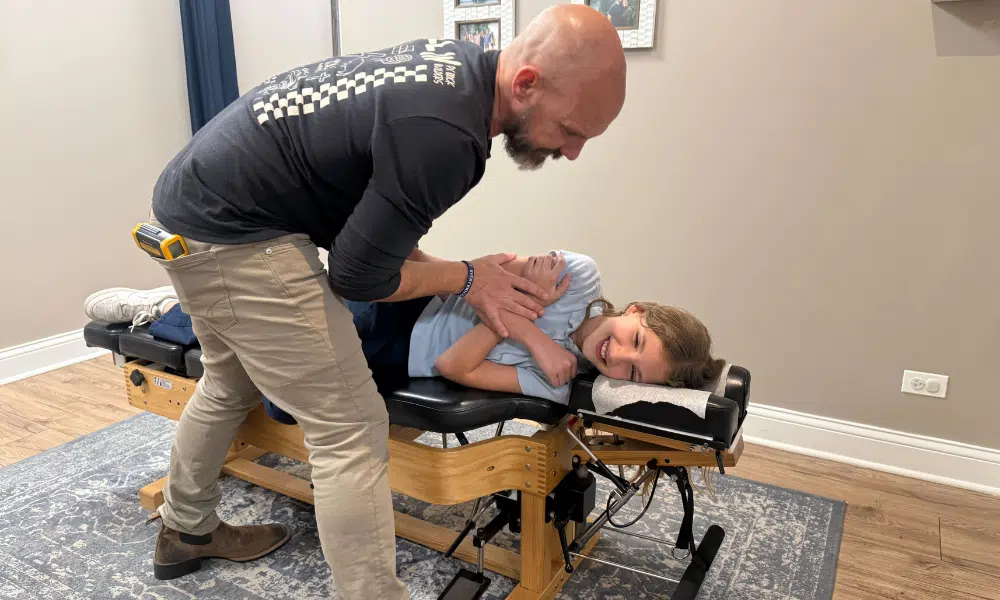
It’s important to note that this technology does not diagnose medical conditions, and Neurologically-Focused Chiropractic Care is certainly not a treatment or cure for ADHD or any other condition, not even back pain. We’re addressing nervous system dysfunction and dysregulation, and how it affects how a child’s whole body operates.
How INSiGHT Scans measure nervous system function
INSiGHT Scans, developed by the Chiropractic Leadership Alliance, let us measure nervous system function instead of guessing. Three non-invasive scans, no radiation, nothing painful:
- NeuroThermal: Reads temperature differences along the neurospinal system, showing where autonomic regulation has gone off track.
- Neuro-EMG: Measures neuromuscular tension and imbalance, mapping where chronic stress and subluxation have settled in.
- Heart Rate Variability: Gauges the adaptability and resilience of the ANS. Low variability points to a system stuck on the gas pedal.

On a classic “raging bull” EMG pattern, I typically see heavy sensory tension concentrated through the neck and upper back, the neurological “noise” that reaches the brain and keeps it wound up. Tension lower in the neurospinal system frequently tracks alongside the constipation and neurogenic gut symptoms these same families are fighting. Together, the scans explain how one child can be wound up and worn out at the same time.
Here’s the part that separates measurement-driven care from hope-driven care. We don’t guess. We test. A baseline scan shows where your child’s nervous system actually sits today, not where a questionnaire suggests it might be. Then we scan again at intervals as care unfolds, to confirm the system is genuinely responding: HRV climbing, neurological tone organizing, the foundation holding. If the data says we’re on track, we keep building. If it says something needs to shift, we change the plan rather than letting months go by. That’s what keeps your child’s care anchored to what’s really happening inside instead of how things look on the surface.
Your Child Is Not Broken
If you’ve read this far, you already know the challenges and the brilliance of loving a kid with an ADHD brain. You’ve seen the struggle and the spark.
I have ADHD myself. As I’ve shared on an episode of the Experience Miracles™ podcast, I fought it through high school and college before finding chiropractic care at 21, and I’ll tell you plainly that an ADHD brain left dysregulated is a genuine daily battle at any age. I’ll also tell you that the same wiring stops being the enemy once the nervous system underneath it gets calmer and better organized.
Your child isn’t broken. Their nervous system has been overwhelmed, for longer than anyone told you, by stressors that stacked up before you had any way of seeing them. That’s a very different problem than a defective brain, and it’s one you can finally do something about.
If you’re ready to learn what’s actually going on inside your child’s nervous system, start with an in-depth consultation and a set of INSiGHT Scans. Use our directory to find a PX Doc near you.