
The ADHD nervous system is an Autonomic Nervous System stuck in sympathetic “fight-or-flight” overdrive, with a weak parasympathetic “rest and regulate” brake. This imbalance, not a simple chemical shortage, drives the hallmark ADHD struggles: trouble focusing, impulsivity, emotional swings, restless energy, and poor sleep. When the gas pedal is jammed down and the brake barely works, a child can’t downshift into calm, focus, or rest.
If your child is wound up one minute and completely zoned out the next, you already know something deeper is going on than a “behavior problem.” You’ve watched them go from zero to one hundred over a sock seam. You’ve watched them stare right through a homework page they’re smart enough to ace.
Here’s what most doctors won’t tell you in an eight-minute appointment. ADHD isn’t really an attention problem. It’s a nervous system problem. The attention struggles, the meltdowns, the impulsivity, the can’t-fall-asleep nights are all downstream of an Autonomic Nervous System that lost the ability to shift gears. With ADHD now affecting roughly 11% of U.S. children, this is one of the most misunderstood challenges parents face today.
This article walks through what’s actually happening inside the ADHD nervous system, why the standard “chemical imbalance” story is incomplete, how this same dysregulation connects ADHD to Autism and Sensory Processing Disorder, and what a root-cause, drug-free path forward looks like.
What Is the ADHD Nervous System?
The ADHD nervous system is a brain and body where the Autonomic Nervous System has lost its balance. The Autonomic Nervous System runs everything you don’t consciously think about, including heart rate, digestion, breathing, sleep, and emotional response. In children with ADHD, the sympathetic “fight-or-flight” branch runs too hot while the calming parasympathetic branch stays underpowered, leaving the whole system stuck in high alert.
Think of it like the two pedals in a car. The Sympathetic Nervous System is the gas pedal: it speeds up heart rate, sharpens alertness, and mobilizes energy for action. The Parasympathetic Nervous System, driven largely by the vagus nerve, is the brake pedal: it slows things down for rest, digestion, sleep, and emotional regulation.
A healthy nervous system moves smoothly between the two. It hits the gas when a child needs focus and energy, then eases onto the brake when it’s time to calm down, wind down, and sleep. The ADHD nervous system can’t make that shift well. The gas pedal is stuck near the floor, and the brakes are worn down to almost nothing.
That single imbalance explains why ADHD symptoms look the way they do. A child running on a jammed gas pedal is restless, impulsive, and quick to anger. A child whose system has worn itself out running in overdrive looks foggy, spacey, and exhausted. Same root problem, two different faces.
Is ADHD Really Just a Chemical Imbalance?
ADHD is not simply a chemical imbalance, though chemicals are part of the picture. The popular story says ADHD comes from too little dopamine and norepinephrine in the brain. That’s accurate but incomplete. Neurotransmitters are messengers for the nervous system, so when the nervous system is dysregulated first, the chemicals follow. Fix the system’s regulation, and the chemistry has a chance to rebalance.
This matters because the chemical-only story leads straight to one answer: medication. Stimulant medications work by temporarily boosting dopamine and norepinephrine, which is why they can help in the short term. But they don’t change the underlying autonomic imbalance. The gas pedal stays stuck down. That’s why so many families find the benefits fade over a few years, or come with side effects like appetite loss, sleep trouble, and a “flattened” personality.
There’s a fair question worth asking. If ADHD were purely a chemical imbalance, wouldn’t there be a blood test for it? There isn’t. ADHD is often diagnosed from behavior questionnaires and observation, not lab work measuring serotonin or dopamine levels. That doesn’t mean ADHD isn’t real. It very much is. It means the real story lies one level deeper, in how the nervous system itself functions.
Researchers describe ADHD as involving autonomic dysregulation, an imbalance between the sympathetic and parasympathetic branches of the nervous system. That framing finally explains what parents see every day.
How Does the Autonomic Nervous System Affect Attention and Behavior?
The Autonomic Nervous System shapes attention and behavior because focus, impulse control, and emotional regulation all depend on a balanced internal state. When a child is stuck in sympathetic fight-or-flight mode, the brain prioritizes scanning for threats and reacting quickly over sitting still, planning ahead, and self-soothing. The result looks exactly like ADHD: distractibility, impulsivity, emotional reactivity, and trouble settling.
A key window into this is heart rate variability, or HRV. HRV measures the constant back-and-forth between the gas and brake pedals, and it’s the most direct everyday marker of vagus nerve activity and parasympathetic tone. Higher HRV reflects a flexible, adaptable nervous system. Lower HRV reflects a system stuck in one gear.
Studies of children with ADHD have found reduced vagally-mediated HRV during attention-demanding tasks, meaning their nervous systems struggle to flexibly engage the parasympathetic brake when the situation calls for focus and recovery. In children, autonomic dysregulation has been linked with inattention, aggression, weaker behavioral inhibition, and emotional lability. In plain terms, the body’s regulation system and the behaviors we label “ADHD” are tied together.
This is why a child with ADHD can hyperfocus on a video game for hours but melt down over a worksheet. It was never about willpower or caring. It’s a nervous system that can only run in extremes, full throttle or stalled out, because it can’t smoothly modulate in between.
Can the Same Nervous System Problem Cause Autism and Sensory Issues?
Children with ADHD frequently also experience Autism, Sensory Processing Disorder, and anxiety, and this overlap isn’t a coincidence. All of these conditions share a common thread: dysregulation of the Autonomic Nervous System, with the system stuck in sympathetic dominance and a suppressed, underactive vagus nerve. The specific label a child receives often depends on which symptoms show up loudest, not on a fundamentally different root cause.
This state of nervous system imbalance is sometimes called pediatric dysautonomia: dysfunction of the Autonomic Nervous System that throws off the balance between the sympathetic and parasympathetic branches. When a child’s “rest, regulate, and digest” system can’t do its job, the effects ripple out into focus, mood, sleep, digestion, and how the brain handles sensory input.
That’s why so many kids carry more than one diagnosis. A child labeled with ADHD may also struggle with sensory overwhelm, anxious spirals, gut issues, or rigid behaviors. From a root-cause view, these aren’t separate problems stacked on top of each other. They’re different rooms in the same house, and the house was built on a dysregulated nervous system. Address the regulation, and you’re working on all the rooms at once.
What Causes the ADHD Nervous System to Become Dysregulated?
The ADHD nervous system usually becomes dysregulated through an accumulation of early stressors, not a single cause. Dr. Tony Ebel calls this sequence the “Perfect Storm”: prenatal stress, then birth trauma, then early childhood stressors, layering one on top of another during the most sensitive windows of brain development until the nervous system gets stuck in overdrive.
It starts before birth. High-stress pregnancies expose a developing baby to elevated stress hormones like cortisol, which can prime the nervous system toward hypervigilance from the very start. A brain that develops in a stressed environment comes online already leaning on the gas pedal.
Birth is the next layer. Birth interventions like C-section, forceps, vacuum extraction, induction, and prolonged or stalled labor can place real physical strain on a baby’s delicate upper neck and brainstem, the exact region that houses the body’s master regulation centers and the origin of the vagus nerve. Strain here interferes with how the nervous system communicates and regulates.
Then come the early childhood stressors. The colicky, fussy baby who can’t latch, can’t sleep, and battles constipation and chronic ear infections is often the same child who gets an ADHD label years later. Add in repeated antibiotics, environmental toxins, and a gut-brain axis thrown off balance, and the nervous system never gets the chance to fully regulate. The neurology doesn’t change between infancy and the school years. It just gets a new name.
How Does Subluxation Affect the ADHD Nervous System?
Subluxation affects the ADHD nervous system by interfering with the brain-body communication that regulation depends on. Subluxation is a problem in the neurospinal system involving three things together:
- Physical misalignment
- Fixation (a joint stuck and not moving the way it should)
- Neurological interference (disrupted nerve signaling between brain and body).
The term for this, neurologically, is “neurospinal,” because the real issue isn’t the bone; it’s the nerve disruption.
When subluxation shows up in the upper neck and brainstem, it adds tension to a nervous system that’s already running hot. That tension biases the whole system toward the sympathetic gas pedal and away from the parasympathetic brake. The physical misalignment is honestly the least important piece. What matters is the neurological interference, the static on the line between the brain and the body that keeps the system from downshifting into calm.
This is the missing piece in most ADHD conversations. Conventional care zooms in on the brain’s chemistry and stops there. A Neurologically-Focused view examines the entire pathway, especially the brainstem and vagus nerve regions where regulation either works or breaks down. Reduce the interference, and the nervous system regains some ability to shift gears on its own.
What Are the Signs of a Dysregulated Nervous System in a Child With ADHD?
The signs of a dysregulated nervous system in a child with ADHD show up across focus, emotions, sleep, and the body, because the Autonomic Nervous System touches all of them. They tend to cluster into the “stuck on” pattern (always revved up) or the “worn out” pattern (running on empty), and many kids swing between the two.
Common signs of a dysregulated ADHD nervous system include:
- Trouble falling or staying asleep: the system can’t downshift at night
- Emotional reactivity: going from calm to meltdown in seconds over small triggers
- Impulsivity and restlessness: constant motion, fidgeting, blurting, climbing
- Inattention and “spacing out”: staring through tasks, especially after years of running hot
- Sensory sensitivities: clothing tags, seams, loud sounds, busy environments
- Digestive issues and constipation: a sign the “rest and digest” brake isn’t working
- Difficulty with transitions: struggling to shift from one activity to the next
- A racing heart or “always on” feeling: the body physically stuck in alert mode
If several of these sound familiar, you’re not looking at a discipline problem or a parenting failure. You’re seeing the visible surface of an Autonomic Nervous System that’s lost its balance. And that’s something that can be measured and worked on directly.
How Do INSiGHT Scans Measure the ADHD Nervous System?
INSiGHT Scans measure the ADHD nervous system using three objective, non-invasive tools that capture how the Autonomic Nervous System is actually functioning. Heart rate variability (HRV) measures autonomic balance and parasympathetic tone, surface electromyography (sEMG) measures patterns of muscle tension along the spine, and thermal scanning measures autonomic regulation of the body. Together, they show whether a child is stuck in sympathetic overdrive.
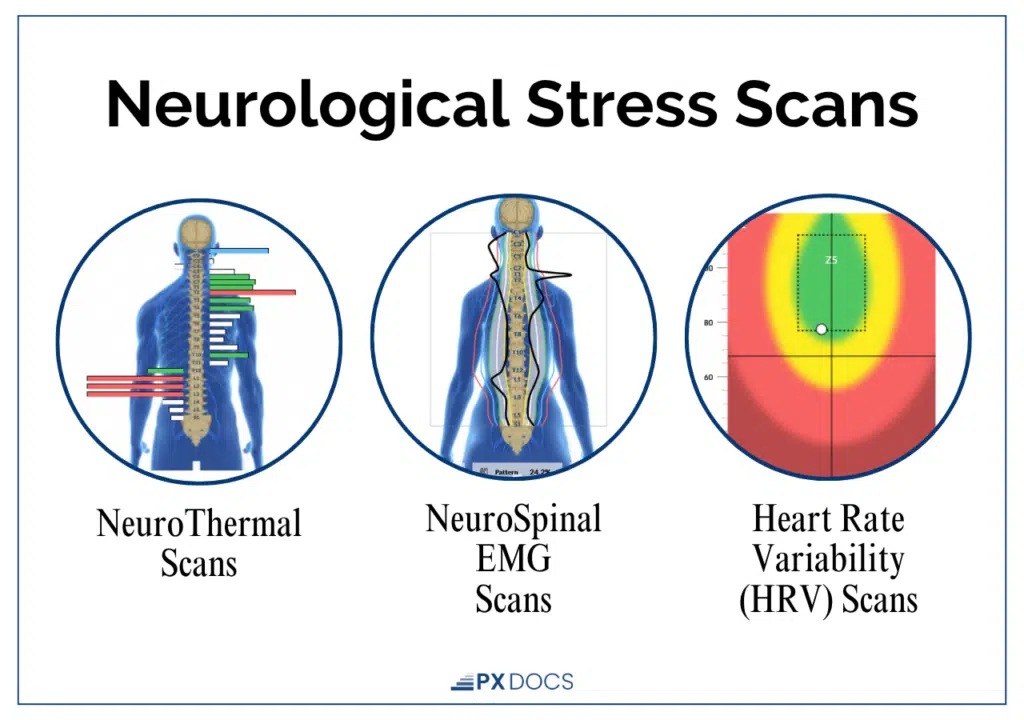
It’s important to be clear about what these scans are and aren’t. INSiGHT Scans are not a treatment or a cure for any condition, not even back pain. They don’t diagnose ADHD or any medical condition. What they do is measure nervous system function and dysregulation, so care can target the root issue instead of guessing from symptoms alone.
For a child with ADHD, a baseline scan often reveals exactly what the behavior already hints at: high sympathetic tone, an exhausted or suppressed parasympathetic side, and asymmetry in how the nervous system is firing. Putting numbers and patterns to the struggle is often the first time a parent sees objective proof that their child’s challenges are neurological, not character flaws. It turns a frustrating mystery into a clear, trackable starting point.
This is the heart of Neurologically-Focused Chiropractic Care: measuring nervous system function, finding where regulation has broken down, and building a care plan to help the system shift back toward balance.
How Does Neurologically-Focused Chiropractic Care Help the ADHD Nervous System?
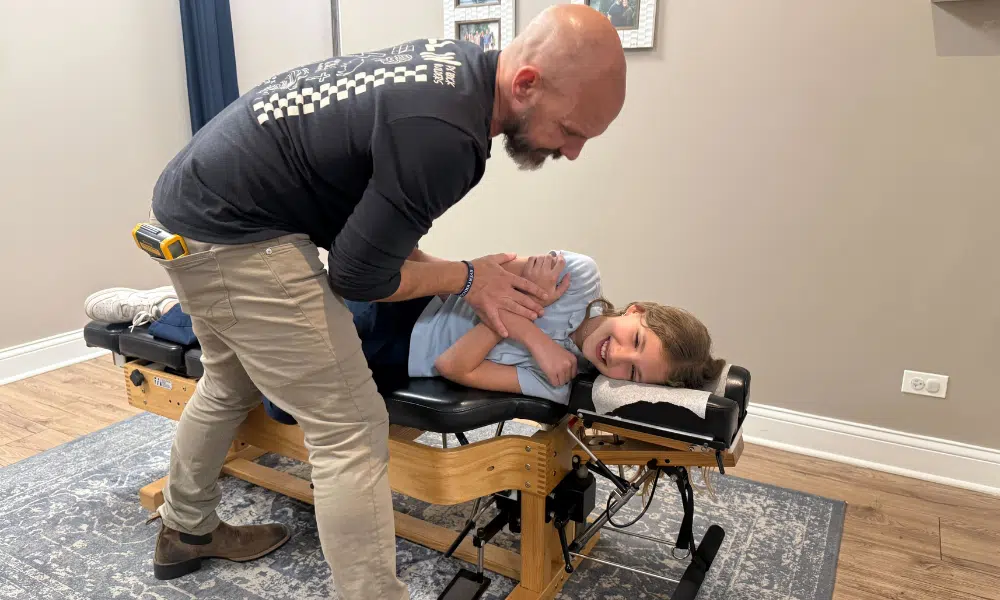
Neurologically-Focused Chiropractic Care helps the ADHD nervous system by reducing the neurological interference that keeps a child stuck in sympathetic overdrive. Using gentle, child-specific adjustments aimed at the areas of subluxation, the goal is to calm the overactive gas pedal and restore strength to the underactive parasympathetic brake, so the nervous system can regulate, rest, and focus more on its own.
This is not about “treating ADHD” or chasing symptoms. It’s about nervous system function. When the brain and body communicate more clearly, and the vagus nerve can do its job, the downstream effects often show up in the things parents care about most: better sleep, smoother transitions, fewer explosive meltdowns, improved digestion, and a child who can finally access the focus and calm that were always in there.
Take Lydia for example. Her mom watched her struggle daily with anger, focus, and outbursts, and even after trying supplements, diet changes, and strategies like drawing or journaling to help her cope, nothing seemed to move the needle. Once Lydia started getting adjusted through Neurologically-Focused Pediatric Chiropractic Care, her family noticed a shift within just a few visits — easier transitions, fewer outbursts, and better sleep. With consistent care, she now has far more good days than bad: she’s kinder to her sisters, able to focus and finish tasks, and can communicate without the hours-long meltdowns that used to define her day.
Here’s the reframe that changes everything for families. ADHD traits aren’t defects to be erased. That intense energy, drive, and creativity can become a genuine strength once the nervous system is regulated enough to harness them. The goal was never to slow the engine down. It’s to give a powerful engine the brakes and steering it deserves, so your child can drive the incredible machine they were born with.
Healing isn’t overnight. The nervous system that took years to wind up takes time to unwind. But with consistent care, many families start noticing shifts in the early weeks, with deeper regulation building over months as the system relearns how to find balance.
You Don’t Have to Guess Anymore
ADHD has never been a willpower problem, a discipline problem, or a sign that anything is wrong with your child. It’s a nervous system that got stuck in overdrive and never learned how to find the brake. Once you understand that, everything you’ve been watching finally makes sense.
The principle that guides this work is simple: we don’t guess, we test. Rather than throwing approaches at the wall and hoping, a baseline INSiGHT scan shows exactly where your child’s nervous system sits right now, how much it’s leaning on the gas pedal, and how much the parasympathetic brake has left to give. That’s the map.
From there, the work is measured, not hoped for. Repeat scans at regular intervals show whether the system is actually responding, with HRV climbing toward balance, muscle-tension patterns organizing, and thermal readings showing steadier autonomic regulation. If the data shows your child is on track, we keep building. If it shows something needs to shift, we adjust the plan. The scans keep care honest and anchored to what’s truly happening inside the nervous system, not just how things look on a given day.
This isn’t a treatment or a cure for ADHD. But it is a way to address the root cause that conventional approaches so often skip. Your child isn’t broken. They’re a powerful engine that’s been running without brakes, and that’s something you can finally do something about. To find a trained Neurologically-Focused Chiropractor near you, visit the PX Docs Directory.