
You’ve tried the weighted blanket, the sensory diet, the tag-free shirts, the noise-canceling headphones. Some of it helps on some days. None of it seems to change the child underneath.
A chiropractor can help with Sensory Processing Disorder, but not in the way most parents expect. Neurologically-Focused Chiropractic Care doesn’t treat sensory symptoms directly. It addresses the nervous system dysfunction underneath, the stuck stress and tension patterns in the brainstem and neurospinal system that leave a child’s brain receiving sensory information that’s too loud, too muted, and too disorganized to use.
That distinction is the whole ballgame. Sensory challenges affect an estimated 5 to 16% of school-aged children, and most of the support parents get focuses on helping a child cope with a dysregulated nervous system rather than regulating it. Clinically, that’s why so many families describe the same pattern: real progress in therapy, then a wall.
So let’s get into it. What’s actually happening in a sensory child’s nervous system, where it started, what a sensory-friendly adjustment looks like when your child hates being touched, and how any of it gets measured.
Can a Chiropractor Help With Sensory Processing Disorder?
Yes, though the honest answer requires being specific about what “help” means. A Neurologically-Focused chiropractor doesn’t work on your child’s sensory symptoms or diagnosis. They work on the brain-body communication that produces and contributes to those symptoms, locating and reducing the neurological interference that keeps a child’s nervous system stuck in a state where ordinary sensory input registers as a threat.
Here’s why that’s a reasonable place to intervene. Sensory processing isn’t a personality trait or a behavior problem. It’s a measurable neurological function. Research used diffusion tensor imaging to compare children with Sensory Processing Disorder to matched neurotypical controls and found reduced microstructural integrity in the posterior white matter tracts that carry sensory information, with those differences tracking alongside parent-reported sensory behavior.
That’s structural. But there’s a functional layer too, and it’s the one chiropractic care is positioned to affect. A research team examined whether Parasympathetic Nervous System activity works as a biomarker for sensory difficulties, and found that children with more significant sensory modulation problems showed physiological activity that differed from children without those problems.
Translated out of the journal: these kids aren’t choosing to fall apart over a seam in a sock. Their Autonomic Nervous System is running a different program than the one it was designed to run. And a neurologically focused chiropractor examines, measures, and works to shift autonomic function.
Why Sensory Processing Is a Nervous System Problem First
When a child struggles to process the outside world, it’s because the inside is disrupted first. External sensory challenges are downstream of internal sensory chaos, and that internal picture has a name in this work: pediatric dysautonomia.
Dysautonomia is dysfunction of the Autonomic Nervous System, the system running everything involuntary, including heart rate, digestion, immune response, and sleep. It has two branches. The sympathetic branch is the gas pedal, handling fight or flight and activation. The parasympathetic branch is the brake pedal, handling rest, digestion, and regulation. A regulated child moves smoothly between them. A sensory child is usually stuck with the gas pedal down and the brake pedal barely functional, a state called sympathetic dominance.
Picture the difference this way. Most sensory kids are idling at 5,000 RPMs even when they look calm on the couch. They’re one sound, one sibling, or one schedule change from redlining. Nothing dramatic has to happen, because the system was already at the edge.
This is also why the hyper and hypo confusion resolves. Parents get told their child is over-responsive, then watch that same child not notice a scraped knee. Both are true. A nervous system can only hold that much sympathetic activation for so long before it runs out of gas and starts shutting down inputs. That’s not two conditions. It’s one dysregulated system at two different points on the same arc.
Common signs of nervous system dysregulation behind sensory challenges include:
- Meltdowns triggered by clothing textures, tags, seams, or socks
- Covering ears at normal volumes, or seeming not to hear at all
- Extreme food selectivity and gagging on textures
- Constant motion, crashing, climbing, and seeking deep pressure
- Trouble falling or staying asleep
- Visible physical tension in the shoulders, neck, and jaw, including teeth grinding
- Toe walking, clumsiness, and poor hand-eye coordination
- Difficulty with transitions between activities or environments
- Constipation, reflux, or other digestive issues, reflecting the gut-brain axis
- Emotional reactions that seem out of proportion, then take a long time to recover from
Underneath the pattern is what chiropractors call subluxation. That word gets misused, so here’s the full definition: subluxation is a neurological stressor with three components: physical misalignment of the neurospinal system, fixation (loss of normal joint motion), and neurological interference, which is disrupted nerve signaling between brain and body. That third component is the one that matters here. Subluxation in a child isn’t a back problem. It’s a signal problem.
Think of the brainstem and upper neck as air traffic control for the entire sensory system. All sensory and motor information travels up through the spinal cord and crosses through that region. When there’s interference at the tower, planes don’t stop arriving. They arrive out of sequence, at the wrong altitude, all at once. That’s a sensory meltdown described neurologically.
Where Sensory Challenges Overlap With Autism and ADHD
Children with Sensory Processing Disorder frequently also carry diagnoses of Autism, ADHD, anxiety, or emotional dysregulation. That co-occurrence isn’t coincidental, and it isn’t bad luck. These conditions share an underlying mechanism, which is Autonomic Nervous System dysfunction and poor vagal tone, expressed differently depending on which developmental systems were hit hardest and when.
The imaging literature supports the overlap directly. Researchers compared children with Autism to children with Sensory Processing Disorder and found shared white matter disruption in sensory pathways, while connectivity in social-emotional pathways diverged between the groups. Same sensory foundation, different downstream expression.
The autonomic findings line up as well. Studies documented reduced cardiac parasympathetic activity in children with Autism, and separate researchers found distinct physiological arousal patterns when they directly compared children with Autism to children with sensory modulation problems.
For a parent, this reframes a confusing pile of labels into one question worth asking. If sensory, attention, emotional, and digestive challenges keep showing up in the same child, the common thread probably isn’t four unrelated problems. It’s one nervous system that never got the chance to organize properly.
What Causes Sensory Processing Disorder in Children?
Nervous system dysregulation develops through an accumulation of early stressors rather than a single cause. Dr. Tony Ebel calls this sequence The Perfect Storm™, and it follows a predictable order: prenatal stress, then birth trauma and intervention, then early childhood stressors, all landing during sensitive windows when the neurosensory system is being built.
The first leg is prenatal stress. A 2024 systematic review pooled 30 studies covering more than 1.3 million mother-child pairs and found consistent links between prenatal maternal stress and neurodevelopmental outcomes in children.
The second leg is birth trauma & intervention. A screening study followed children born by vacuum-assisted delivery, second-stage cesarean, and spontaneous vaginal delivery, and found higher rates of difficulty in both motor skills and perception among the assisted-delivery groups. Perception is the domain that maps most closely to sensory processing.
Forceps, vacuum extraction, cesarean delivery, cord wrapping, and prolonged labor all concentrate physical force at the upper neck and brainstem. That’s where sensory information crosses. It’s also where the vagus nerve originates, the longest cranial nerve in the body, carrying parasympathetic signals between the brain and the heart, lungs, and digestive system.
Then the third leg stacks on top: colic, reflux, recurrent ear infections, repeated antibiotics, feeding struggles, missed motor milestones. Parents get told a child will grow out of it. Clinically, we see children grow into the next version of it. The colicky infant becomes the toddler with tantrums nobody can explain, who becomes the six-year-old who can’t sit through circle time. It was the same nervous system dysregulation the entire way through.
What a Sensory-Friendly Adjustment Actually Looks Like
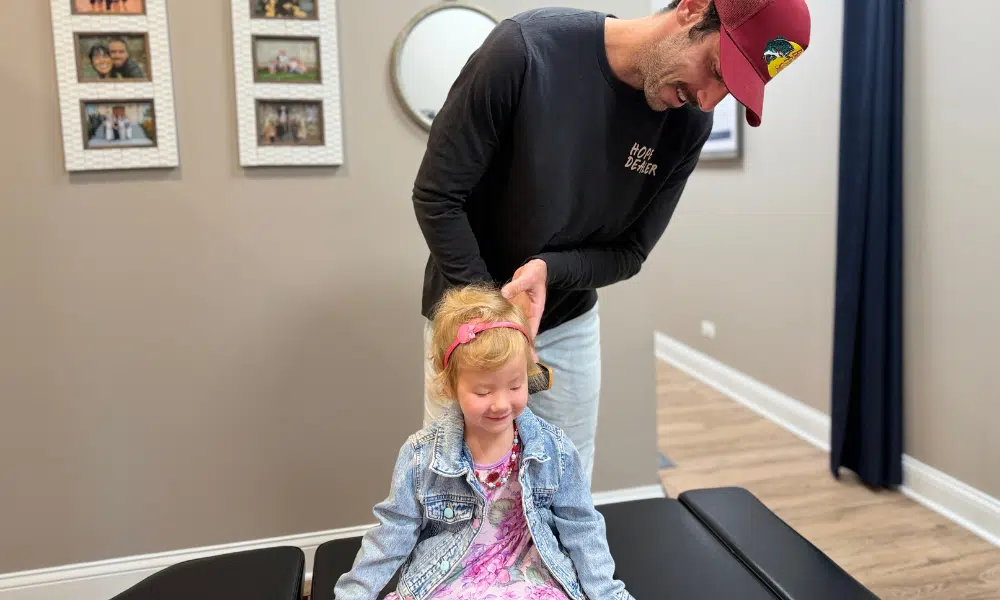
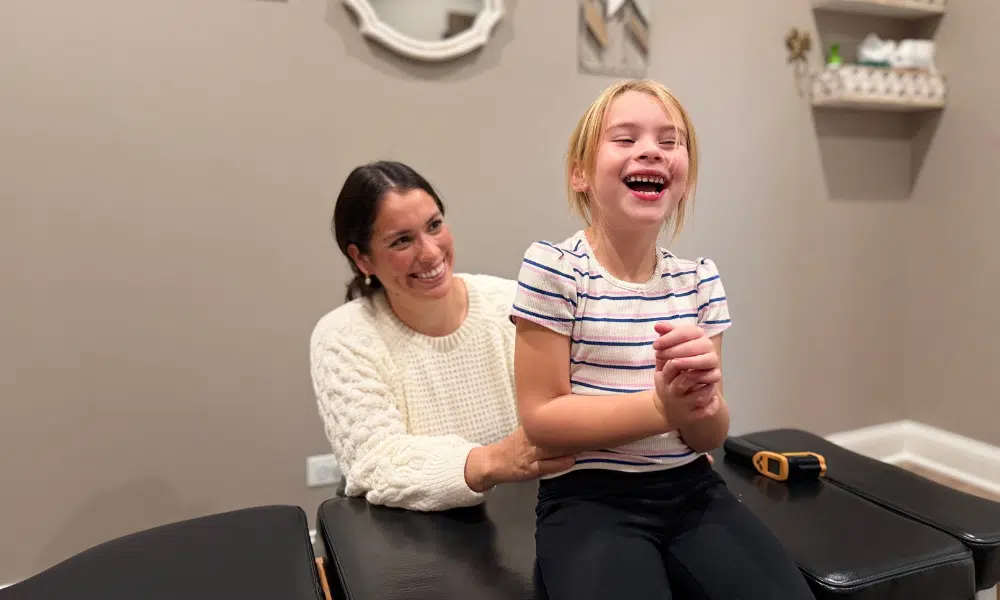
The most common reason parents never book the appointment is a version of this: my child hates being touched, hates strangers, and will never lie still on a table. Fair concern, and it rests on a picture of chiropractic that has nothing to do with pediatric care. A sensory child’s adjustment is low-force, brief, and built around their nervous system rather than against it.
Start with what it isn’t. It isn’t the cracking and popping video you’ve seen online, and it isn’t what a fifty-year-old with spinal degeneration receives. Many of these adjustments are what’s called low tone or light force, using sustained contact to deliver calming proprioceptive input. From across the room, it can look like almost nothing is happening.
The practical adaptations matter more than most parents expect:
- Adjustments happen on the move. Standing adjustments, scoop adjustments, and bear hug adjustments mean the table is optional. Plenty of care happens in the toy room or the waiting room.
- Parents become the adjusting table. A child sits in your lap or lies on top of you while the adjustment happens. The safest place for a dysregulated child is your arms, so that’s where the work gets done.
- Nobody is in a hurry. Slower movement, quieter voices, no rush to get a child scanned or adjusted before they’re ready.
- Fewer inputs, not more. You can’t overstimulate an already overstimulated system. Sensory kids typically get one to three specific adjustments rather than a long list, delivered at higher frequency over time.
- Predictability gets engineered in. Countdowns, the same room, the same order, a fidget or a familiar object. Routine is regulating.
Here’s the part that surprises families. Sensory kids already tell you what their nervous system wants. They seek deep pressure, big hugs, hard squeezes, crashing into the couch. That’s proprioceptive input, and it’s calming. A neurologically-focused adjustment delivers the same category of input with precision. Which is why, clinically, the pattern we see most often isn’t resistance. It’s kids who get upset when the adjustment is over.
Does Chiropractic Replace Occupational Therapy for Sensory Issues?
No. Occupational therapy, physical therapy, speech therapy, and sensory integration work are genuinely valuable. The argument isn’t that those approaches don’t work. It’s that they work considerably better on a nervous system that isn’t stuck in sympathetic dominance.
Think of it as sequencing rather than competition. Building anything on an unstable foundation means constantly re-doing the work. When a child’s neurospinal system is generating interference, therapies aimed at coordination, speech, and regulation are pushing against a system that keeps reverting. Address the foundation, and the same therapies tend to stick.
This is also the honest answer to why so many families plateau. They didn’t choose the wrong therapy. They started on the second step. Clinically, once a child’s autonomic function shifts toward balance, parents and therapists usually report the same thing: better tolerance in sessions, faster carryover at home, more progress from the same hour of OT.
So the useful framing isn’t chiropractic versus therapy. It’s foundation first, then everything else, and the sensory diets and lifestyle strategies you’ve already built stay in the plan. Though sometimes, they are no longer needed.
Measuring a Stuck Nervous System With INSiGHT Scans
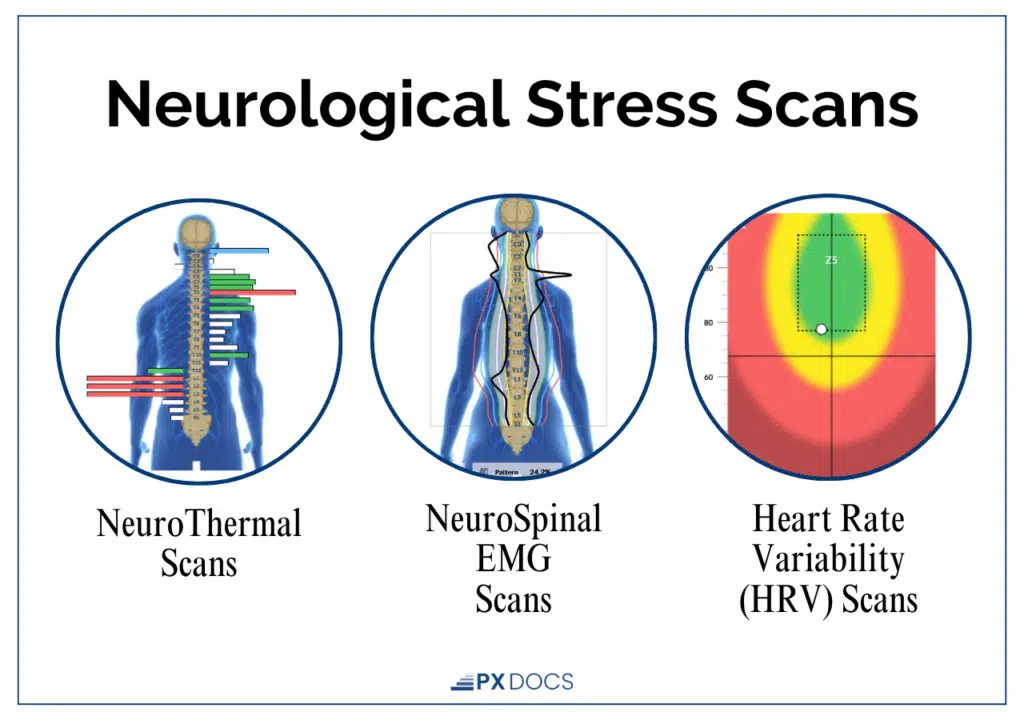
You can’t work on what you haven’t measured, which is where scanning technology comes in. INSiGHT scanning, developed by the Chiropractic Leadership Alliance, is a three-part neurological assessment used in Neurologically-Focused Chiropractic Care.
- Heart rate variability (HRV) measures autonomic balance and vagal tone.
- Surface electromyography (sEMG) measures tension patterns along the neurospinal system.
- Thermal scanning measures Autonomic Nervous System function.
It’s important to note that this technology does not diagnose medical conditions, and Neurologically-Focused Chiropractic Care is certainly not a treatment or cure for Sensory Processing Disorder or any other condition, not even back pain. Instead, these INSiGHT Scans help us track down the root cause of nervous system dysfunction and dysregulation, and build customized care plans and adjusting protocols to help shift the nervous system back into a state of balance, regulation, and resilience.
For sensory families specifically, scans are usually less of an obstacle than parents fear. They take roughly 10 to 20 minutes; they’re mobile, and nothing goes into your child the way it does with an X-ray or MRI. The technology reads information coming out. No radiation, no needles, no sedation, no holding a child down.
What it produces is a picture rather than a guess. A child whose sEMG shows high tension through the upper neck alongside a collapsed pattern in the core is telling a specific story: too much tension close to the brain, not enough regulation available underneath it. That calls for a very different care plan than a child whose thermal readings cluster around the digestive and immune regions.
How Long Does It Take to See Changes?
There’s no honest universal answer, and results vary from child to child. The timeline depends on a handful of factors, and the biggest is case history. How early the stressors arrived, how many stacked up, and how long the system has been running this way all shape what’s realistic.
The other factors matter too. Age and growth spurts change the picture, since a child hitting a growth spurt or a hormonal shift may look like backsliding when they’re really renegotiating. Training and experience of the chiropractor matter. So does frequency, because neurological change works through repetition. Nerves that fire together wire together, and that principle built the dysregulated pattern in the first place. Reversing it takes the same mechanism running the other direction, which is why a once-a-month schedule rarely moves a significantly dysregulated child.
One factor gets overlooked constantly: your nervous system. Parents living alongside years of meltdowns and sleepless nights develop their own dysregulation. Getting the whole family checked, siblings included, often reveals matching patterns.
Take Arianna for example. Her sensory processing challenges had started to take over her family’s life. Everyday noises like vacuums, blow dryers, and blenders set off anxiety, tantrums, and overwhelm. Restaurants, stores, and social outings often ended early or got canceled. Her nervous system was so stressed internally that her brain and body struggled to process outside input like sound, touch, social settings, and sometimes food. It was like a broken volume gauge turning every sense up too high.
After Arianna began regular nervous system–focused chiropractic care, her nervous system calmed and regulated much better. Her mom knew it was working when Arianna could finally be around louder noises without melting down. She has kept getting adjusted over the years to help her adapt to new stressors. Family and friends have noticed a big difference, and she’s growing into the bright, creative, full-of-life girl she was meant to be, with sensory processing disorder no longer holding her back.
Where This Leaves You
Your child isn’t broken, and they aren’t difficult. They’re running a nervous system that got overwhelmed early and never got the chance to organize the way it was designed to. Sensory challenges are the visible part of that. Sympathetic dominance, poor vagal tone, and neurological interference are the part nobody has been measuring.
Which brings us to the only reasonable way to start. We don’t guess. We test. A baseline set of INSiGHT scans shows where your child’s nervous system sits right now, whether that’s tension locked into the upper neck, HRV parked well below where it should be for their age, or a thermal pattern pointing toward the gut and immune systems.
Then we keep testing. Repeat scans at intervals are how we confirm the system is genuinely reorganizing rather than just having a good week. When HRV starts climbing toward the green zone and sEMG patterns get more symmetrical, we know the foundation is holding, and we keep building. When the numbers don’t move, that shows up early, and the plan changes. That’s the difference between hoping your child is improving and knowing it.
Talk with your pediatrician and your child’s therapy team as you go, and keep the supports that are working. Then find a Neurologically-Focused chiropractor near you through the PX Docs Directory, get the scans done, and get a plan built around your child’s actual neurology.
You’ve spent long enough managing the storm. It’s worth finding out what’s driving it.