
A baby not crawling is a baby who has reached the typical 7-to-10-month window without moving forward on hands and knees, or who skips crawling and goes straight to walking. While often within the normal range, crawling is one of the most neurologically demanding milestones a baby completes, so a delayed, skipped, or lopsided crawl can also be an early window into how well the brain and nervous system are wired together.
If your baby isn’t crawling yet, you’ve probably gotten one of two answers. Your pediatrician says, “Don’t worry, some babies skip it,” and the internet says the same. Then a friend’s baby the same age has been crawling for two months, and the worry doesn’t go away.
Here’s what almost no one explains: crawling isn’t just a physical step on the way to walking. It’s a whole-body neurological event that wires the left and right sides of the brain to work together. So the real question isn’t only “is my baby behind?” It’s “What is my baby’s nervous system telling me?” That’s the question we’ll answer here, with the neuroscience that the standard milestone chart leaves out.
When Do Most Babies Start Crawling?
Most babies start crawling between 7 and 10 months, according to the Cleveland Clinic, though the typical range for development is about 6 to 12 months. Some babies army crawl at 6 months and are up on hands and knees by 7. Others don’t crawl until 11 months, and a meaningful number skip traditional hands-and-knees crawling and move straight to cruising and walking.
That wide range is why crawling timing alone rarely tells the whole story. A baby who is a few weeks “late” but moving through development in the right order is in a very different situation than one who skips a stage entirely. (Notably, in 2022, the CDC removed crawling from its milestone checklists, taking away one of the easiest-to-spot windows into how a baby’s brain and body coordinate.)
Why Does Crawling Matter So Much for the Brain?
Crawling matters because it’s one of the first movements that forces the left and right hemispheres of the brain to talk to each other in a coordinated, repeating pattern. The cross-crawl pattern, opposite arm and opposite leg moving together, builds the neural connections that later support balance, coordination, focus, memory, and even speech.
When a baby gets up on hands and knees and starts moving, the brain receives a flood of proprioceptive and vestibular input, the body-position and movement signals that help map where the body is in space.
Research on crawling infants shows that this stage generates tightly correlated visual, proprioceptive, and vestibular information that the brain has to learn to coordinate. That input travels from the back of the brain, where movement is coordinated, forward to the prefrontal cortex, where the brain’s advanced functions live. In other words, crawling feeds the very part of the brain responsible for attention, planning, and self-control.
This is why crawling is foundational. The brain builds from the bottom up, not the top down. Lower brain networks organize tone, reflexes, and coordination first, and that input feeds the higher centers, which is why the order of developmental milestones matters as much as their timing. So when a baby can’t organize crawling, it’s not just a motor issue; it can ripple upward into the brain functions that show up years later as focus and regulation.
Children who skip or struggle with crawling more often go on to experience challenges with attention, sensory processing, anxiety, and emotional regulation. This co-occurrence isn’t a coincidence. In one longitudinal study of crawling variation, infants with fewer, less varied crawling patterns were more likely to show later delays, especially in fine motor and language skills. Crawling, Autism, ADHD, and Sensory Processing Disorder all run through the same hub: the brainstem and the Autonomic Nervous System, which coordinate tone, sensory input, and movement.
What Causes a Baby Not to Crawl?
The most common driver of delayed, skipped, or asymmetrical crawling is a nervous system that can’t fully organize movement, usually due to subluxation and dysregulation in the spine and brainstem. Subluxation is a neurological dysfunction of the neurospinal system with three components:
- Physical misalignment
- Fixation (loss of normal motion)
- Neurological interference that disrupts signaling between the brain and body.
When subluxation sets in, the brain’s coordination of muscle tone and movement gets thrown off.
Crawling is a genuinely advanced neuromotor task. It requires good head and neck control, a successful run through tummy time and rolling, and symmetrical firing from the spine down into the legs and up into the arms. The brainstem and cerebellum act like air traffic control for whole-body muscle tone. When the upper neck (especially the C2 region) is subluxated, the control tower can’t direct traffic evenly, resulting in whole-body gross motor incoordination.
There’s a second piece. The spine’s transitional zones, where its sections meet, each drive part of the crawl: the cervicothoracic junction (the arms), the thoracolumbar junction, and the lumbosacral pelvic region (the legs and core). When those zones are subluxated, some muscles get tight and wound up (hypertonicity) while others stay weak and disengaged (hypotonicity), and a baby can’t organize a smooth cross-crawl on top of that imbalance.
So when one leg drives and the other sticks out to the side in an uneven, lopsided crawl, that asymmetry is a signal. It points to subluxation, disrupted rhythm, and broken neurosensory-motor coordination, all of which can be found and addressed. Sometimes a late crawl is your child’s unique timeline. Sometimes it’s the nervous system waving a flag.
How Does the “Perfect Storm” Lead to Crawling Delays?
The “Perfect Storm” is the cumulative buildup of stressors that overwhelms a baby’s developing nervous system: prenatal stress, then birth trauma, then early childhood stressors, layering into nervous system dysregulation. Coined by Dr. Tony Ebel, the framework explains why a baby’s nervous system might not organize crawling in the first place, rather than treating the late crawl as the whole problem.
It often starts before birth. When a mother experiences chronic stress, elevated cortisol can cross the placenta and alter fetal brain structure and function, priming the nervous system toward a more reactive state. Then comes birth. Interventions like C-section, forceps, vacuum extraction, and prolonged or induced labor can place real mechanical strain on a newborn’s delicate upper neck and brainstem, exactly the region that runs whole-body motor coordination. Even an unremarkable vaginal delivery involves significant twisting and pulling forces on the head and neck.
After birth, the layering continues: colic, reflux, frequent ear infections, exposure to toxins and antibiotics, and the ordinary falls of early life. When enough stacks up, the nervous system shifts into sympathetic dominance, a “stuck gas pedal” state, and struggles to downshift into the calm, organized mode motor development needs.
Think of the nervous system as having a gas pedal and a brake pedal. The sympathetic system is the gas (fight or flight); the parasympathetic system is the brake (rest, digest, regulate). A baby caught in sympathetic dominance is running with the gas pedal stuck down, staying braced and tense instead of relaxed and coordinated. And a tense, braced body has a much harder time organizing the smooth, symmetrical cross-body pattern that crawling demands.
What Are the Signs a Crawling Delay Needs Attention?
The signs that a crawling delay deserves a neurological look are less about the calendar and more about the quality and symmetry of movement. A baby on a slower path usually still shows drive, strength, and both sides working together.
Signs worth attention in a baby not crawling well include:
- Asymmetrical or “stinky leg” crawling, where one side drives and the other drags, sticks out, or doesn’t engage
- Strong dislike or avoidance of tummy time, or still struggling to push up and lift the head and chest past 6 months
- Clear one-sidedness in reaching, rolling, or movement, or an early hand preference before 12 months
- Low muscle tone or floppiness, or the opposite, stiffness and constant arching
- A “Perfect Storm” history, such as a traumatic or intervention-heavy birth, colic, reflux, or chronic ear infections, or little drive to move and explore, even when motivated
If your child is exhibiting these signs, it is worth getting evaluated through a neurological lens rather than a “wait and see” one. Skipped or lopsided crawling often accompanies low tone, torticollis, tongue-tie, and retained primitive reflexes, which are themselves compensations the brain makes when the foundation isn’t organized.
What Happens When a Baby Skips Crawling?
When a baby skips crawling, the brain doesn’t simply do without it. The brain is so hardwired to get upright and walk that it builds compensatory movement patterns to reach the next milestone instead of completing the one it missed. The baby walks, but the deeper neurological wiring crawling was meant to build never fully forms.
Those compensations come at a cost. The cross-crawl wiring that links the hemispheres and the rich proprioceptive and vestibular input that the crawling feeds to the higher brain both get shortchanged. This is why retained primitive reflexes show up so often in kids who skipped crawling. Those reflexes aren’t the root problem. They’re another compensation, a sign that the subluxation and dysregulation underneath were never resolved.
Trying to drill reflexes or motor skills directly, without addressing the nervous system foundation first, is like working on the second floor while the foundation is still cracked. The encouraging part is that this is reversible far more often than parents are told, because the brain is built to return to its developmental sequence once the interference is removed.
How Can Chiropractic Care Help a Baby Who Isn’t Crawling?
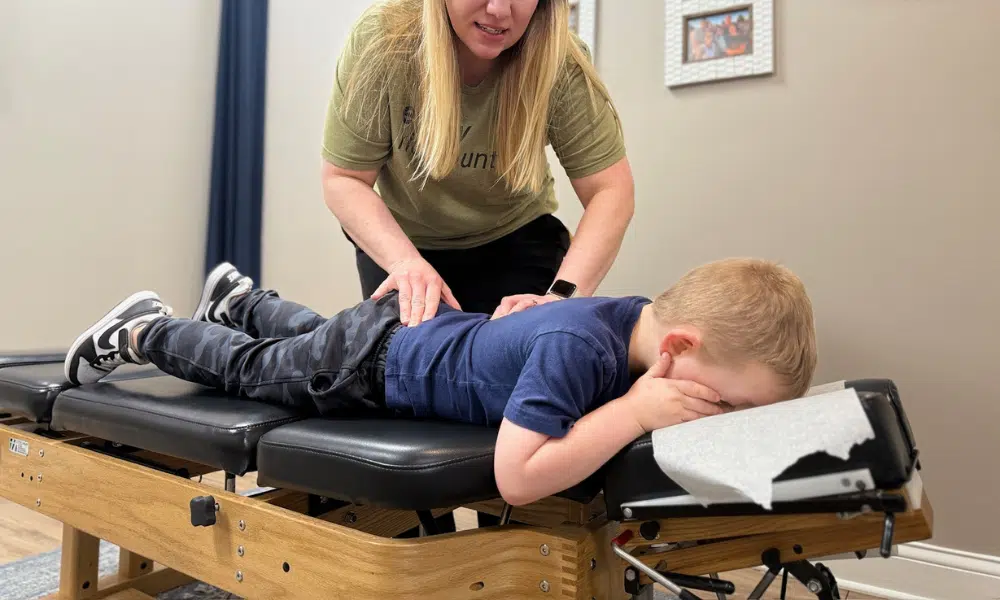
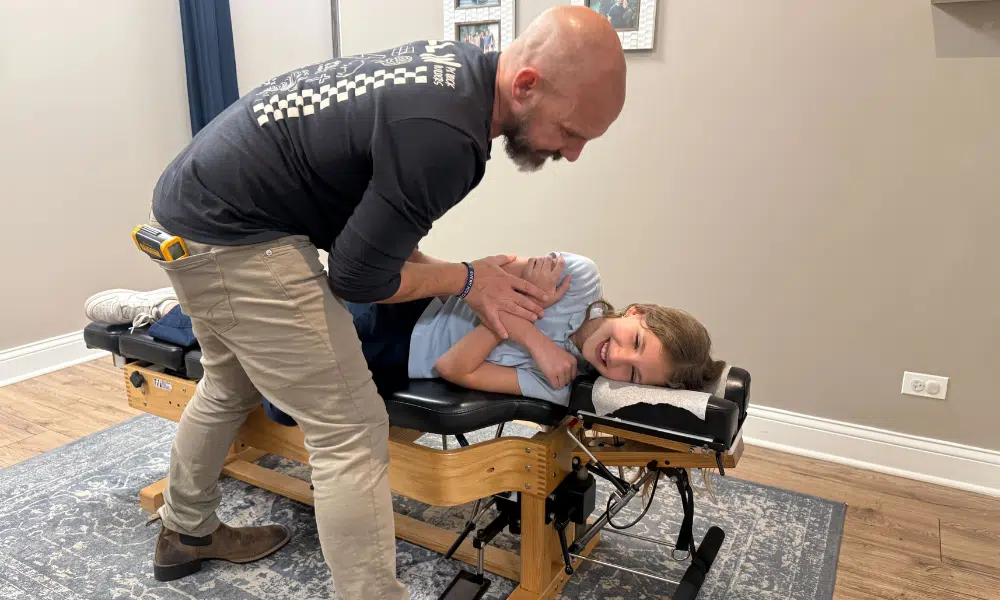
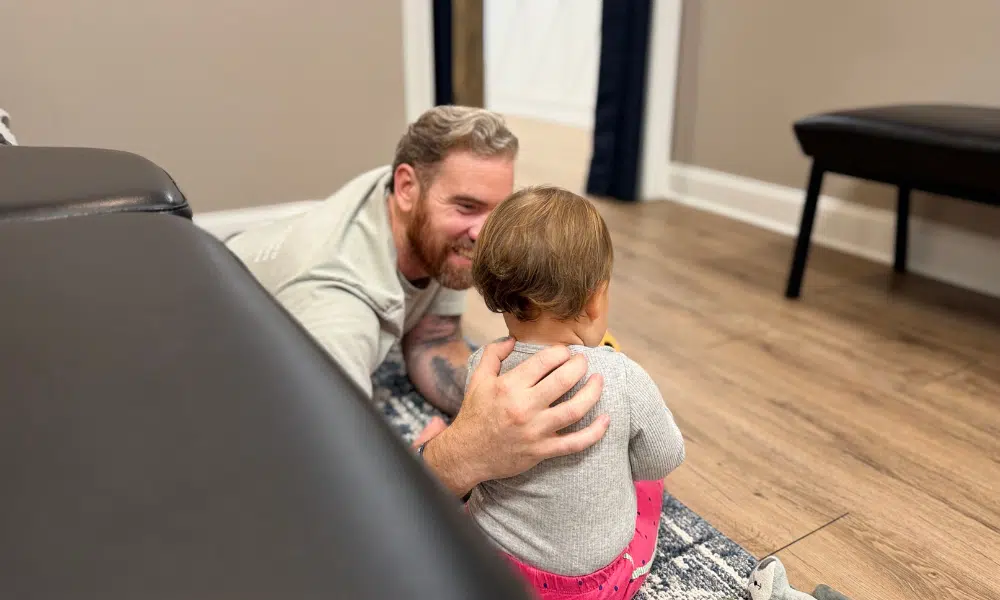
Neurologically-Focused Chiropractic Care helps a baby who isn’t crawling by identifying and reducing subluxation and dysregulation that interfere with motor coordination, allowing the nervous system to organize movement on its own. It’s a specialized form of pediatric chiropractic that targets subluxation patterns affecting the Autonomic Nervous System, using gentle, child-specific adjustments and neurological assessment.
The goal is never to “make” a baby crawl. It’s to remove the interference so the brain and body can coordinate the movement naturally. When the upper neck, brainstem, and transitional zones fire symmetrically, and the nervous system shifts out of sympathetic dominance and back toward balance, the foundation for crawling is restored, and the body often does what it’s designed to do.
One of the most encouraging clinical findings is what’s sometimes called reorganizational healing. As care reduces subluxation and the nervous system calms and reconnects, children frequently return to cross-crawl patterns on their own, sometimes years later, because the brain knows it missed a step and goes back to fill it in. As the foundation steadies, the downstream functions tend to follow: concentration, emotional and behavioral regulation, sleep, and even speech often improve, because crawling is a gross motor function that sits beneath those finer abilities.
The same brainstem and vagus-nerve regulation that governs motor tone also governs digestion and sleep through the gut-brain axis, which is why parents often notice easier sleep and digestion first. Sequencing, after all, is how the nervous system heals.
How Do INSiGHT Scans Show What’s Driving a Crawling Delay?
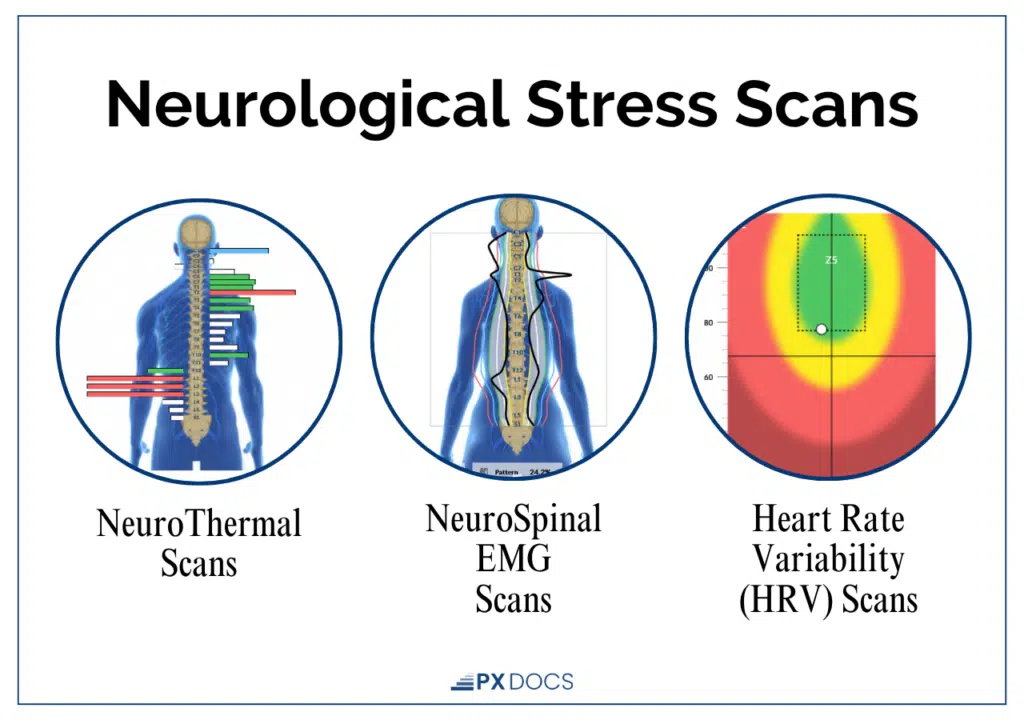
INSiGHT scans are a three-part neurological assessment used in Neurologically-Focused Chiropractic Care to measure how a child’s nervous system is actually functioning: heart rate variability (HRV) for autonomic balance, surface electromyography (sEMG) for muscle tension patterns, and thermal scanning for autonomic nervous system function. For a baby who isn’t crawling, these scans turn an invisible question into visible data. INSiGHT scans are not a treatment or a cure for any condition, not even back pain. They are a measurement tool.
For a crawling delay, each scan tells part of the story. The sEMG can reveal the uneven muscle tone pattern, the hypertonic-here, hypotonic-there imbalance, behind a lopsided crawl. The thermal scan reflects autonomic regulation, showing whether the system is stuck in sympathetic dominance. And HRV, a direct readout of vagal tone, shows whether the brake pedal can engage. Together, they reveal whether autonomic nervous system dysfunction is driving the motor picture, the kind of pediatric dysautonomia no milestone chart can show.
This is what separates a neurological assessment from a guess. Instead of “let’s wait and see,” you get an objective baseline of where the nervous system is and a way to measure whether it’s changing.
The Bottom Line on Your Baby Not Crawling
A baby not crawling isn’t automatically a problem, and it isn’t automatically nothing. Crawling is one of the most neurologically demanding things your baby will do, which is exactly why a delayed, skipped, or lopsided crawl can be such a useful window into how the nervous system is wired and working. The order and quality of the movement tell you more than the date ever could.
So when you’re wondering where your baby’s nervous system actually stands, the answer isn’t to guess. We don’t guess. We test. A baseline set of INSiGHT scans shows where your baby’s nervous system is right now, including whether uneven muscle tone or sympathetic dominance is behind a lopsided or stalled crawl. From there, repeat scans confirm whether the system is genuinely reorganizing, with HRV climbing back toward the green zone and muscle-tone patterns smoothing out and syncing up. If the data shows your baby is back on track, we keep building. If it shows something still needs to shift, we adjust the plan. That’s what keeps your child’s care anchored to what’s really happening inside their nervous system, not just how things look from the outside.
Your baby isn’t broken, and you’re not behind. A nervous system that’s been overwhelmed can be found, supported, and helped back into its natural sequence, and the earlier you start, the more room there is to work. If your baby isn’t crawling and you want to get to the root of it, you can find a trained provider through the PX Docs Directory.
Frequently Asked Questions
At what age should I worry if my baby isn’t crawling?
Most babies crawl between 7 and 10 months, within a typical range of about 6 to 12 months. Rather than fixing on one age, watch for drive and symmetry. By around 9 to 10 months, a baby should show purposeful attempts to move, push up, and reach. Persistent one-sidedness, loss of skills, or a lack of interest in moving is worth raising with a provider sooner rather than later.
Is skipping crawling a sign of autism or ADHD?
Skipping crawling is not a diagnosis of Autism or ADHD, but it can be an early, shared sign. Crawling, Autism, ADHD, and Sensory Processing Disorder all run through the same brainstem and autonomic nervous system that coordinate tone, sensory input, and movement. When that system is dysregulated, it can show up early as a skipped or lopsided crawl and later as attention, sensory, or regulation challenges. It’s a window worth checking, not a verdict.
Can a baby learn to crawl after skipping it?
Yes. The brain is built to return to its developmental sequence once the interference holding it back is removed. Clinically, children often resume cross-crawl patterns on their own, sometimes years later, once the underlying subluxation and nervous system dysregulation are addressed. The brain recognizes it missed a step and fills it in, which is part of why early support matters.
Is chiropractic care safe for babies?
Adjustments for babies are gentle and specific, using about the same light pressure you’d use to check the ripeness of a tomato, nothing like the forceful adjustments adults picture. Neurologically-Focused Chiropractic Care for infants focuses on reducing nervous system interference, not cracking or twisting. As with any care decision, talk with your provider and look for a chiropractor trained in pediatrics who uses neurological assessment.
What’s the difference between delayed crawling and a real problem?
Delayed crawling in a baby who’s otherwise thriving, moving symmetrically, building strength, and showing drive is usually just a slower timeline. A more significant issue tends to show up as a cluster of signs: asymmetry, low or high muscle tone, tummy-time avoidance, early hand preference, or a history of birth trauma and early stress. The difference isn’t the date on the calendar. It’s whether the nervous system has the wiring and tone to organize the movement.
This information is educational and not a substitute for medical advice. Always consult your healthcare provider about your child’s development and any concerns.