
Chronic constipation in children is far more common than most parents realize. It affects up to 30% of kids worldwide, it often starts in the toddler and preschool years, and about one in four children with it still struggle as adults.
In other words, this isn’t something every child simply outgrows.
Maybe you’ve already tried the prune juice, the fiber, the probiotics, and the magnesium gummies. Maybe you’ve even reached for Miralax (which comes with side effects like behavior changes and meltdowns that many parents never get warned about). And your child still can’t go. If that’s you, you’re not doing anything wrong, and you’re not alone.
At PX Docs, we want to share the number one missing link we find in kids with constipation who haven’t responded to diet changes or medication: the nervous system. Once you understand how the nervous system runs digestion, the whole picture changes, and so do your options for natural, drug-free support.
What Is Chronic Constipation in Children?
Chronic constipation means bowel movements that are infrequent, hard, painful, or difficult to pass, and that keep happening for weeks rather than days. The vast majority of cases are what doctors call functional constipation, meaning no structural disease or blockage explains it.
Doctors diagnose functional constipation using the Rome IV criteria. A child meets them when two or more of these show up at least once a week for at least a month:
- Two or fewer bowel movements in the toilet per week (in kids 4 and older)
- At least one episode of stool leakage or soiling per week
- Withholding postures or deliberately holding stool in
- Hard or painful bowel movements
- A large mass of stool in the rectum
- Stools so large they clog the toilet
At home, it usually looks like this. Your child goes days between bowel movements, passes hard or pebble-like stools, complains of belly pain or bloating, or has skid marks in their underwear that look like diarrhea (stool leaking around a hard mass, known as encopresis). The NIDDK notes that many kids also show withholding behaviors, like standing on tiptoes, clenching their buttocks, or doing a little dance to avoid going, and some have daytime or nighttime wetting.
If constipation drags on, it can lead to complications that affect your child’s comfort and quality of life:
- Anal fissures: Small tears around the anus from passing large, hard stools, which can cause pain and bleeding.
- Hemorrhoids: Swollen veins in the rectum or anus from straining.
- Fecal impaction: A buildup of hardened stool that can cause belly pain, nausea, and vomiting.
- Rectal prolapse: Part of the rectum pushing out through the anus, more common with long-lasting constipation.
- Bladder problems: Chronic constipation is linked to bladder control problems, wetting, and urinary tract infections.
When Should You Call Your Child’s Doctor About Constipation?
Most childhood constipation isn’t dangerous, but some situations need medical attention first. See your child’s doctor if constipation lasts more than two weeks or doesn’t improve with at-home changes.
Get help right away if constipation comes with any of these:
- Bleeding from the rectum or blood in the stool
- A swollen, bloated belly
- Constant belly pain
- Vomiting
- Weight loss or poor growth
- Fever
Constipation that starts in the first month of life, or a newborn who didn’t pass their first stool within 48 hours of birth, can point to an underlying condition like Hirschsprung disease and should always be checked. Neurologically Focused Chiropractic Care works alongside your child’s medical team, never in place of ruling these out.
What Causes Chronic Constipation in Kids?
Most of what you’ll read online points to one cycle. A child has a painful bowel movement, so they start holding it in. The longer stool sits in the colon, the more water the colon pulls out of it, so the next one is even harder and more painful. Over time, the rectum stretches and the urge to go fades. Common triggers include starting solid foods, potty training, and starting school.
That cycle is real. But it doesn’t explain why some kids get stuck in it for years while others don’t.
Here’s something that surprises a lot of parents. The same clinical review that reports up to 30% prevalence also found that pushing fiber and fluids above normal daily recommendations doesn’t improve constipation in children, and that probiotics provide no added benefit. So if you’ve done all of that and your child still can’t go, it’s not because you didn’t do it right. Something else is going on.
I call that something else “neurogenic constipation.” One of the clearest clues is who struggles with it most. Research shows that about 37% of children with autism experience constipation, and a large study of nearly 743,000 children found that kids with ADHD are significantly more likely to have constipation and fecal incontinence than kids without it.
Clinically, the pattern is even stronger. In my practice, the vast majority of kids with ADHD, autism, and anxiety also struggle with constipation and significant gut issues. These are all challenges rooted in nervous system dysregulation. That’s a big sign that constipation isn’t only a nutrition problem. As I like to tell parents, “Your child’s poop problems are very likely nervous system stress problems.”
The Perfect Storm™ Behind Chronic Constipation
The Perfect Storm™, the framework I developed, describes how physical, chemical, and emotional stressors pile up early in life and overwhelm a child’s developing nervous system. When that happens, digestion is one of the first functions to suffer.
- Prenatal stress. The storm can start before birth. One study found that babies whose mothers had higher stress or higher cortisol levels during pregnancy developed a different gut bacteria pattern in their first months of life, and that pattern was linked to more gastrointestinal symptoms. The study shows an association, not cause and effect, but it fits what we see in case histories every day.
- Birth interventions and birth trauma. Forceps, vacuum extraction, induction, and C-sections can put significant strain on a baby’s delicate upper neck and brainstem, right where the vagus nerve exits the skull. I teach that even an uncomplicated vaginal birth puts real pressure and twisting forces on a baby’s head and neck. I often find early red flags in the case histories of constipated kids: torticollis, a flat spot on the head, or trouble nursing on one side.
- Early childhood stressors. Rounds of antibiotics can disrupt a still-developing gut microbiome. A diet heavy in processed, low-fiber foods adds strain. So do emotional stressors like a new sibling, family changes, or school pressure, which doctors already recognize as common triggers for constipation.
Each layer pushes the nervous system further into “fight or flight.” That state of sympathetic dominance makes it hard for a child to rest, digest, and eliminate, and the cycle of stress and constipation feeds itself.

How Does the Nervous System Control Pooping?
Here’s something nobody tells parents. The gut is a muscle. Your child’s entire digestive tract, from the esophagus to the rectum, is smooth muscle that runs on autopilot. You can tell your arm to move. You can’t tell your intestines to squeeze.
So what’s running that autopilot?
The nervous system. The gut does have its own local network, the enteric nervous system, often nicknamed the “second brain.” But as I like to say, if it’s the second brain, there’s still a first brain. Research shows that the brain and Autonomic Nervous System control the gut’s major functions through that enteric network, and that problems anywhere along the neural pathway, from the brain to the nerves feeding the gut, show up mainly as problems with movement and motility.
The autonomic nervous system works like a car’s gas pedal and brake pedal:
- The Sympathetic Nervous System (gas pedal): Your “fight or flight” response. When it’s in charge, the body pulls energy away from digestion and sends it to the muscles you’d need to fight or run. Digestion slows down, and stool sits.
- The Parasympathetic Nervous System (brake pedal): Your “rest and digest” response. It drives the wave-like contractions (peristalsis) that move food and waste through. The vagus nerve carries most of this signal to the upper and middle gut, and nerves at the base of the spine handle the lower end.
My shorthand for this is simple: “The Ps go together. Parasympathetics, poop.” A child stuck with their foot on the gas can’t fully access the brake, so the gut can’t keep things moving.
The Three-Zone Conveyor Belt
I teach digestion as a three-part conveyor belt, where each zone has to hand off smoothly to the next, like runners passing a baton in a relay race:
- Upper zone (get it in): The brainstem, jaw, and esophagus handle chewing and swallowing. This is why so many constipated kids are also picky eaters with sensory challenges.
- Middle zone (break it down): The mid-back region supports the stomach and the middle of the digestive tract.
- Lower zone (sort it and move it out): The low back and sacral region support the lower bowel and elimination. This is the area I lovingly call “the poop button.”
When one handoff breaks down, the whole race falls apart. I call constipation “a neurogenic digestive DNF,” as in did not finish. And in the toughest cases, I typically find interference in all three zones.
What causes that interference? Subluxation. Subluxation has three components: misalignment, fixation (areas of the neurospinal system that are stuck and not moving properly), and neurological interference that disrupts communication between the brain and body. When subluxation sets up shop along the neurospinal system, it can drive dysautonomia and broader nervous system dysregulation, where the gas pedal and brake pedal are out of balance.
That’s why no supplement, detox kit, or binder can attach to the vagus nerve and turn it back on. The issue lives in the nervous system, so that’s where the answer has to start.
Where Conventional Constipation Care Falls Short
Conventional care for chronic constipation focuses on managing symptoms: clearing out impacted stool, then keeping stool soft with daily medication. Polyethylene glycol (Miralax) is the standard first-line option, followed by lactulose, enemas, and stimulant laxatives.
These can provide short-term relief, and there are times a doctor will rightly recommend them. But they don’t ask why the gut stopped moving in the first place. Many children stay on maintenance medication for months or even years, relapses are common, and many parents have reported behavioral and mood changes in their kids on long-term Miralax use. Some laxatives also carry their own risks, including electrolyte problems with certain types, which is why you should never start one without your child’s doctor.
None of this means nutrition doesn’t matter. It matters a lot. Your child needs real food, enough water, and good nutrients for the nervous system and gut to do their jobs. Two things can be true at once. Nutrition and supplements just can’t do the job alone when the problem starts in the nervous system.
How Neurologically Focused Chiropractic Care Approaches Chronic Constipation
PX Docs doctors take a different path. Instead of chasing symptoms, Neurologically Focused Chiropractic Care looks for the nervous system dysfunction underneath them, and that starts with measuring it.
PX Docs doctors use INSiGHT Scans, a neurological assessment technology. These painless scans measure heart rate variability (HRV) to show autonomic balance and resilience, surface EMG to show neuromuscular tension along the neurospinal system, and thermal patterns to show how well the Autonomic Nervous System is regulating. Together, they help locate where subluxation has set up shop along the upper, middle, and lower zones of that digestive conveyor belt.
It’s important to note that this technology does not diagnose medical conditions, and Neurologically Focused Chiropractic Care is certainly not a treatment or cure for constipation or any other condition, not even back pain. Instead, these INSiGHT Scans help us track down the root cause of nervous system dysfunction and dysregulation, and build customized care plans and adjusting protocols to help shift the nervous system back into a state of balance, regulation, and resilience.
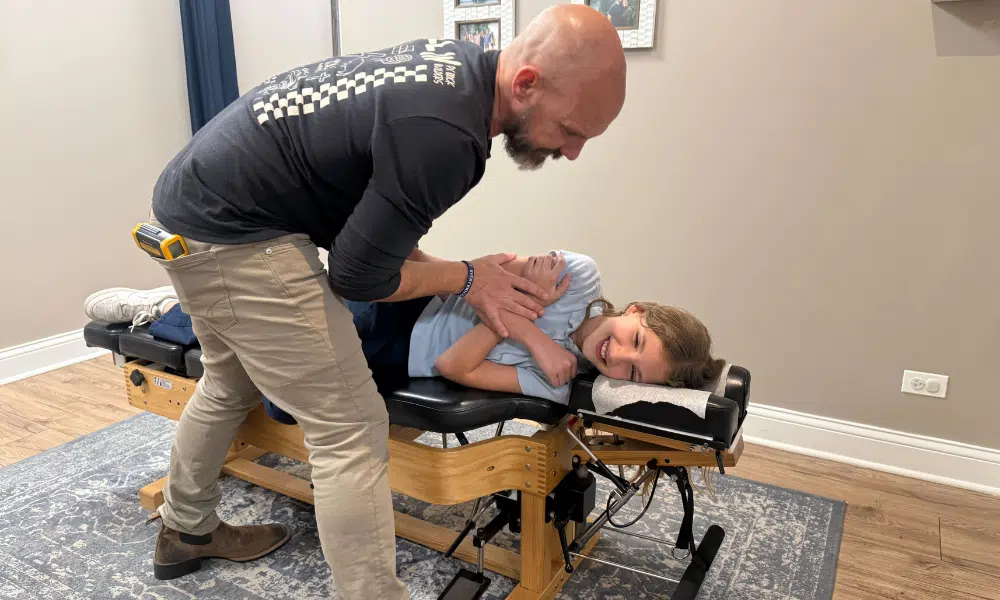
From there, gentle, specific adjustments focus on releasing tension from the sympathetic “gas pedal” side of the nervous system and supporting the parasympathetic, vagus-driven “brake pedal” side. For kids with constipation, that often means careful attention to the upper neck and brainstem as well as the sacral region. The approach is drug-free, non-invasive, and tailored to each child.
And here’s what keeps care honest: we don’t guess, we test. The first INSiGHT Scan is a baseline that shows where your child’s nervous system is today. Progress scans along the way show whether it’s actually responding, like HRV climbing toward a healthier range and neuromuscular tension becoming more organized. If the data shows we’re on track, we keep building. If it shows something isn’t responding, the plan changes. Every child is different, and results vary, which is exactly why the scans matter.
Juniper’s Story of Hope
Juniper was just 5 months old when her mom brought her to a PX Doc. She’d started getting constipated and wasn’t pooping regularly, and her mom trusted her gut that something deeper was going on.
Juniper’s neurological scans showed her nervous system was stuck in “fight or flight” instead of “rest and digest.” Her PX Doc began a series of gentle, specific adjustments to calm that stress response and support her nervous system.
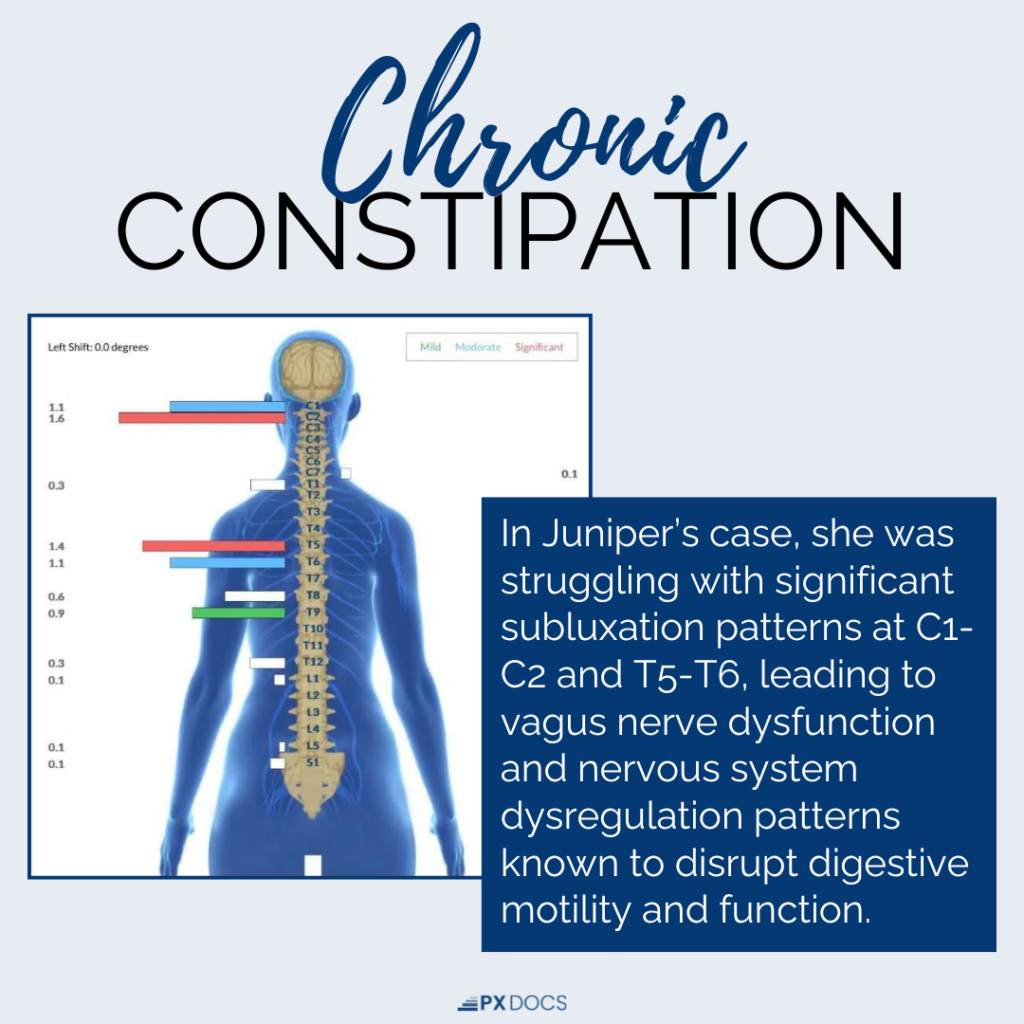
As care progressed, Juniper’s mom reported she was pooping regularly and was in a better mood overall. She was grunting and crying less, she was more content during independent play, and she was sleeping 5 to 6 hours at a stretch at night instead of just 2 or 3.
Juniper’s story is one family’s experience, and every child is different. For another family’s experience, read Shelby’s story.
Natural, Long-Term Support for Your Child’s Bowel Habits
While you look into the nervous system side of things, a few simple habits can support your child at home. Have your potty-trained child sit on the toilet after meals, use a reward chart for regular toilet time, and take a break from potty training if constipation flares. Our free Constipation Relief for Kids guide walks you through more drug-free ideas.
But if you’ve tried everything and your child is still struggling, remember this: your child’s constipation isn’t a willpower problem, a potty training failure, or a sign you picked the wrong probiotic. The nervous system conversation is the one that’s been missing the whole time.
If you suspect nervous system stress is behind your child’s chronic constipation, visit the PX Docs Directory to find a Neurologically Focused Chiropractor near you. Your child isn’t broken. Their nervous system has been overwhelmed, and now you have a map to help them find their way back to balance.