
Lip smacking in autism is a form of self-stimulatory behavior, or “stimming,” a repetitive opening, closing, or pursing of the mouth that helps a child calm and regulate an overwhelmed nervous system. While occasional lip smacking in babies is a normal feeding reflex, persistent or intense lip smacking alongside other signs can point to sensory and nervous system dysregulation, not a habit a child chooses or can simply stop.
If you’ve watched your child smack their lips over and over and felt that knot of worry in your stomach, you’re not overreacting, and you’re not alone. Parents notice these things. You know your kid better than anyone, and when a behavior keeps showing up, it’s worth understanding what’s driving it.
Here’s what most articles won’t tell you. Lip smacking isn’t random, and it isn’t “just a phase” you have to wait out and hope it disappears. It’s your child’s nervous system doing exactly what it’s wired to do when it’s stressed: find a way to feel safe. In this article, we’ll explain what lip smacking actually is, why it shows up so often in kids on the spectrum, how it connects to the deeper story of sensory and motor function, and what you can actually do about it at the root level.
What is Lip Smacking in a Child with Autism?
Lip smacking is a repetitive oral movement, opening and closing the lips, pursing them, or making a smacking sound, that functions as a self-soothing, self-stimulatory behavior. In children with autism, it falls under the umbrella of stimming, the repetitive movements and sounds that help a child manage sensory input and regulate their emotions when their nervous system is overwhelmed.
Stimming shows up in many forms: hand flapping, rocking, finger flicking, toe walking, teeth grinding, and yes, lip and mouth movements. Researchers group these under the term “restricted and repetitive behaviors,” and they’re one of the core diagnostic features of Autism Spectrum Disorder. Repetitive motor movements like these appear in the large majority of children with autism.
But here’s the part that matters most. Your child can’t control it, and they don’t want to do it. Lip smacking isn’t a conscious choice any more than ‘cracking your own neck’ after a stressful day is. It’s the body’s automatic attempt to discharge stress and find calm. When you understand that, the behavior stops looking strange and starts looking like communication.
Is Lip Smacking Always a Sign of Autism?
No. Lip smacking by itself is not a reliable sign of Autism, especially in babies. In the first months of life, lip smacking is usually a normal feeding cue tied to the rooting reflex, signaling hunger, tiredness, or readiness for solid food. On its own, it’s almost never a cause for concern.
Lip smacking becomes more meaningful when it shows up alongside other patterns: limited eye contact, delayed speech, not responding to their name, intense reactions to sound or texture, or other repetitive behaviors. Lip smacking can also be linked to other things entirely, like reflux, teething, or certain types of seizures, which is why a child showing several signs at once deserves a closer look from a qualified provider.
The takeaway isn’t to panic over a single behavior. It’s to pay attention to the whole picture. One stim in isolation is just one data point. A cluster of sensory, motor, and developmental signs together tells a bigger story about how that child’s nervous system is functioning.
Why Do Kids with Autism Smack Their Lips?
Kids smack their lips because the mouth and jaw are one of the most sensory-rich regions in the entire body, and stimulating that area floods the brain with calming input. When a child’s nervous system is stuck in a stressed, overwhelmed state, they instinctively reach for the body parts that give the brain the most regulation. The jaw is near the top of that list.
To really understand this, you have to know two words: proprioception and nociception. Proprioception is your sense of where your body is in space and how it’s moving, and it’s a foundational sensory channel the brain relies on to track body position and movement. It’s deeply calming to the brain. Think about sitting still on a long flight. The longer you sit without moving, the more wound up and restless you get. The moment you stand and move, you feel better. That’s proprioception doing its job.
Nociception is the opposite. It’s the nervous system’s perception of stress, threat, or potential harm. When a child doesn’t get enough calming proprioceptive input, a kind of neurological “gate” opens and lets more of that alarm signal through. The child feels unsafe in their own body, so they create movement and pressure, smacking lips, chewing, flapping, to crank the calming input back up.
So when your child smacks their lips, ask yourself: does it ever look like they’re trying to feel safe? Like they’re a little bit in fight-or-flight and this movement helps them settle? If that’s what it looks like emotionally, that’s exactly what’s happening neurologically.
How Are Lip Smacking, Sensory Processing, and the Nervous System Connected?
Lip smacking is the visible end of a chain that starts deep in the nervous system. The simplest way to map it is as a sequence: a disruption in how the brain and body communicate leads to sensory and motor dysfunction, which leads to the sensory overwhelm we recognize in autism, which leads to stimming behaviors like lip smacking. The mouth movement is the symptom. The root is much deeper.
Nearly every child with autism also meets the criteria for Sensory Processing Disorder. Their sensory system is working overtime, either flooding them with too much input or leaving them seeking more, and sensory processing differences are now recognized as a near-universal feature of autism. Oral stims like lip smacking, chewing, and mouthing objects are classic sensory-seeking behaviors, the child is hunting for the input their nervous system can’t generate on its own.
At the center of all of this is the Autonomic Nervous System, the part that runs everything automatically: heart rate, digestion, stress responses. When it’s balanced, a child can shift smoothly between alert and calm. When it’s stuck in sympathetic “gas pedal” mode, what we call sympathetic dominance, the brake pedal won’t engage, and the child stays revved up, overwhelmed, and reaching for any input that helps them cope. Research has documented this pattern of autonomic imbalance in Autism, with reduced parasympathetic regulation tied to social and emotional difficulties. This state of Autonomic Nervous System dysfunction has a clinical name: dysautonomia.
Can Lip Smacking Be Connected to ADHD, Anxiety, and Other Conditions?
Children who stim through lip smacking frequently also experience ADHD, Sensory Processing Disorder, anxiety, and conditions like PANS or PANDAS. Co-occurring conditions like these are well-documented in autism research. This overlap isn’t a coincidence. All of these share a common thread: a nervous system stuck in sympathetic dominance, with low vagal tone and an imbalanced autonomic system that can’t downshift into rest and regulation.
This is why a stimming conversation is never really about just one diagnosis. The same gas-pedal-stuck nervous system that drives lip smacking in a child with autism can drive teeth grinding in an anxious one, restless legs in a stressed adult, or hyperactivity in a child with ADHD. Different labels, same underlying dysregulation.
The vagus nerve sits at the heart of this. It’s the longest cranial nerve in the body and the main driver of the parasympathetic “rest and digest” system, carrying signals between the brain and the heart, lungs, and gut. It also helps control the muscles of the mouth, jaw, and throat. The vagus nerve is central to the body’s social engagement and calming system. When vagal function is suppressed, regulation, digestion, and oral-motor coordination all suffer together, which is part of why oral stims and feeding struggles so often travel as a pair.
What Causes the Nervous System Dysregulation Behind Stimming?
The dysregulation behind lip smacking and other stims usually develops through what we call The “Perfect Storm”: a build-up of stress on a developing nervous system that starts before birth and accumulates through early childhood. It’s rarely one single cause. It’s a stacking of stressors that eventually overwhelms the system’s ability to regulate.
The storm typically builds in three stages.
- First, prenatal stress: a mother’s own stress chemistry crosses the placenta and primes the baby’s developing nervous system toward a heightened stress response.
- Second, birth trauma: interventions like C-section, forceps, vacuum extraction, or a long, difficult labor can place significant strain on a newborn’s head, neck, and upper spine.
- Third, early childhood stressors: repeated ear infections, antibiotics, and other chemical and physical stress that keep the system on high alert.
That upper neck region matters more than most people realize. It’s one of the densest sources of proprioceptive, calming input to the brain. When birth strain creates tension and restriction there, the brain gets less of its most important calming signal, and the child is left reaching for that input elsewhere, through the jaw, the hands, the feet. This is the deeper “A” that conventional approaches miss when they stop at “it’s a sensory issue” without asking what’s driving the sensory issue in the first place.
This brain-body interference has a name in our world: subluxation. Subluxation is neurological interference that includes three things together: physical misalignment, fixation (a loss of normal motion), and neurological interference that disrupts signaling between the brain and body. When subluxation settles into the upper neck and spine, it lowers calming proprioception, raises alarming nociception, and tips the autonomic system into the stuck-on-gas-pedal pattern that drives stimming.
Why Is Lip Smacking So Hard to Stop?
Lip smacking is hard to stop because of a basic principle of brain wiring: nerves that fire together, wire together. Every time a child repeats a stim to find calm, that pathway gets a little more grooved in, until the behavior becomes an automatic, deeply ingrained loop the child relies on more and more.
Think of an old CD with a scratch. Every time the disc spins to that spot, it skips, same place every time, no smooth flow. A dysregulated nervous system develops its own version of that skip. The stim becomes the groove the system keeps falling into, which is exactly why white-knuckle approaches that try to simply stop the behavior tend to fail. You can’t talk a nervous system out of a pattern it’s using to survive.
This is also why so many families feel like they’ve thrown everything at the problem, sensory tools, essential oils, deep pressure, therapy after therapy, and still feel stuck. Those tools help a child cope with a dysregulated system. They’re valuable. But coping with dysregulation and resolving it are two different goals, and lasting change comes from addressing the root, not just managing the groove.
How Can Neurologically-Focused Chiropractic Care Help?
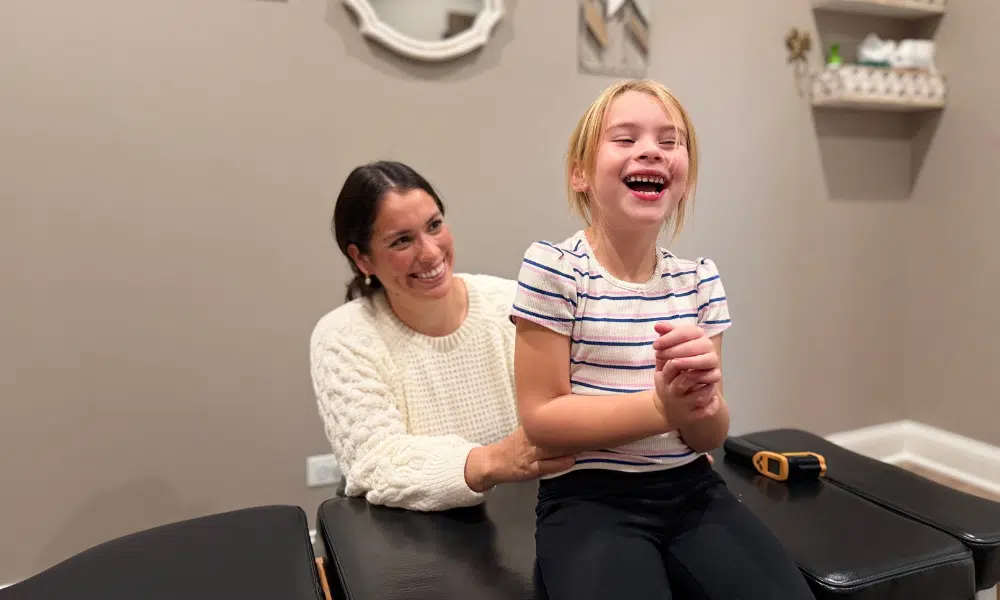
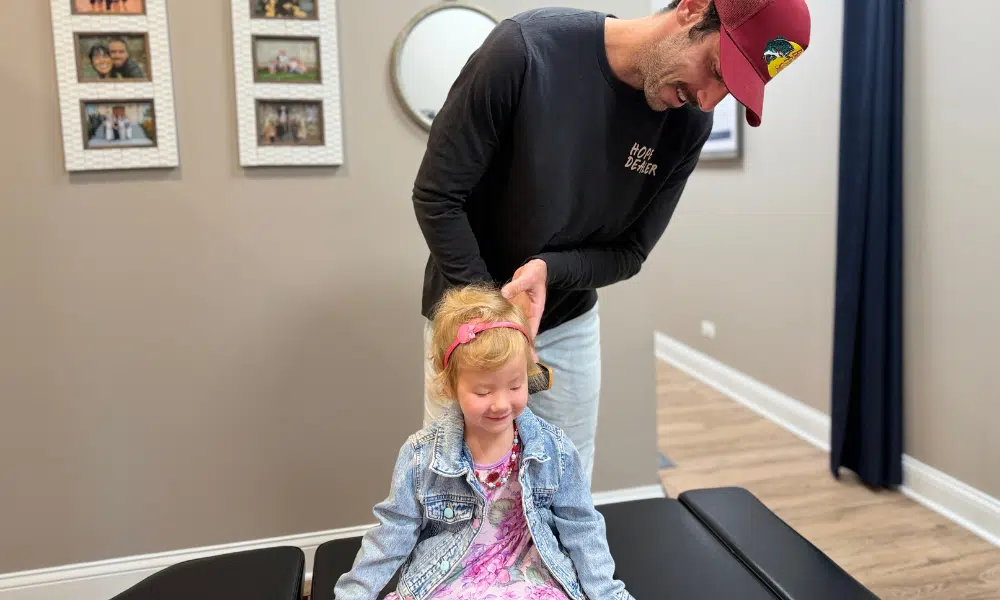
Neurologically-Focused Chiropractic Care (NFCC) is a specialized form of pediatric chiropractic that identifies and addresses subluxation patterns that interfere with a child’s Autonomic Nervous System. Instead of trying to suppress the stim from the outside, it works to restore the calming input and nervous system balance the child is missing on the inside, so they need the compensatory behavior less.
The approach rests on a simple idea: if a child smacks their lips, chews, or flaps because their brain isn’t getting enough calming proprioceptive input from the spine, then restoring healthy movement and signaling in that central region helps give the brain what it’s been hunting for. Gentle, child-specific adjustments help release tension and fixation in the upper neck and spine, lowering the alarm signal and helping the autonomic system shift out of a constant state of fight-or-flight.
We always encourage a team approach. NFCC works beautifully alongside occupational therapy, speech therapy, and other supports. The piece that often gets missed is sequencing: getting the foundational nervous system more stable and regulated first, so that everything else a family is doing actually lands and works better. Sometimes doing less, in the right order, accomplishes more than doing everything at once.
One honest note for parents: as a child’s nervous system reorganizes and heals, you may sometimes see stims briefly increase before they settle. This “two steps forward, one step back” pattern is common in real neurological healing and is very different from quick symptom suppression. A skilled clinician can help you tell the difference between healthy reorganization and a sign that the plan needs adjusting.
How Do INSiGHT Scans Measure What’s Happening?
Because the nervous system is invisible from the outside, we don’t guess at what’s going on. We measure it. INSiGHT scans are a three-part neurological assessment that gives an objective picture of how a child’s nervous system is functioning. It’s important to note that INSiGHT scans are not a treatment or a cure for any condition, not even back pain. They’re a measurement tool, full stop.
The three scans work together.
- Heart rate variability (HRV) measures the balance between the gas pedal and brake pedal of the autonomic system as well as overall adaptability of the nervous system.
- Surface electromyography (sEMG) measures patterns of neuromuscular tension and how organized or disorganized the nervous system’s energy is.
- Thermal scanning reads autonomic function along the neurospinal system. In children with autism, these scans very commonly reveal severe sympathetic dominance, suppressed vagal tone, and disorganized, asymmetrical patterns, the measurable fingerprint of the dysregulation driving the stimming.
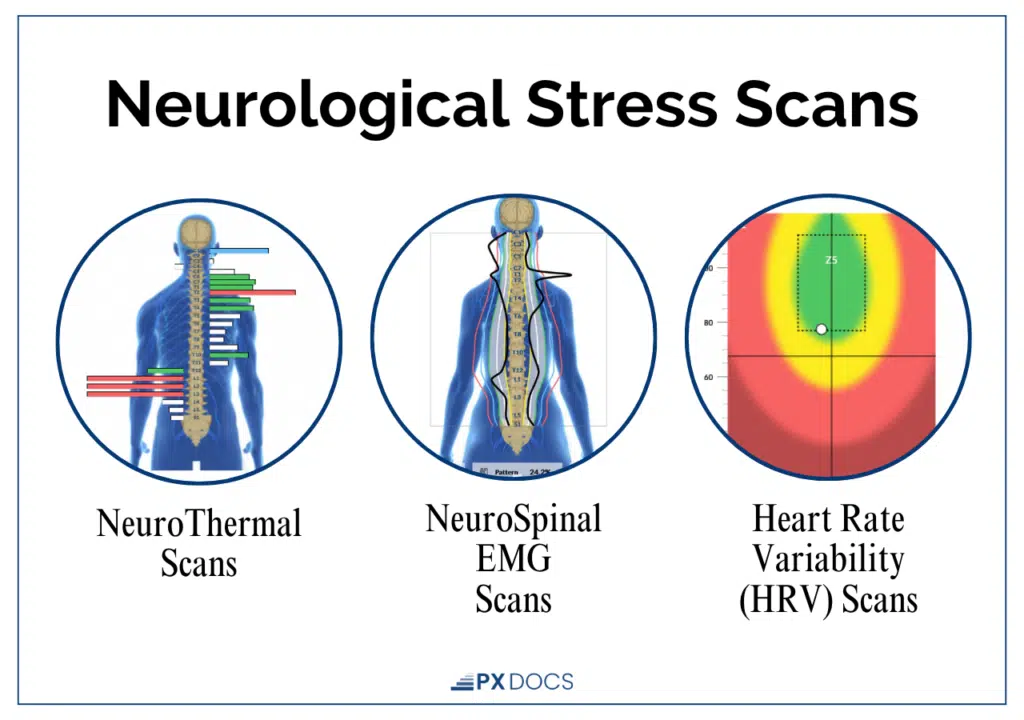
The real power is that these scans turn a vague worry into a clear baseline. Instead of wondering whether a child is “getting better,” parents and doctors can identify the nervous system’s starting point and track its response over time.
Finding Real Answers for Your Child
Lip smacking isn’t a quirk to wait out or a habit to scold away. It’s your child’s nervous system telling you it’s overwhelmed and working hard to find calm. Once you see the behavior as communication rather than a problem to be erased, the path forward becomes much clearer.
In our world, we don’t guess, we test. An INSiGHT scan gives you a clear baseline of where your child’s nervous system actually is right now, including how stuck-on the gas pedal has become and how much calming reserve they still have. From there, follow-up scans show whether the system is responding, with HRV climbing toward healthier balance, tension patterns organizing, and the brake pedal starting to work again. If the scans show things moving in the right direction, you keep building on what’s working. If something looks off, you adjust the plan before pressing on. That’s the whole point of measuring instead of guessing: care stays anchored to what’s really happening inside your child, not to hope alone.
Your child isn’t broken. They’re a brilliant kid whose nervous system has been stuck in survival mode, and nervous systems can change. With the right understanding, the right sequence of support, and a clear view of what’s actually happening underneath, real change is possible.
This article is educational and not a substitute for medical advice, so partner with qualified providers who can evaluate your specific situation. If you’d like to explore whether this approach could help your child, you can find a PX Doc near you to start with a scan and a real conversation.