
Autism noise sensitivity is a heightened, often painful reaction to everyday sounds caused by differences in how a child with autism’s nervous system takes in, filters, and responds to auditory input. Sounds most people tune out (a vacuum, a hand dryer, a noisy classroom) can trigger real distress, ear-covering, or a full meltdown. At its root, it reflects a nervous system stuck on high alert, not a behavior problem or a child being “dramatic.”
If you’ve watched your child crumble at a birthday party, bolt out of a public bathroom, or melt down the second the blender turns on, you already know this is real. You’re not imagining it, and you’re not overreacting by looking for answers. Noise sensitivity is one of the most common and most exhausting parts of daily life for families raising a child with autism, and it rarely gets explained in a way that actually helps.
Here’s what most articles won’t tell you: noise sensitivity isn’t really about the ears. It’s about the nervous system. In this guide, we’ll cover what sound sensitivity looks like, why an autism brain processes sound differently, and the deeper neurological reason so many of these kids live in a constant state of overwhelm. We’ll also walk through how Neurologically-Focused Chiropractic Care approaches this challenge through a root-cause lens that conventional approaches often miss.
What Is Noise Sensitivity in Autism?
Noise sensitivity in autism is an over-responsiveness to sound, in which the brain treats ordinary noise as threatening or overwhelming. Auditory hypersensitivity is one of the most commonly reported sensory traits across the autism spectrum, with figures often cited in the range of 70% to 90% of individuals with autism, far higher than in the general population. For these kids, sound isn’t just louder; it’s harder to filter, harder to ignore, and far more likely to push the body into a stress response.
The clinical term you’ll sometimes hear is hyperacusis, meaning an increased sensitivity to sound volume or frequency. But sound sensitivity in autism shows up in a few different ways. Some kids react to volume, finding loud noises physically painful. Others are triggered by specific frequencies, like a smoke alarm or a hand dryer. Many struggle most with unexpected sounds, where a slamming door or sudden cough sets off an outsized reaction. And a huge group simply can’t filter background noise, the hum of a refrigerator or the chatter of a crowded room drowns out everything else.
This is a sensory processing difference, not a hearing problem. Most of these children have perfectly normal hearing. The issue is what the brain does with sound once it arrives.
What Are the Signs of Sound Sensitivity in Children?
Signs of sound sensitivity in children with autism are usually observable in how a child’s body reacts to noise. The most common sign is covering the ears, but the fuller picture includes both the obvious reactions and the subtle physical ones that parents often miss.
Common signs of noise sensitivity in children include:
- Covering ears or hiding from sounds others barely notice
- Meltdowns or panic triggered by specific noises (vacuums, toilets, sirens, hand dryers)
- Avoiding noisy places like restaurants, parties, gyms, or grocery stores
- Running away or “eloping” from loud environments
- Trouble focusing when there’s background noise
- Becoming anxious in anticipation of a sound they know is coming
- Physical signs of stress: flushed face, racing heart, sweating, a wide-eyed startle response
That last group matters most, because it’s the clue to what’s really happening. A 2014 study in Molecular Autism found that children with autism showed overall autonomic hyperarousal, including marginally elevated basal heart rate, compared to typically developing peers. In other words, the body is sounding a five-alarm fire over a sound that doesn’t warrant one.
Why Does an Autism Brain Process Sound Differently?
A brain with autism processes sound differently because of how its sensory and nervous systems are wired to filter and react to input. Instead of screening out unimportant background noise, the auditory system lets too much through, and regions involved in threat detection and emotion, like the amygdala, fire more strongly than they should. The result is a brain that can’t easily separate “safe” sound from “dangerous” sound.
Imaging studies have found that individuals with autism often have increased neural activation in response to sounds that neurotypical people barely register. One of the best ways to understand this is an analogy we use all the time with families. Think of the nervous system as the air traffic control tower for the entire body. In a well-regulated system, the tower calmly sorts thousands of incoming signals, lands the important ones, and waves off the rest. In a child with sensory challenges, the tower is jammed. Every signal screams for attention at once; nothing gets prioritized, and the whole system goes into overload.
That traffic jam has a name in our world: nervous system dysregulation. And underneath it sits the real driver of so much of this, an Autonomic Nervous System stuck in the wrong gear.
How Does the Nervous System Cause Noise Sensitivity?
Noise sensitivity is driven by an imbalance in the Autonomic Nervous System, the part of the body that runs involuntary functions like heart rate, digestion, and the stress response. Think of it like a car. The Sympathetic Nervous System is the gas pedal: fight, flight, alertness, activation. The Parasympathetic Nervous System, run mostly by the vagus nerve, is the brake pedal: rest, digest, calm, and regulate. A regulated child can move between the two as life demands.
A noise-sensitive child with autism, though, is often stuck with the gas pedal pressed to the floor. We sometimes nickname these kids “raging bull” sensory kids, because their nervous system lives in sympathetic fight-or-flight overdrive, even at rest. That’s the part most people miss. When your child isn’t melting down, when everything looks calm on the outside, their brain is still noisy on the inside. There’s no quiet idle. So when a real sound hits, there’s no headroom left. The system is already maxed out, and the sound tips it over the edge.
This state of imbalance is called pediatric dysautonomia, a dysfunction of the Autonomic Nervous System that, in children, drives a wide range of challenges. Sound sensitivity is one of the most visible. A 2022 study in the Journal of Autism and Developmental Disorders using heart rate variability (HRV), a marker of autonomic balance, found that children with autism showed autonomic hyper-arousal during demanding tasks, and that those with greater hyper-arousal had more severe signs and higher anxiety. The body is telling on itself: the brake pedal isn’t working.
Is Noise Sensitivity Connected to Other Conditions Like ADHD and Sensory Processing Disorder?
Yes. Children with autism noise sensitivity very frequently also experience Sensory Processing Disorder, ADHD, anxiety, and sleep struggles. This overlap isn’t a coincidence; it’s a shared root. All of these challenges trace back to the same Autonomic Nervous System dysfunction, where sympathetic dominance and suppressed vagal tone leave the brain-body connection dysregulated and unable to filter input properly.
That’s why a noise-sensitive child so often also can’t sit still, struggles to fall asleep, has a hair-trigger temper, or gags at certain food textures. Parents are told these are separate problems handed off to separate specialists. We see them as different branches of the same tree. When the nervous system is stuck in overdrive, it doesn’t just affect one sense or one behavior; it ripples through focus, emotion, digestion, sleep, and sensory processing all at once. Address the root, and you’re no longer chasing five symptoms separately.
What Causes a Child’s Nervous System to Become Dysregulated?
A child’s nervous system becomes dysregulated through an accumulation of early stressors that overwhelm it during critical windows of development. At PX Docs, we call this the “Perfect Storm,” a sequence of events that stacks up to push a developing system into sympathetic overdrive before a child ever speaks their first word.
The “Perfect Storm” usually unfolds in three stages:
- Prenatal stress: High maternal stress during pregnancy floods the developing nervous system with stress hormones like cortisol, which can cross the placenta and affect fetal brain development and the Autonomic Nervous System, priming the system toward the sympathetic, fight-or-flight side from the start.
- Birth trauma: Interventions like C-section, forceps, vacuum extraction, cord-wrapping, induction, or prolonged labor can physically strain the upper neck and brainstem, the exact region where the vagus nerve and autonomic control live.
- Early childhood stressors: Repeated antibiotics, formula feeding, chronic ear infections, falls, and a heavy toxic load keep the system on alert and disrupt the gut-brain axis.
Each stressor on its own might be manageable. Stacked together, in sequence, during the most sensitive period of brain development, they overwhelm the system’s ability to regulate. The result is nervous system dysregulation, and very often, a child who can’t tolerate sound.
What Is Subluxation and How Does It Affect Sound Processing?
Subluxation is a disruption in the spine and nervous system made up of three components:
- Physical misalignment
- Joint fixation (loss of normal motion)
- Neurological interference (disrupted signaling between the brain and body).
It’s far more than a bone “out of place.” It’s a pattern of stress on the nervous system that keeps it from regulating properly.
In kids, subluxation most often shows up in the upper neck and brainstem, the same area that takes the brunt of birth trauma, and the same area packed with proprioceptors and the vagus nerve. When that region is under strain, the nervous system shifts into sympathetic dominance and stays there. That’s the direct link to sound: a subluxated, dysregulated nervous system can’t dial down its threat response, so it keeps treating ordinary noise as a threat.
When subluxation is present, the vagus nerve (the body’s “great protector” and the main driver of calm, parasympathetic function) gets suppressed. And the vagus nerve is overwhelmingly a sensory and regulatory nerve. When it’s offline, the whole sensory processing system loses its ability to integrate, modulate, and calm. That’s why we focus so much on restoring vagal function and clearing neurological interference rather than just managing the noise.
How Can Neurologically-Focused Chiropractic Care Help?
Neurologically-Focused Chiropractic Care is a specialized approach that identifies and addresses subluxation, nervous system dysregulation, and dysautonomia through advanced neurological assessment and gentle, child-specific adjustments. Rather than trying to suppress the reaction to sound, it works to restore balance to the Autonomic Nervous System so a child’s body can finally find its brake pedal.
The goal is to take a child stuck in sympathetic overdrive and help that system shift back toward parasympathetic, vagus-driven regulation. When that happens, families often describe the same pattern: their child starts tolerating sounds that used to send them running, transitions get easier, sleep improves, and meltdowns become less frequent and less intense. We’re not “treating” the noise sensitivity itself. We’re addressing the dysregulated nervous system underneath it, and the sensory tolerance tends to follow.
This is a different lens than what most families have been offered. Conventional approaches like occupational therapy, noise-canceling headphones, and environmental accommodations can be genuinely helpful for coping in the moment, and we’re glad when they bring relief. But coping strategies manage the symptoms. They don’t change why the nervous system is stuck on high alert in the first place. That’s the gap Neurologically-Focused Chiropractic Care aims to fill.
How Do INSiGHT Scans Measure Nervous System Function?
INSiGHT Scans are a set of three neurological assessments used in Neurologically-Focused Chiropractic Care to objectively measure how a child’s nervous system is functioning. Together, they give a clear picture of where a child sits on the gas-pedal/brake-pedal spectrum, without guessing.
The three scans are:
- Heart Rate Variability (HRV): measures the balance between the sympathetic (“gas pedal”) and parasympathetic (“brake pedal”) branches of the Autonomic Nervous System and reflects vagal tone.
- Surface electromyography (sEMG): measures electrical activity and tension patterns in the muscles along the neurospinal system.
- Thermal scanning: uses infrared sensors to detect temperature differences along the neurospinal system that can indicate dysautonomia.
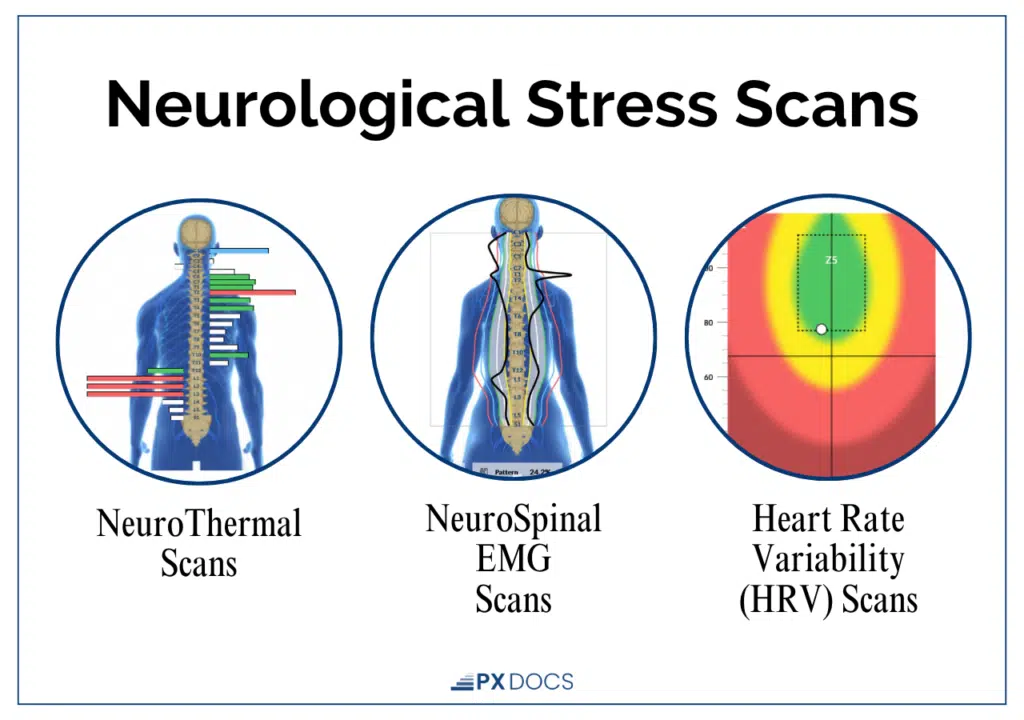
For a noise-sensitive child, these scans often reveal exactly what parents have felt all along: a system parked in sympathetic dominance with low vagal tone. It finally puts data behind the behavior.
It’s important to note that this technology does not diagnose medical conditions, and Neurologically-Focused Chiropractic Care is certainly not a treatment or cure for autism or any other condition, not even back pain. Instead, these INSiGHT Scans help us track down the root cause of nervous system dysfunction and dysregulation and build customized care plans to shift the nervous system back into a state of balance, regulation, and resilience.
Finding Real Answers for Your Child
Noise sensitivity isn’t your child being difficult, and it isn’t something they’ll necessarily just outgrow. It’s a window into a nervous system working overtime, one that’s been stuck in fight-or-flight and can’t find its way back to calm. Once you see it that way, the path forward changes from managing reactions to addressing the root.
In our world, we have a simple rule: we don’t guess, we test. A baseline INSiGHT Scan shows where your child’s nervous system actually sits today, how stuck the gas pedal is, how quiet the brake pedal has gone. From there, progress scans along the way tell us whether the system is genuinely responding: HRV climbing back toward the green zone, neurological tension organizing, vagal tone strengthening. When the data says we’re on track, we keep building. When it says something needs to shift, we adjust the plan. That’s what keeps your child’s care anchored to what’s really happening inside, not just to how a loud afternoon went.
And here’s the part to hold onto: a nervous system stuck on high alert can learn to settle. Kids who once bolted from every noisy room can grow into kids who sit through a birthday party. That kind of change is real, and it starts with understanding what’s driving the sound sensitivity in the first place. Always partner with your trusted care team as you explore options, and trust what you’ve observed about your own child.
If you’re ready to understand the nervous system behind your child’s noise sensitivity, you can find a PX Doc near you to learn what an INSiGHT Scan might reveal.
Frequently Asked Questions
Can autism noise sensitivity go away on its own?
Noise sensitivity rarely resolves fully on its own when it stems from an underlying dysregulated nervous system. Some children develop coping skills with age, but the root imbalance (a nervous system stuck in sympathetic overdrive with suppressed vagal tone) usually persists unless it’s addressed directly. Supporting nervous system regulation tends to improve sensory tolerance more reliably than waiting it out.
Why does my autistic child cover their ears at normal sounds?
Covering the ears is a protective response to sound that the nervous system is misreading as threatening. In many autistic children, the brain doesn’t filter background noise well, and the Autonomic Nervous System reacts to ordinary sounds with a fight-or-flight surge, faster heart rate, stress, and discomfort. Covering the ears is the body’s attempt to block input it can’t otherwise turn down.
Is sound sensitivity in autism a hearing problem?
No. Most autistic children with sound sensitivity have completely normal hearing. The challenge is in how the brain processes and reacts to sound, not in the ears themselves. It’s a sensory processing and nervous system difference in which the brain struggles to filter input and the Autonomic Nervous System overresponds, making ordinary sounds feel overwhelming or painful.
What’s the difference between hyperacusis and noise sensitivity?
Hyperacusis is a specific increase in sensitivity to the volume or frequency of sound, while noise sensitivity is a broader term encompassing any over-responsiveness to auditory input. A child can have hyperacusis, difficulty filtering background noise, and strong reactions to sudden sounds all at once. In autism, these often overlap and share the same root in sensory and autonomic dysregulation.
Is chiropractic care safe for autistic children with sensory issues?
Pediatric Neurologically-Focused Chiropractic Care uses gentle, child-specific adjustments, nothing like the forceful techniques used on adults. Practitioners trained in this approach use light pressure tailored to a child’s size and nervous system. Always work with a chiropractor experienced in pediatric and neurologically-focused care, and discuss your child’s full history with both that provider and your pediatrician.
How long does it take to see improvement in noise sensitivity?
Timelines vary by child, depending on how long the nervous system has been dysregulated and the severity of the underlying patterns. Some families notice calmer reactions and easier transitions within the first several weeks of care, while deeper, more lasting change in sensory tolerance typically unfolds over months as the nervous system reorganizes and vagal tone improves.