A speech delay in children means a child’s ability to produce speech sounds and words is developing more slowly than expected for their age. It’s one of the most common developmental concerns parents raise, and it’s rarely random. In most cases, a speech delay is a signal that the nervous system controlling the muscles of speech isn’t communicating clearly with the brain.
If you’re here because you’ve been counting words, replaying what your friend’s kid was saying at this age, or lying awake wondering whether to call someone, you’re not overreacting. Parents notice these things first, and usually for good reason. This article walks through the milestones worth watching, the warning signs that deserve a call, and the root cause that most standard evaluations never look for.
What Is A Speech Delay In Children?
Speech is the physical act of making sounds and words. It takes precise coordination between the brain, the cranial nerves, the brainstem, and roughly a hundred small muscles in the jaw, tongue, lips, and throat. When that coordination is off, speech comes out late, unclear, or not at all.
Speech delay is common. According to national prevalence data from the National Institute on Deafness and Other Communication Disorders, about 1 in 14 U.S. children ages 3 to 17 has had a voice, speech, or language condition in the past 12 months, and the rate is highest among the youngest kids, at 10.8% for ages 3 to 6.
How A Speech Delay Differs From A Language Delay
These two terms are often used interchangeably, but they aren’t the same.
A speech delay is a problem with production. Your child may have plenty to say but be hard to understand, or struggle to form specific sounds.
A language delay is a problem with the content itself. Your child may pronounce words clearly but only string two together, or have trouble following what you’re asking.
Language is also split into two halves that develop separately, and clinical guidance for physicians treats them as distinct skills.
- Receptive language is what your child understands.
- Expressive language is what your child can produce. Plenty of kids understand nearly everything and can express almost none of it, which is one of the more frustrating patterns for a parent to watch.
Many children have some combination of all of the above. In severe cases, where the brain knows exactly what it wants to say but can’t sequence the movements to say it, the pattern is called apraxia of speech.
What Are The Speech Milestones By Age?
Developmental milestones are a guide, not a deadline. Kids arrive on their own schedule. That said, here’s the general shape of typical development:
- By 12 months: babbling with a mix of consonant sounds, using gestures like waving and pointing, responding to their own name
- By 18 months: a handful of real words, preferring words over gestures, imitating sounds you make
- By 24 months: roughly 50 words, combining two words into short phrases, following simple one-step directions
- By 36 months: short sentences, asking questions, being understood by people outside the family
- By 48 months: full sentences, telling you about something that happened earlier in the day
Clarity has its own timeline, and it’s the benchmark parents tend not to know. Family and regular caregivers should understand roughly half of what a 2-year-old says and about three-quarters of what a 3-year-old says. By age 4, a child should be mostly intelligible even to strangers.
When Should You Worry About Your Child’s Speech?
A few signs are worth a call rather than a wait-and-see. Reach out to your pediatrician if your child:
- Isn’t using gestures like pointing or waving by 12 months
- Still prefers gestures over vocalizing by 18 months, or can’t imitate sounds
- Isn’t producing words or phrases spontaneously by 2 years, only copying you
- Can’t follow simple directions by 2 years
- Has an unusual vocal quality, such as raspy or noticeably nasal
- Loses words or skills they previously had
- Is significantly harder to understand than the clarity benchmarks above
Any baby who doesn’t respond to sound at all should be evaluated right away.
One note on the phrase “late talker.” It gets applied generously, and sometimes it’s accurate. But “he’ll grow out of it” is advice, not an assessment. If your gut says something is off, get it looked at. Early answers cost you very little and buy you a lot.
What Causes Speech Delay In Children?
Standard evaluation works through a reasonable list. Hearing loss is first, which is why an audiologist should test hearing whenever speech is a concern. Chronic ear infections and persistent middle ear fluid can muffle input during the exact window when a child is learning to map sounds to meaning. Oral-motor problems come next, meaning difficulty coordinating the lips, tongue, and jaw, often showing up alongside feeding trouble. A short frenulum, or tongue-tie, can restrict tongue movement. Speech delay is also frequently an early marker of autism or broader developmental delay.
Each of those is worth ruling out, and a speech-language pathologist is the right professional to assess them.
But that’s usually where the list stops. Once hearing is normal and no structural problem turns up, many families are told the cause is unknown and handed a referral to speech therapy. That answer is incomplete, and it’s the reason so many parents end up searching at 11 pm.
Why Speech Develops In A Specific Order
Development isn’t a set of parallel tracks. It’s a sequence, and the order matters more than the timing.
Gross motor control comes first. Fine motor builds on top of gross motor. Speech builds on top of fine motor. Higher cognitive and social skills build on top of speech. A child has to hold their head steady before they can sit, sit before they can crawl, and organize their core and neck before the small muscles of the mouth have a stable platform to work from.
This is why speech delay so rarely travels alone. Look closely at a child with a speech delay, and you’ll often find a history of skipped crawling, low muscle tone, sensory processing challenges, constipation, or chronic congestion. Those aren’t a pile of separate problems, but rather one dysregulated system showing up in several places at once.
How Birth Interventions Set The Stage For Speech Delay
Over 15 years of clinical practice, the pattern PX Docs’ offices see most consistently in speech delay case histories has nothing to do with vocabulary exposure or screen time. It’s what happened during pregnancy and birth.
This is the framework we call The Perfect Storm™, developed by Dr. Tony Ebel. It describes a sequence rather than a single cause. Prenatal stress affects the developing Autonomic Nervous System. Birth interventions like forceps, vacuum extraction, C-section, induction, and stalled labor add physical strain to the upper neck and brainstem. Early childhood stressors, including repeated antibiotics and chronic illness, pile on from there. No single item is the whole story. Together they can leave a nervous system stuck in high alert from the very beginning.
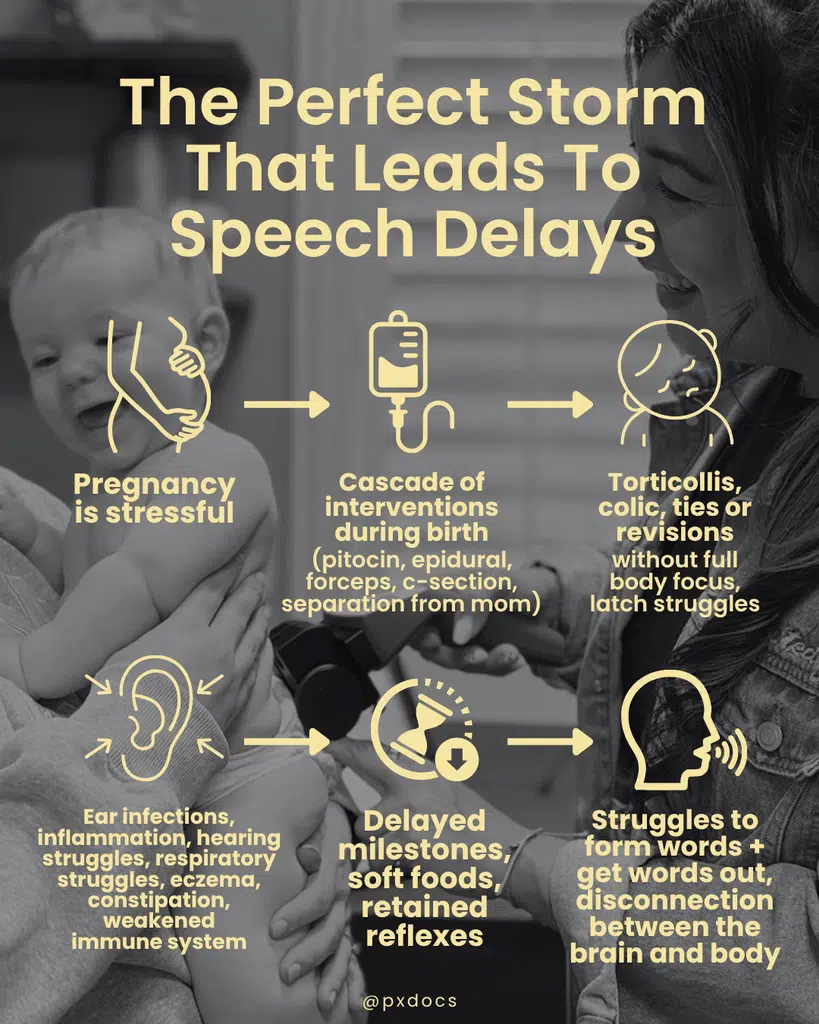
Think of the Autonomic Nervous System as a car with two pedals. The sympathetic side is the gas pedal, built for fight or flight. The parasympathetic side, run largely by the vagus nerve, is the brake pedal, built for rest, digest, and regulate. Speech is expensive, finely tuned work. It happens on the brake pedal. A child riding the gas pedal all day has limited resources left for it.
The mechanical piece of this is subluxation, which has three components that must be present together: misalignment of the vertebrae, fixation where those segments stop moving properly, and neurological interference where the disrupted movement distorts the signals traveling between brain and body. Birth-related subluxation shows up most often in the cranial and upper cervical region, which is precisely where the cranial nerves and brainstem structures that build speech live.
Birth is mechanically demanding on that region for nearly every baby, not just the complicated deliveries. In an observational study of 100 healthy newborns, 99 had at least one cranial strain pattern within 72 hours of birth, 95 showed condylar compression at the base of the skull, and 91 had restricted motion in at least one cervical segment. The region governing speech is under real mechanical strain in almost every newborn, so checking it is a reasonable step.
Interference in that region doesn’t announce itself as neck pain. In a toddler, it announces itself as a child who isn’t talking yet.
Why Speech Therapy Sometimes Plateaus
Speech therapy is genuinely good at what it does, and we recommend it. It trains the muscles and patterns of speech through skilled, repetitive practice.
What it can’t do is change the quality of the signal arriving at those muscles. If the underlying communication between brain and body is distorted, therapy is asking a child to practice with a bad connection. Progress often comes, then stalls. Families describe hitting a wall, working hard for months, and watching gains slow to nothing.
That plateau isn’t a sign your child has reached their ceiling, and it isn’t a sign the therapist is doing anything wrong. It usually means the foundation underneath the therapy still needs attention.
How Insight Scans Measure What’s Underneath
This is where objective measurement changes the conversation. INSiGHT Scans, a scanning technology developed by the Children’s Chiropractic Alliance and used in PX Docs offices, measure nervous system function directly across three views. Heart rate variability shows how well the autonomic system adapts between the gas pedal and the brake pedal. Surface EMG maps muscle tension patterns along the neurospinal system. Thermal scanning reads how well the autonomic system is regulating.
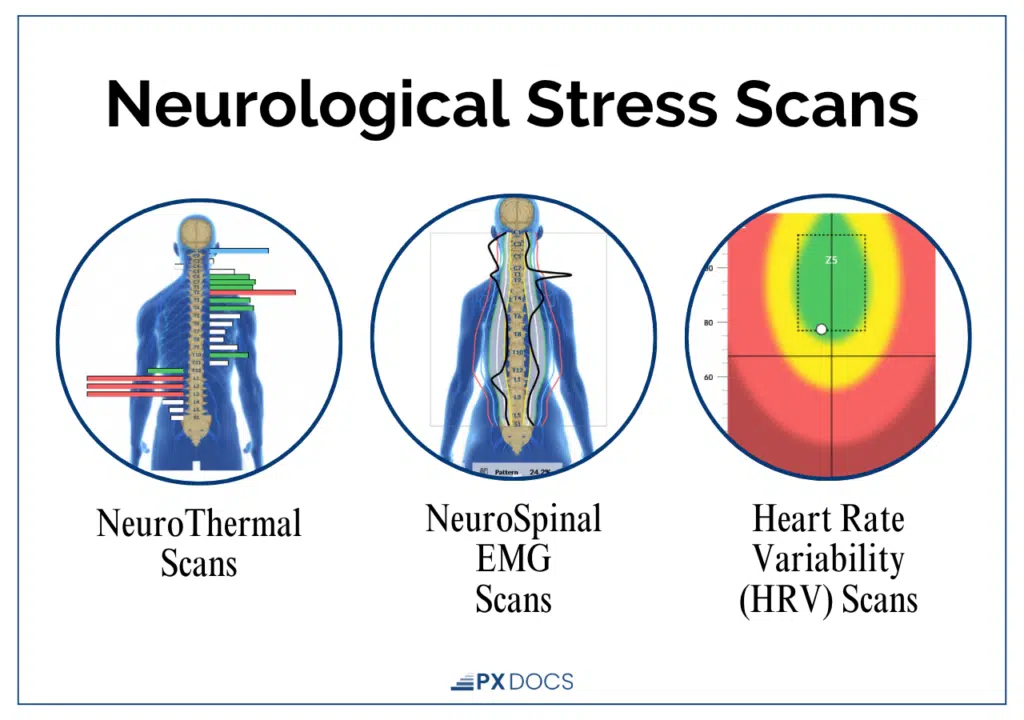
It’s important to note that this technology does not diagnose medical conditions, and Neurologically-Focused Chiropractic Care is certainly not a treatment or cure for speech delay or any other condition, not even back pain. Instead, these INSiGHT Scans help us track down the root cause of nervous system dysfunction and dysregulation, and build customized care plans and adjusting protocols to help shift the nervous system back into a state of balance, regulation, and resilience.
Here’s the part that should take some weight off your shoulders. You don’t have to keep guessing. A baseline scan shows where your child’s nervous system actually is right now, not where it looks like it might be. Progress scans along the way show whether it’s genuinely reorganizing, with heart rate variability climbing and tension patterns settling. When the data tracks, we keep building. When it doesn’t, we change the plan rather than spending another six months hoping. That’s the difference between hoping your child is improving and knowing it.
You’re Not Alone
If your child is in speech therapy and stalled, or you’re still waiting on a first word and want a fuller picture of the causes and care process, our complete guide to speech delay goes deeper on both.
Your child isn’t broken, and this isn’t your fault. There’s a root cause, and nervous systems are built to adapt and recover when you address the interference. To have your child checked, find a PX Doc near you in our provider directory and schedule a consultation.
PX Docs has established sourcing guidelines and relies on relevant and credible sources for the data, facts, and expert insights and analysis we reference. You can learn more about our mission, ethics, and how we cite sources in our editorial policy.