

A stressed newborn tells you through their body: inconsolable or high-pitched crying, constant arching and stiffening, clenched fists or splayed fingers, trouble latching, spitting up, constipation, short, broken sleep, and turning the head to only one side. Most of these signs trace back to an overloaded Autonomic Nervous System, the part of the brain and body that runs digestion, sleep, breathing, and the stress response.
If you searched for signs your newborn is stressed, you were probably told that babies cry, babies spit up, and babies grow out of it. Sometimes that’s true. Often it isn’t. Crying and body tension convey real information about a baby’s neurological state, and researchers who study infant crying have made this point directly: when assessed carefully, crying provides parents and clinicians with diagnostic information they can act on.
Almost every article on this topic lists the same emotional and environmental causes: loud noises, too many visitors, a stressed-out mom. Those are real. But they leave out the physical side, and the physical side is often the reason a baby can’t come back down after the noise stops.
What Are the Signs Your Newborn Is Stressed?
Newborns don’t have words, so they communicate with physiology. A stressed newborn shows it through their muscles, gut, sleep, and skin, often all at once. Neonatal researchers have cataloged these behavioral stress cues for decades, and the cues aren’t random: in preterm infants, behaviors like finger splaying tracked measurably with changes in heart rate variability during a painful procedure, meaning what you see on the outside reflects what the Autonomic Nervous System is doing on the inside.
Common signs of stress in a newborn include:
- A high-pitched, inconsolable cry that sounds different from a hungry or tired cry, and doesn’t respond to feeding, changing, or holding
- Constant arching of the back and neck, especially during feeds or while lying on their back
- Fists clenched, or fingers splayed wide and stiff, along with rigid arms and legs
- Head turned to one favorite side, with resistance or fussing when you turn it the other way
- Latch trouble on one side, clicking while nursing, shallow latch, or painful nursing for mom
- Digestive chaos: frequent spit-up, painful gas, a hard, distended belly, straining to pass stool
- Sleep that won’t consolidate: 20 to 30 minute catnaps, startling awake, never dropping into deep sleep
- Gaze aversion, turning away or refusing eye contact during interaction
- Color changes, hiccups, sneezing, or fast irregular breathing that show up during handling rather than illness
- Extreme tension or unusual floppiness, along with a flat spot on the head or facial asymmetry
One important note about how to read this list. A newborn showing one cue for a minute during a diaper change is a baby communicating normally, and the right response is to slow down and comfort them. A newborn showing several of these signs day after day, across feeding, sleeping, and handling, is showing you something different: a nervous system that isn’t recovering between stressors.
Why Does a Newborn’s Nervous System React to Stress So Strongly?
A newborn’s Autonomic Nervous System is running the show before it’s finished building. It controls heart rate, breathing, digestion, immune response, and sleep, and it does all of that through two branches. Think of it as a gas pedal and a brake pedal. The Sympathetic branch is the gas pedal, driving fight-or-flight activation. The Parasympathetic branch is the brake pedal, driving rest, digestion, and calm. A stressed newborn is a baby whose gas pedal is stuck down and whose brake pedal can’t get traction.
The main brake cable is the vagus nerve, the longest cranial nerve in the body, carrying parasympathetic “rest and digest” signals between the brainstem and the heart, lungs, and digestive system. Vagal tone, a measurable indicator of how well the vagus nerve is functioning, is linked to digestion, immune regulation, and the ability to settle. Researchers mapping autonomic development have identified specific critical windows in late pregnancy and the newborn period when vagus nerve maturation is most sensitive to disruption. The system is being wired at exactly the moment it’s under the most load.
This isn’t theoretical, and it isn’t invisible. Heart rate variability (HRV), the beat-to-beat variation in a baby’s heart rhythm, gives a non-invasive read on autonomic balance. In a study of 150 healthy newborns monitored over their first 24 hours, HRV shifted significantly during the first 6 hours after birth before gradually normalizing, and the researchers concluded that HRV is sensitive enough to detect birth-related stress and track whether it resolves. Newborn stress leaves a measurable signature. It just isn’t part of a standard well-baby visit, which focuses on weight, length, and chemistry rather than neurology.
When that autonomic imbalance persists, it has a clinical name: dysautonomia, dysfunction of the Autonomic Nervous System. In infants and children, pediatric dysautonomia shows up as nervous system dysregulation driving a wide range of issues, from feeding and sleep problems to gut symptoms through the gut-brain axis.
How Can You Tell Normal Newborn Fussiness From Nervous System Stress?
The difference isn’t the sign; it’s whether the sign resolves. A regulated newborn escalates, gets comforted, and comes back down, and that recovery is the whole point. A dysregulated newborn escalates and stays escalated, or drops into shutdown without ever passing through calm. When cues persist across weeks, cluster together, and stop responding to soothing that used to work, you’re looking at a pattern rather than a moment.
Timing matters too. Most crying peaks around six weeks and eases by three to four months. Crying that persists beyond four to six months, especially alongside other regulatory problems like feeding and sleep difficulties, identifies a distinct group of infants at higher risk of longer-term challenges. That’s not a reason to panic. It’s a reason to look deeper instead of waiting.
Here’s the part parents rarely hear. Babies with significant early nervous system stress frequently go on to experience Sensory Processing Disorder, ADHD, or Autism. That overlap isn’t a coincidence, and it isn’t a prediction about your baby.
All three involve Autonomic Nervous System dysfunction: a nervous system stuck in sympathetic dominance, with poor vagal tone and limited ability to shift into a regulated state. The colicky, arching, poor-sleeping newborn and the four-year-old melting down over a shirt tag are often the same nervous system at two different ages. That’s why the newborn window and early childhood years matter so much.
What Causes Nervous System Stress in a Newborn?
Newborn stress rarely starts at birth. It accumulates. Dr. Tony Ebel calls this the “Perfect Storm”: prenatal stress, then birth trauma, then early childhood stressors, stacking in sequence during the most sensitive period of neurological development and leaving the nervous system dysregulated.
Prenatal stress comes first. Maternal stress hormones cross the placenta and shape how the baby’s own stress response system develops. In a study following infants across their first year, greater exposure to prenatal stressors predicted lower HRV after a stressor at both six and twelve months, which the authors interpreted as a reduced ability to recover from stress. Prenatal stress shapes the baby’s wiring.
Then comes birth. This is the piece conventional care skips. Even a delivery everyone calls normal puts real mechanical force through a baby’s head, neck, and neurospinal system. Interventions turn the dial up: C-section, forceps, vacuum extraction, induction, prolonged labor, cord complications. In an examination of 100 healthy newborns, researchers found at least one cranial strain pattern in 99 of them and motion restriction in at least one cervical segment in 91%, with total dysfunction scores related to length of labor (Waddington et al., 2015). These were the babies who passed their newborn exams.
Those forces concentrate in the upper neck and brainstem, exactly where the vagus nerve exits the skull. What results is subluxation: not simply a bone out of place, but three things at once. Physical misalignment, joint fixation where normal motion is lost, and neurological interference disrupting the signaling between brain and body. That third component is the one that matters most for a stressed newborn, because it’s the one that keeps the brake pedal from working.
Then early stressors pile on. Feeding struggles, colic and reflux, rounds of antibiotics for ear infections, disrupted gut flora. The colic connection is worth sitting with: research comparing 120 colicky babies with 117 non-colicky babies found clinical evidence of vestibular dysregulation in the colicky group, and the author argued colic may be the behavioral expression of brainstem dysregulation, with tight suboccipital muscles acquired at birth as a plausible driver. Colic looks like a gut problem but behaves like a neurological one.
This is what we see over and over in practice. In the pediatric nervous system evaluations we run every week, subluxation and neurological interference show up again and again in exactly the kids described above: the hard pregnancy, the difficult birth, the colic that never fully resolved. And when that interference is addressed, we watch for the same shifts every time: better sleep, easier digestion, calmer motor tone, a nervous system that’s finally out of survival mode. Real, visible change — not because we’ve treated a diagnosis, but because we’ve restored the foundation the rest of the body was waiting on.
That’s the cascade, and it’s why we describe nervous system dysregulation as hidden in plain sight. Everyone already knows the nervous system controls everything, that a newborn’s neck is vulnerable, and that birth can be hard, but those facts are rarely connected.
Can Your Own Stress Affect Your Newborn?
Yes, and this is the section to read slowly, because the answer is not “so this is your fault.” Newborns co-regulate. Their Autonomic Nervous System borrows stability from yours, which is exactly why skin-to-skin contact works when nothing else does. In a controlled laboratory study, infants exposed to their mother’s acute stress showed measurable disruption in autonomic regulation and behavior afterward.
Co-regulation runs both ways: when a baby’s nervous system settles, the parent’s stress load drops, and feeding and sleep get easier, which in turn feeds back into the baby. And when a newborn is stuck in survival mode after a hard birth, no amount of maternal calm fully compensates, because the interference is physical. Plenty of parents did everything right and still ended up with a dysregulated baby.
Two babies can go through the same C-section and land in completely different places, and the difference usually comes down to the reserve capacity that particular nervous system had going in.
How Do You Help a Stressed Newborn Calm Down?
Start with the acute cue, because most of the time that’s all it is. When you see splayed fingers, gaze aversion, or a sudden startle, the move is to reduce input and add containment: dim the lights, cut the noise, stop the bouncing, and hold your baby’s arms and legs gently tucked toward their body. Skin-to-skin contact, slow rhythmic movement, and a quiet room do more than any product you can buy.
If soothing works, keep soothing. If the same soothing no longer works, adding more input often isn’t helpful. A baby whose gas pedal is stuck doesn’t need more stimulation to override it, and escalating the rocking, the white noise, and the swinging often makes things worse. That’s the signal to have the neurospinal system checked rather than to try a different swaddle.
That’s also where Neurologically-Focused Chiropractic Care fits. It’s a specialized form of pediatric chiropractic care focused on locating and addressing subluxation patterns affecting the Autonomic Nervous System, using neurological assessment and gentle, infant-specific adjustments. There’s nothing to stretch away here and no supplement that reaches it, because the problem is interference in brain-body communication.
Take Emersyn, for example. She was constantly tight and uncomfortable after every feeding, shoulders pinned up near her ears, barely sleeping, tummy time a daily fight. Once her care team addressed the neurospinal stress from a long delivery, the shift wasn’t gradual — her mom described her sleeping through the night for the first time within a week of starting care.
Most PX Docs offices check newborns from the first days of life and often run a full nervous system assessment around two weeks.
How Do INSiGHT Scans Measure a Newborn’s Stress Response?
INSiGHT scanning is a three-part neurological assessment used in Neurologically-Focused Chiropractic Care.
- Heart rate variability measures autonomic balance, or how well the gas pedal and brake pedal are working together.
- Surface electromyography (sEMG) measures tension patterns along the neurospinal system.
- Thermal scanning measures autonomic function through the temperature differences the nervous system controls.
Together, they give a picture of a newborn’s stress physiology in a few painless minutes, with no needles, no radiation, and nothing your baby has to hold still for.
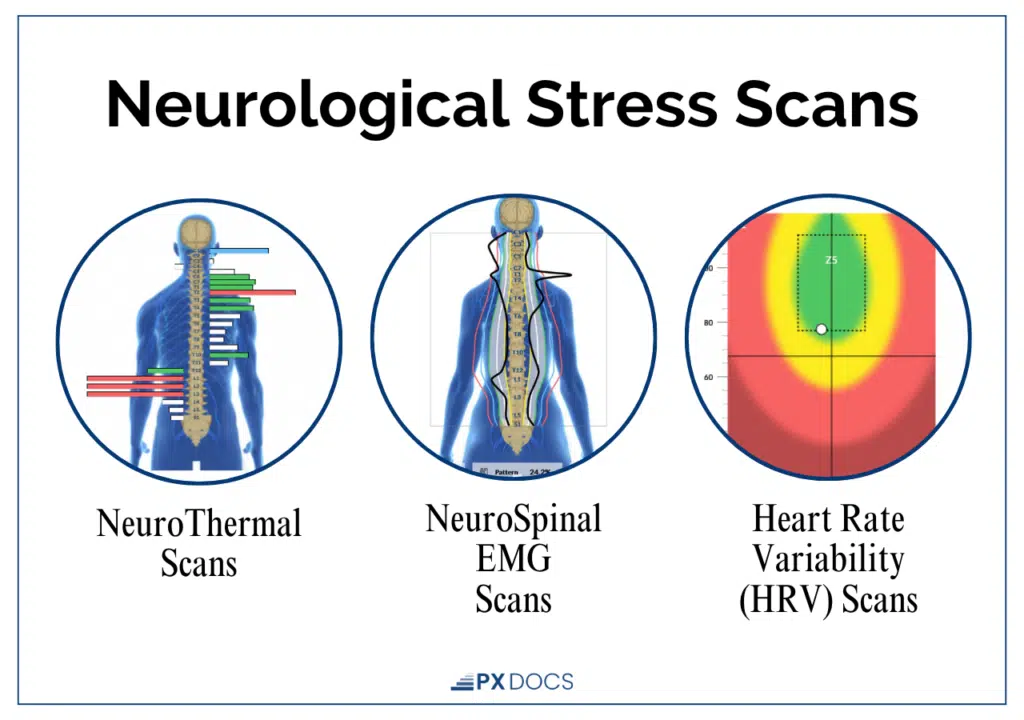
INSiGHT scans are not a treatment or a cure for any condition, not even back pain. They don’t diagnose Autism, ADHD, colic, or anything else. They measure how the nervous system is functioning right now, which is a different and more useful thing for a two-week-old.
Why does this matter for a stressed newborn? Because “she looks great” and “some babies are just fussy” are both guesses. Scanning replaces the guess with a baseline. If a baby’s HRV shows sympathetic dominance and their thermal scan shows dysregulation, that’s no longer a mystery. It’s a starting point, and it’s a starting point your doctor can show you on a screen.
What Should You Do If You Think Your Newborn Is Stressed?
Newborn stress isn’t a personality. It’s physiology, and it’s readable. The crying, the arching, the clenched fists, the broken sleep: these are your baby’s only available language, and they’re pointing at a nervous system carrying more load than it can currently clear.
So how would you know where your baby actually stands? Not from a guess, and not from a weight chart. We don’t guess. We test. A baseline set of INSiGHT scans shows where your newborn’s nervous system sits today, including whether HRV is skewed toward the gas pedal. From there, repeat scans at intervals show whether the system is genuinely reorganizing: HRV climbing back toward balance, tone evening out, sleep and digestion following. If the data says the foundation is holding, care keeps building on it. If it says something isn’t responding, the plan changes early rather than after six frustrating months. That’s what keeps your baby’s care tethered to what’s happening inside them instead of how things look from the outside.
This is educational information, not medical advice, and it doesn’t replace your pediatrician. Bring your observations to a trusted healthcare provider, and keep bringing them even when you’re told to wait it out. You’ve been reading your baby correctly this whole time. Now there’s a way to check.
If you’re ready for answers instead of reassurance, find a PX Doc near you and get your newborn’s nervous system checked. You can also read more about the hidden stress affecting even “healthy” babies.