
It’s 9:40 at night. Your child rubbed their eyes at dinner, melted down over the wrong cup at 7, and is now doing laps around the living room.
When a child is tired but wired, their body has run out of fuel, but their nervous system never got the signal to power down. The sympathetic “fight or flight” side stays switched on past bedtime while the parasympathetic “rest and digest” side, the part that actually produces sleep, can’t take over. Exhaustion and alertness aren’t opposites here. They’re happening at the same time, in two different systems.
If you’ve already moved bedtime earlier, killed the screens, run the sound machine, and tried the gummies, and your child is still wide-eyed at 10 p.m., you’re not doing bedtime wrong. Most advice on this assumes the problem is scheduling. For a lot of kids, it is. But when this happens every night, year after year, the schedule isn’t what’s broken. The regulation of the nervous system underneath it is.
So let’s get into what’s actually happening: what tired but wired means neurologically, why the usual fixes stall out, where this pattern starts, and how it gets measured.
What Does Tired but Wired Actually Mean in a Child?
Tired but wired describes a child whose sleep pressure is high but whose nervous system won’t downshift to let sleep happen. Think of the Autonomic Nervous System as having a gas pedal and a brake pedal. The sympathetic branch is the gas: alert, activated, ready to go. The parasympathetic branch, driven largely by the vagus nerve, is the brake: rest, digestion, repair, sleep. Falling asleep isn’t something a child does. It’s something that happens when the brake finally outweighs the gas.
In a tired but wired child, the gas pedal is stuck down, and the brakes are worn thin. Sleep researchers have a name for this state: hyperarousal. The alerting system runs hot at exactly the hour it should be powering down. Heart rate, stress hormones, and brain activity all sit higher than they should while a child lies in the dark waiting for sleep to come.
That term comes out of insomnia research in adults, but the same pattern has been measured in young children. In a 2021 study, researchers tracked preschoolers minute by minute through their bedtime routines with a wearable that logged heart rate, skin temperature, and sweat response. The kids running hottest on those measures took the longest to fall asleep. Small sample, but it puts a number on what you’re already watching from the hallway.
This matters because it reframes the whole problem. Your child isn’t stalling. They’re not manipulating you with the seventh glass of water. Their brain and body are stuck in a state where letting go feels physiologically unsafe.
Why Is My Child Tired but Wired Every Single Night?
The standard explanation goes like this: your child missed their sleep window, cortisol and adrenaline surged to keep them going, and now they’ve caught a second wind. That’s real. Push a child past the point where their body expected sleep, and you’ll get a wired, hyper, dysregulated kid, and an earlier, more consistent bedtime genuinely helps. Analyzing National Survey of Children’s Health data, children with a regular bedtime were more likely to get enough sleep.
But that explanation has a ceiling. It accounts for the child who’s wired on the night of the late wedding or the skipped nap. It doesn’t account for the child who is wired on a Tuesday, after a calm afternoon, with a 7:30 bedtime that hasn’t moved in two years.
And this is more common than most parents realize. During 2020 to 2021, CDC data show insufficient sleep duration was reported for 35.0% of U.S. children aged 4 months to 14 years. That’s not a nation of families who forgot to buy blackout curtains. When a third of kids aren’t sleeping enough, something upstream of bedtime routines is going on.
Here’s the test we’d offer any parent: if your child’s sleep falls apart only when the schedule falls apart, you’re likely dealing with overtiredness. If your child’s sleep falls apart even when everything else is dialed in, you’re dealing with a nervous system that can’t shift gears.
Signs Your Child Is Wired, Not Just Overtired
Common signs of nervous system-driven sleep struggles in children include:
- Taking 45 to 60 minutes or more to fall asleep, even on nights they were clearly exhausted
- A burst of energy after the bath, when the routine should be winding them down
- Bedtime resistance that looks like defiance but arrives at the same time every night
- Restless sleep: twitching, thrashing, kicking off covers, ending up sideways or on the floor
- Mouth breathing, snoring, or fast shallow breathing during sleep
- Waking at 2 or 3 a.m. fully alert, sometimes for an hour or more
- Waking early and still seeming unrested, with dark circles and a short fuse by breakfast
- Belly discomfort at night, constipation, or a stomach that seems busy when it should be quiet
- Big emotional swings and meltdowns over transitions during the day
That last cluster is the part most sleep advice skips. Dr. Tony Ebel calls the nighttime version restless kid syndrome. During real, deep, restorative sleep, the motor system should go completely quiet. When a child’s body is still moving, twitching, and uncomfortable hours after lights out, that’s not a bad mattress. That’s a nervous system that never fully stood down.
The Connection to Autism, ADHD, and Sensory Processing Disorder
Children who are chronically tired but wired frequently also carry diagnoses of ADHD, Autism, Sensory Processing Disorder, or anxiety. This overlap isn’t a coincidence, and one condition doesn’t cause the other. All of them share a common substrate: an Autonomic Nervous System stuck in sympathetic dominance, unable to access the parasympathetic state that sleep, digestion, and emotional regulation all require. The sleep problem and the daytime symptoms are the same dysregulation showing up at different hours.
The research backs that up. In a study of children aged 6 to 12, parents reported sleep problems in roughly 64% of kids with ADHD and 64% of kids with autism, compared with 25% of typically developing children, with shorter sleep duration in both groups. Two different diagnoses, nearly identical sleep picture.
And the trouble doesn’t stay in the bedroom. A 2025 review of 26 studies found trouble falling asleep, night waking, and bedtime resistance showing up alongside daytime aggression, hyperactivity, and emotional dysregulation, consistently, across the literature. When researchers ran a network analysis on 240 children with autism with significant sleep problems, the sleep, mood, and behavior measures didn’t sit in separate boxes. Anxiety and behavioral difficulty sat at the center of the map, carrying trouble from one cluster into the next.
This is why we care for sleep as the first domino rather than a side issue. Sleep is where the nervous system detoxifies, consolidates learning, and repairs. A child who can’t get there is a child whose brain is trying to develop without a nightly reset.
Where a Stuck Gas Pedal Comes From
A nervous system doesn’t get stuck at bedtime out of nowhere. It gets there through early accumulation of stress, and Dr. Tony Ebel calls that accumulation The Perfect Storm™.
It usually starts before birth. Fertility challenges and Prenatal stress elevate maternal cortisol, which crosses the placenta and shapes how the baby’s stress response system calibrates. Then comes birth trauma: interventions like C-section, forceps, vacuum extraction, a long stalled labor, or rapid delivery, all of which can strain the upper neck and brainstem where the vagus nerve exits. From there, the early years stack on more: rounds of antibiotics, chronic ear infections, reflux, toxins, formula transitions, falls, and a steady stream of stimulation a developing system was never designed to filter.
Each layer alone might be manageable. Stacked, they leave a child in sympathetic dominance as the baseline. The gas pedal isn’t pressed because something is happening right now. It’s pressed because the system learned, early, that staying ready was the safer setting. If you want the fuller picture of how this begins, we’ve mapped it in The Perfect Storm™ in pregnancy.
Parents often tell us the sleep trouble showed up in infancy and never really left. The colicky newborn who only slept when held becomes the toddler with night terrors, who becomes the eight-year-old lying awake at 10 p.m. Same nervous system. Different chapter.
What Subluxation Has to Do With Sleep
Subluxation is the clinical term for what interferes with this system, and it has three components that have to be present together:
- Misalignment within the neurospinal system
- Fixation or loss of normal motion at those segments
- And, most importantly, neurological interference that disrupts the signaling between brain and body.
It’s the third component that drives everything we’re describing. A neurospinal system can look unremarkable on imaging and still be sending scrambled signals.
When that interference sits high in the neck, near the brainstem and vagus nerve, three things tend to show up at night.
- The motor system won’t quiet. Subluxation hits sensory and motor function first. Awake, that looks like a child who cannot stop moving, fidgeting, or talking. Asleep, it looks like the restless, twitching body described above.
- The gut stays open for business. Digestive motility should wind down overnight. When vagus nerve signaling is disrupted, the neuro-gut becomes inefficient and ends up doing its work at the wrong hour. As Dr. Tony puts it, it’s like staying up late to finish a work project. The body can’t settle because the gut is still running.
- Breathing stays shallow. Sympathetic dominance drives fast, shallow, upper-chest breathing. At night, that should slow and deepen. Instead, you get mouth breathing, snoring, and a child who never quite drops into deep restorative sleep.
This clustering of dysfunction across sleep, digestion, breathing, and emotional regulation has a name: dysautonomia, meaning dysfunction of the Autonomic Nervous System, the system that runs heart rate, digestion, immune response, and sleep cycles without conscious input.
Do Melatonin and Magnesium Help a Tired but Wired Child?
They can help a child fall asleep. Neither addresses why the nervous system won’t downshift on its own, and melatonin in particular has become the default in a way that deserves a closer look.
Between 2012 and 2021, the CDC documented 260,435 pediatric melatonin ingestions reported to U.S. poison control centers, with annual reports rising 530%. Melatonin accounted for 4.9% of all pediatric ingestions reported in 2021, up from 0.6% in 2012, and hospitalizations and serious outcomes rose across the period, driven largely by unintentional ingestions in children aged 5 and under. By 2020, it had become the substance children ingested most often among reports to national poison control centers.
None of that means melatonin is dangerous when a doctor recommends it at an appropriate dose. It does mean it has quietly become the tool families reach for first, often for years, without anyone asking what the nervous system is doing underneath. The same logic applies to magnesium. If a child needs a supplement every night to produce a function their body should generate on its own, that’s worth investigating rather than managing indefinitely.
Talk to a trusted pediatrician about any supplement or medication questions for your child.
The Sleep Habits That Still Matter
Nothing here means the fundamentals stop mattering. In practice, we push families hard on them, because they’re the foundation everything else sits on:
- A protected, consistent bedtime. Circadian rhythms thrive on consistency and get wrecked by inconsistency. Pick a time and defend it.
- A real wind-down window. Thirty minutes minimum, ideally 60 to 120, with no screens and no sugar.
- A cool, dark, decluttered room. Darkness supports deep sleep, and calm spaces support calm nervous systems.
- Sensory support. White noise and a diffuser give the auditory and olfactory systems something regulating to settle into.
- A warm bath with Epsom salts. The tactile calm of warm water is genuinely effective.
- Real daytime movement. Kids who never burn off energy or get proprioceptive input struggle to fall asleep. You’ve felt this yourself after a twelve-hour day at a desk: exhausted, and still unable to sleep.
For a deeper version of this list, we’ve put together a guide to improving your child’s sleep.
And here’s the honest part. You could get every one of these perfect, run the ideal room, the ideal routine, the ideal diet, and if the nervous system itself is dysregulated and subluxated, your child still won’t sleep well. That’s not a failure of effort. It’s a signal that the problem sits one level deeper than habits can reach.
Measuring a Stuck Nervous System
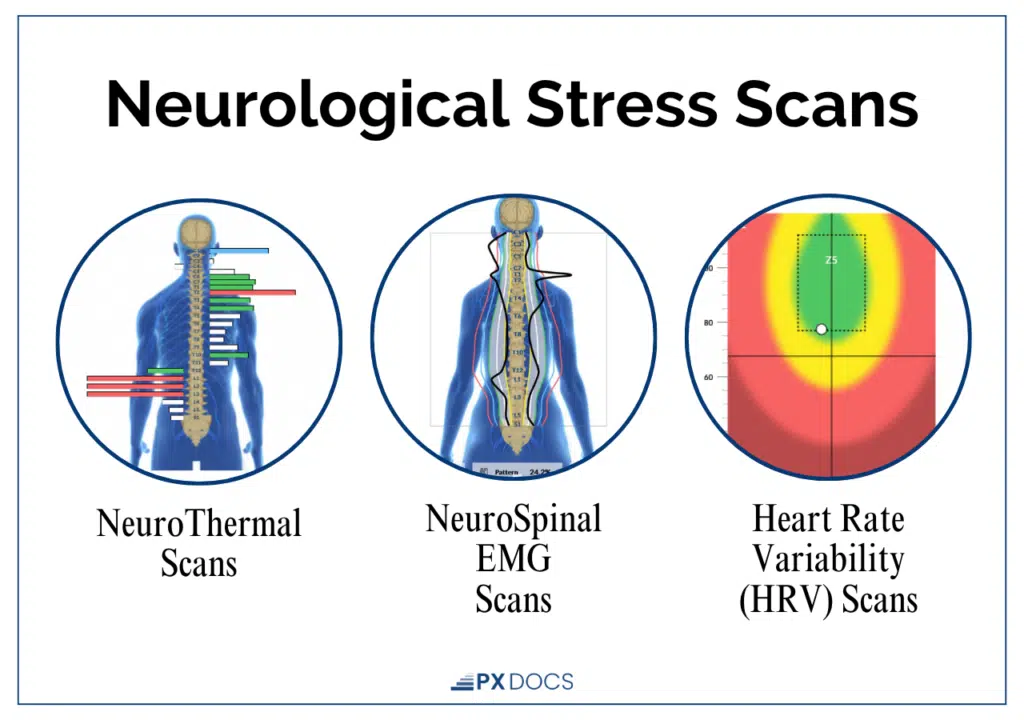
This is where guessing has to stop. Neurologically-Focused Chiropractic Care uses a three-part neurological assessment called INSiGHT Scanning, developed and owned by the Chiropractic Leadership Alliance:
- Heart rate variability (HRV) measures the balance between the sympathetic and parasympathetic branches, showing how much reserve a child has to shift into rest.
- Surface electromyography (sEMG) measures electrical activity along the neurospinal system, revealing patterns of tension, asymmetry, and disorganization.
- Thermal scanning uses infrared sensors to detect temperature differences that can indicate autonomic dysfunction.
To be clear: INSiGHT scans are not a treatment or a cure for any condition, not even back pain. They are an assessment. They measure function so that care can be directed at what’s actually dysregulated rather than at a guess. Care itself is never aimed at a diagnosis. It’s aimed at the nervous system interference underneath.
Your Child Isn’t Fighting You
A child who is tired but wired isn’t difficult, and you aren’t failing bedtime. Their body is exhausted, and their nervous system never got permission to stand down. That gap between the two is the whole problem, and it’s a neurological one.
We don’t guess. We test. A baseline set of INSiGHT Scans shows where your child’s nervous system sits right now: whether the sympathetic side is running hot into the evening, whether HRV shows enough reserve to reach the brake pedal, whether the tension patterns along the neurospinal system match the restless body you’re watching at 11 p.m. That’s the starting map.
The scans don’t stop there. As care unfolds, repeat scans at intervals tell us whether the system is genuinely reorganizing: HRV trending upward, neurological tone settling, the thermal picture evening out. When the data shows we’re on track, we keep building. When it shows something isn’t responding the way it should, we change the plan rather than asking you to wait and hope. That’s what keeps care anchored to what’s really happening inside your child instead of to how a given week happened to go.
Sleep is usually the first thing to shift, because sleep is where healing starts.
If your child has been exhausted and wired for longer than you can remember, and you’ve already tried everything the internet told you to, it’s worth finding out what their nervous system is actually doing. Find a trained PX Doc near you through the PX Docs directory and ask for a consultation that includes INSiGHT Scanning.