A fussy baby is a baby whose nervous system is having trouble settling. Most fussiness comes from a system that’s stuck in a stress response and can’t downshift into calm, comfort, digestion, and sleep on its own. While hunger, gas, tiredness, and overstimulation all play a role, persistent fussiness that doesn’t respond to the usual fixes is usually your baby’s nervous system signaling that it’s overwhelmed and struggling to regulate.
If you’re rocking, bouncing, feeding, swaddling, and shushing, and your baby still melts down anyway, you’re not doing it wrong. You’re exhausted, you’re second-guessing yourself, and somewhere along the way, someone probably told you “some babies are just fussy” or “they’ll grow out of it.” That answer never sat right with you, and your gut is correct to keep asking.
Here’s what most articles won’t tell you: fussiness, colic, gas, reflux, and trouble sleeping aren’t usually separate problems. They’re often the same problem showing up in different ways, and that problem lives in the nervous system. This article walks through the everyday reasons babies fuss, the signs that point to something deeper, and the root-cause explanation that’s been hiding in plain sight.
Why Is My Baby So Fussy?
Babies fuss because crying is their only language. In the early months, fussing is how an infant tells you something feels off, whether that’s hunger, a wet diaper, gas, fatigue, or too much stimulation. A certain amount of this is completely normal. Research tracking thousands of infants found that healthy babies fuss and cry an average of about 2 hours a day in the first 6 weeks, dropping to roughly 1 hour by 3 months.
So some fussiness is expected. The challenge is that “normal” covers a wide range, and parents are rarely given a way to tell ordinary fussing apart from the kind that signals a deeper issue. When a baby cries hard, arches, clenches, and won’t settle no matter what you try, that’s not the same as a quick grumble before a nap.
The nervous system is the boss of everything in those first months. It controls digestion, sleep, the ability to calm down, and the muscles your baby uses to latch and feed. When that system is regulated, babies tend to settle, eat, and sleep with relative ease. When it’s stressed and stuck on high alert, you get fussiness that no amount of bouncing seems to fix. Understanding that difference is the key to everything that follows.
What Are the Most Common Reasons Babies Get Fussy?
Most everyday fussiness traces back to a handful of normal causes that are usually easy to spot and resolve. Before looking deeper, it helps to rule these out, because meeting a basic need often ends the crying quickly.
Common reasons babies fuss include:
- Hunger: Newborns have tiny stomachs and feed often, especially during growth spurts. Look for rooting, hand-to-mouth, and lip-smacking before the crying starts.
- A dirty or wet diaper: Simple discomfort that’s quick to check.
- Gas and digestive discomfort: Babies swallow air during feeding and crying, and an immature gut can leave them bloated and uncomfortable.
- Tiredness and overtiredness: An overtired baby who missed their window is often harder to settle, not easier.
- Overstimulation: Bright lights, noise, and activity can overwhelm a young nervous system that can’t yet filter it all out.
- Temperature: Too hot or too cold will make most babies cranky.
- Needing closeness: Sometimes a baby just needs to be held and co-regulated with a calm caregiver.
When you meet the need, and the fussing stops, you’ve found your answer. The harder situations are the ones where you’ve checked every box, your baby is fed and clean and rested, and they’re still inconsolable. That pattern is worth paying closer attention to.
When Is Fussiness Normal?
Fussiness crosses from normal into concerning when it’s intense, persistent, and unresponsive to the usual soothing. Crying for three or more hours a day, several days a week, gets labeled “colic,” which affects up to a quarter of babies in the first six weeks of life. But here’s the part that matters: “colic” isn’t a diagnosis. It’s a description of a baby who cries a lot, with no explanation attached.
For decades, colic was treated as a mystery with no known cause and no real fix. That’s starting to change. A study published in Frontiers in Pediatrics compared 120 colicky babies to non-colicky babies and found that the colicky infants showed clear, measurable signs of nervous system dysregulation at the brainstem level, not just “extra crying”. The colicky babies scored dramatically higher on a clinical index of vestibular hyperactivity, and when researchers gently relaxed the tight muscles at the top of the neck, those scores dropped by 96.5%.
This is a consistent pattern we’re seeing in real babies, with real families, every day across the PX Docs Network. When a PX Doc identifies and corrects nervous system stress in a colicky baby, parents often begin to notice calmer stretches, easier feeds, and longer periods of sleep, even within those first few visits.
Translation: these babies weren’t just fussy by temperament. Their nervous systems were genuinely stuck in an overactive, irritable state. The signs parents notice but get told to ignore start to make sense in that light:
- Inconsolable crying that nothing seems to touch
- Constant arching of the back and stiffening
- A strong head turn or preference to one side
- Trouble latching, clicking while nursing, or feeding only on one side
- Spitting up, reflux, painful gas, or a hard, distended belly
- Almost no real sleep, just short catnaps
These aren’t six random problems. They cluster together because they share one root.
How Is My Baby’s Fussiness Connected to the Nervous System?
Fussiness is connected to the nervous system through the Autonomic Nervous System, the part that runs everything your baby can’t control on purpose: heart rate, digestion, immune response, and the ability to shift between stress and calm. Think of it like a car. The sympathetic side is the gas pedal (fight-or-flight, alertness, stress), and the parasympathetic side is the brake pedal (rest, digest, settle, sleep). A regulated baby moves smoothly between the two. A fussy baby is often stuck with the gas pedal pressed down and can’t reach the brake.
That brake pedal runs largely through the vagus nerve, the longest cranial nerve in the body, which carries calming “rest and digest” signals between the brain and the heart, lungs, and gut. Vagal tone, a measurable marker of how well that nerve is working, is closely tied to a baby’s ability to self-soothe, digest comfortably, and sleep. Research using heart rate variability to measure vagal activity shows that in a well-functioning system, vagal tone flexibly rises and falls to dampen stress and allow effective self-soothing. When that system isn’t working well, calming down becomes genuinely hard for the baby.
This is also why fussy infancy and later childhood diagnoses are connected. Babies who struggle with this kind of dysregulation early and often go on to experience Autism, ADHD, Sensory Processing Disorder, and pediatric dysautonomia. This co-occurrence isn’t a coincidence. All of these conditions share the same underlying thread: an autonomic nervous system stuck in sympathetic dominance, unable to find its brake. Pediatric dysautonomia, the broader term for this autonomic dysfunction, is the hidden root that ties early fussiness to later neurodevelopmental challenges. As clinicians who work with these kids put it, fussy babies don’t simply grow out of these patterns. Without help, they tend to grow into them.
What Causes a Baby’s Nervous System to Get Stuck in the First Place?
A baby’s nervous system gets stuck in stress mode through an accumulation of stressors that often begins before birth, a pattern PX Docs calls the “Perfect Storm.” Coined by Dr. Tony Ebel, the “Perfect Storm” describes how nervous system dysregulation builds in stages: prenatal stress, then birth trauma and intervention, then early childhood stressors, each layer adding tension to a developing system until it stays locked in fight-or-flight.
The biggest single factor is usually birth. Birth interventions like C-section, forceps, vacuum extraction, induction, a cord wrapped around the neck, or a long, stalled labor all place real physical strain on a baby’s delicate head and neck. That’s not a knock on any parent, and it’s not about blame. Many births require these interventions, and they save lives. But the physical stress on the upper neck and brainstem can create tension and interference in exactly the area where the vagus nerve exits the skull.
That interference shows up as subluxation, which involves three things: a physical misalignment, a loss of normal joint motion (fixation), and neurological interference that disrupts signaling between the brain and body. When subluxation sits in a baby’s upper neck, the brake pedal can’t fully engage. The system runs hot. The result is a baby who can’t calm, can’t digest comfortably, and can’t sleep deeply, which is to say, a fussy baby.
Clinically, this is the pattern seen over and over with babies who are super colicky or struggle to latch: a large share trace back to some form of physical stress at birth. The fussiness isn’t the baby’s personality. It’s a stressed system asking for help.
How Do INSiGHT Scans Show What’s Happening in a Fussy Baby?
Because the nervous system runs the show, the most useful thing you can do is actually measure how it’s functioning rather than guess. INSiGHT scans are a set of three gentle, non-invasive neurological assessments used in Neurologically-Focused Chiropractic Care: heart rate variability (HRV) to measure autonomic balance, surface electromyography (sEMG) to measure muscle tension patterns along the spine, and thermal scanning to measure autonomic function. Together, they give an objective picture of whether a child is stuck in sympathetic dominance.
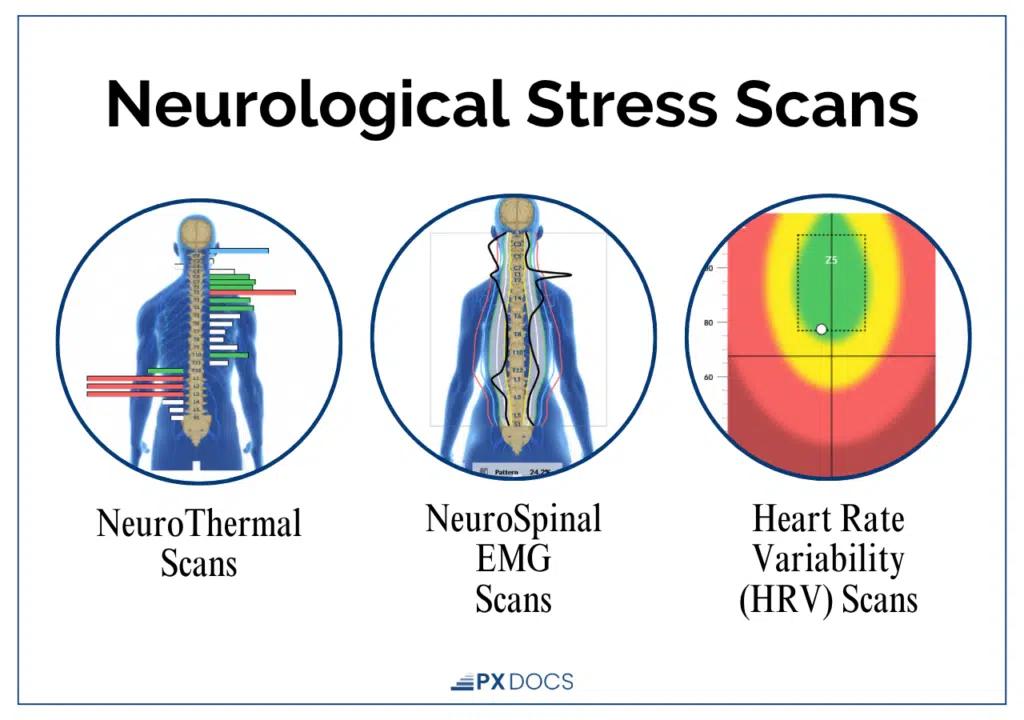
These scans don’t hurt and don’t require the baby to do anything. They simply read what the nervous system is already doing. For parents who’ve been told everything looks “normal” while their gut says otherwise, seeing dysregulation on a scan can be the first time that experience is validated with data.
It’s important to be clear about what these scans are and aren’t. INSiGHT scans are not a treatment or a cure for any condition—not even back pain. They’re an assessment tool that helps a trained pediatric chiropractor understand where the nervous system is struggling, so care can be tailored to that specific baby instead of guessing.
How Does Neurologically-Focused Chiropractic Care Help a Fussy Baby?
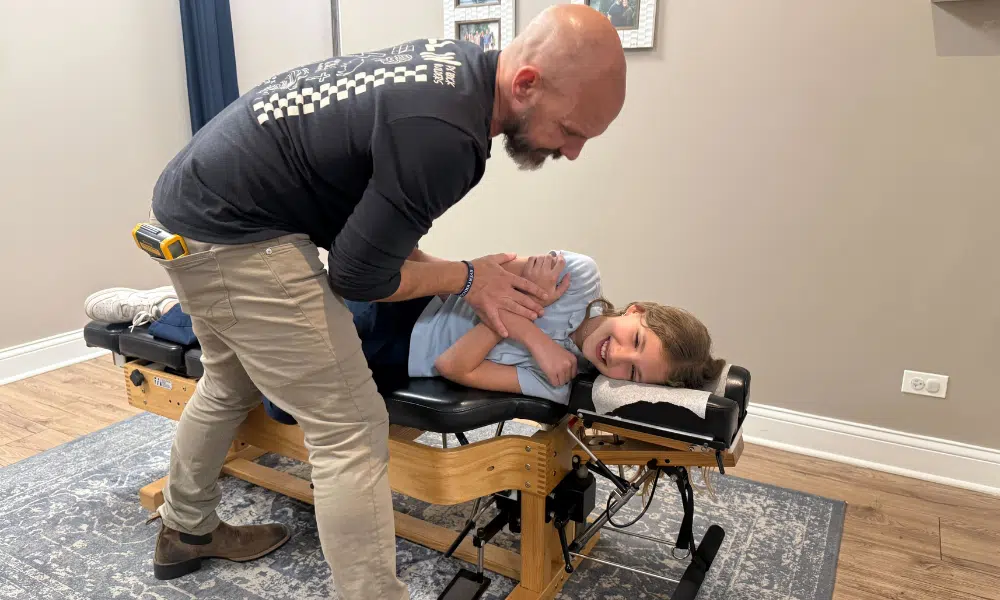
Neurologically-Focused Chiropractic Care helps a fussy baby by addressing subluxation and tension that interfere with the nervous system, so the brake pedal can engage again. Using extremely gentle, baby-specific adjustments (about the pressure you’d use to check a ripe tomato, nothing like adult chiropractic), the goal is to reduce interference in the upper neck and restore the system’s ability to regulate.
When that happens, the changes parents report tend to cluster, because they all come from the same source. As the nervous system shifts out of constant stress, babies often start to settle more easily, latch and feed more comfortably, pass gas and stool without the painful straining, and finally sleep. The point isn’t to “fix a fussy baby.” It’s to take the stress off a system that was never able to relax in the first place.
Take Peyton, for example. Her mom described the early weeks as nonstop crying — even mid-feeding, even while being held. Naps only happened in someone’s arms, and any attempt to lay her down ended within minutes. She’d tried the usual fixes, cutting dairy, sugar, and eggs from her own diet, and switching to a hydrolyzed formula, but nothing seemed to touch the root of the fussiness.
This time, with her third baby, Peyton’s mom started chiropractic care at six weeks old, earlier than she had with her other two kids. Within a week, she noticed a completely different baby: smiling, settling easily, and finally staying asleep once put down for naps. Today, Peyton eats well, naps well, and cries far less — proof, her mom says, that even the most exhausting stretches of fussiness can turn around once the underlying stress on a baby’s nervous system is addressed.
The research backs the mechanism. In the Frontiers in Pediatrics study, gently relaxing the tight upper-neck musculature produced a dramatic 96.5% drop in vestibular dysregulation scores, which aligns with what families experience when an irritable, overstimulated infant finally calms down.
How Long Does It Take for a Fussy Baby to Improve?
How long it takes varies from baby to baby, because it depends on how long the system has been stuck and how much stress it’s carrying. Some families notice their baby sleeping or settling better within the first week or two of care. For others, especially babies with a more involved birth history, the change is more gradual as the nervous system reorganizes over several weeks.
The encouraging news is that babies are remarkably resilient, and the earlier the nervous system gets support, the faster it tends to respond. A newborn’s brain forms more new connections per day than an adult brain does in a year, which makes infancy the most powerful window for change. This is also why so many practitioners encourage getting babies checked early rather than waiting to see if they “grow out of it.”
A good provider won’t promise miracles or a fixed timeline. They’ll assess your baby, explain what they find, and lay out a clear plan based on that specific nervous system, not a generic script.