
PANDAS tics are sudden, involuntary movements or vocalizations that appear in children after a streptococcal infection, resulting from an autoimmune response in which the immune system mistakenly attacks the basal ganglia, the brain region that controls motor function. They typically emerge overnight, often alongside OCD behaviors, anxiety, and regression in previously mastered skills.
One day, your child is fine. The next, they’re blinking uncontrollably, clearing their throat every few seconds, or repeating phrases they can’t stop. If you’ve been told “it’s just a tic, they’ll grow out of it,” you already know something deeper is going on.
Here’s what most sources won’t tell you. PANDAS tics aren’t just a neurological glitch triggered by strep. They’re the visible signal of a nervous system that was already struggling underneath the surface, and now an immune storm has pushed it into open dysregulation.
What Are PANDAS Tics?
PANDAS tics are involuntary motor movements or vocal sounds that appear suddenly in children following a Group A streptococcal infection, as part of Pediatric Autoimmune Neuropsychiatric Disorders Associated with Streptococcal Infections. They are one of the two hallmark symptoms required for a PANDAS diagnosis, along with obsessive-compulsive behaviors.
What makes them different from ordinary childhood tics is the dramatic, rapid onset. Most tic conditions develop gradually over months or years. PANDAS tics crash in overnight, often with such intensity that parents describe their child as “not themselves anymore.”
- Common motor tics: eye blinking, facial grimacing, head jerking, shoulder shrugging, arm or hand jerking, complex touching, or hopping.
- Common vocal tics: throat clearing, grunting, sniffing, coughing that isn’t from illness, repeating words or phrases (echolalia), and blurting out sounds.
The intensity tends to wax and wane, with “tic storms” during flare-ups and near-remission in between—only to roar back with the next infection, stressor, or immune trigger.
How Are PANDAS Tics Different From Tourette Syndrome?
PANDAS tics and Tourette syndrome can look nearly identical from the outside, but the mechanisms and courses differ significantly.
Tourette’s typically begins between ages 5 and 10, progresses gradually, and is associated with dopamine dysregulation in the basal ganglia.
PANDAS has an abrupt, explosive onset, usually traced to a strep infection within the prior four to six weeks, with tics appearing alongside OCD, separation anxiety, handwriting changes, and often bedwetting. Studies indicate PANDAS accounts for up to 25% of pediatric OCD cases.
What Causes PANDAS Tics in Children?
PANDAS tics are caused by a misdirected autoimmune response following a streptococcal infection, in which antibodies produced to fight the bacteria instead cross-react with brain tissue in the basal ganglia—the region controlling movement, behavior, and emotional regulation.
This process is called molecular mimicry, because the strep bacteria’s surface proteins resemble structures on the child’s own neurons closely enough to confuse the immune system. The resulting inflammation disrupts motor loops in the brain, and tics emerge.
But here’s the part most articles stop short of.
Not every child who gets strep develops PANDAS. So why do some children’s immune systems turn against their own brain while others recover uneventfully? The answer lies in what came before the infection.
Why Do Some Kids Get PANDAS Tics and Others Don’t?
PANDAS kids typically have a pre-existing foundation of nervous system and immune dysregulation that makes them vulnerable- what Dr. Tony Ebel calls “The Perfect Storm.” The strep infection isn’t the root cause; it’s the trigger that pushes an already-struggling system into open crisis.
“The Perfect Storm” is a concept developed by Dr. Tony Ebel describing the cumulative sequence of neurological stressors—prenatal stress, birth trauma, and early childhood toxic load—that can overwhelm a child’s developing nervous system, leading to subluxation, dysautonomia, and chronic health challenges.
In PANDAS kids, the storm typically includes:
- Maternal stress or inflammation during pregnancy that dysregulates the developing nervous system.
- Birth trauma from interventions like C-section, forceps, or vacuum that strains the upper neck and brainstem.
- A history of colic, reflux, ear infections, or repeated antibiotic use signals an already dysregulated immune system.
By the time strep arrives, the child’s nervous system is often already stuck in sympathetic dominance—gas pedal floored, brake pedal weak, vagus nerve compromised.
Children with PANDAS tics frequently share overlapping patterns with Autism, ADHD, Sensory Processing Disorder, and pediatric dysautonomia. This co-occurrence isn’t coincidental; all these conditions share the same foundation of autonomic nervous system dysfunction, poor vagal tone, and sympathetic dominance, which leave the brain and immune system unable to regulate properly.
What Is Subluxation and Why Does It Matter for PANDAS Tics?
Subluxation is a pattern of neurological dysfunction in the spine characterized by three components:
- Misalignment within the neurospinal system
- Fixation or restricted joint motion
- Neurological interference that disrupts communication between the brain and body.
For PANDAS children, subluxation matters because the upper cervical spine houses critical pathways for the vagus nerve, brainstem, and autonomic control centers. When there’s interference in this region, the vagus nerve can’t properly regulate inflammation; dysautonomia sets in—an imbalance within the Autonomic Nervous System where the sympathetic “fight or flight” response is overactive and the parasympathetic “rest, digest, and regulate” response is weak- and basal ganglia signaling gets noisier, producing more tics.
How Does Vagus Nerve Dysfunction Drive PANDAS Tics?
Vagus nerve dysfunction drives PANDAS tics through two connected pathways.
First, the vagus nerve is the body’s master regulator of inflammation—and when it’s offline, the neuroinflammation that triggers tics in the basal ganglia has no brake.
Second, the vagus coordinates the parasympathetic “rest, digest, regulate” state that allows the brain to calm motor circuits. Without that regulation, the child stays locked in high activation, where tics, OCD, and anxiety thrive.
Researchers have increasingly pointed to vagus nerve involvement as a common thread linking PANDAS to POTS, mast cell activation, and other autoimmune-adjacent pediatric conditions through the gut-brain axis.
What Does Conventional Care Look Like for PANDAS Tics?
Conventional care typically involves antibiotics for the strep infection, anti-inflammatories or immune therapies (NSAIDs, corticosteroids, IVIG) for moderate flares, and sometimes SSRIs or antipsychotics for symptom management.
These interventions can provide short-term relief and are appropriate in acute flares, but they rarely address the root nervous system dysregulation that made the child susceptible in the first place.
Research also shows up to 25% of pediatric antibiotic prescriptions are unnecessary, and repeated antibiotic exposure further disrupts the gut microbiome, which is directly tied to immune and nervous system regulation.
How Does Neurologically-Focused Chiropractic Care Address PANDAS Tics?
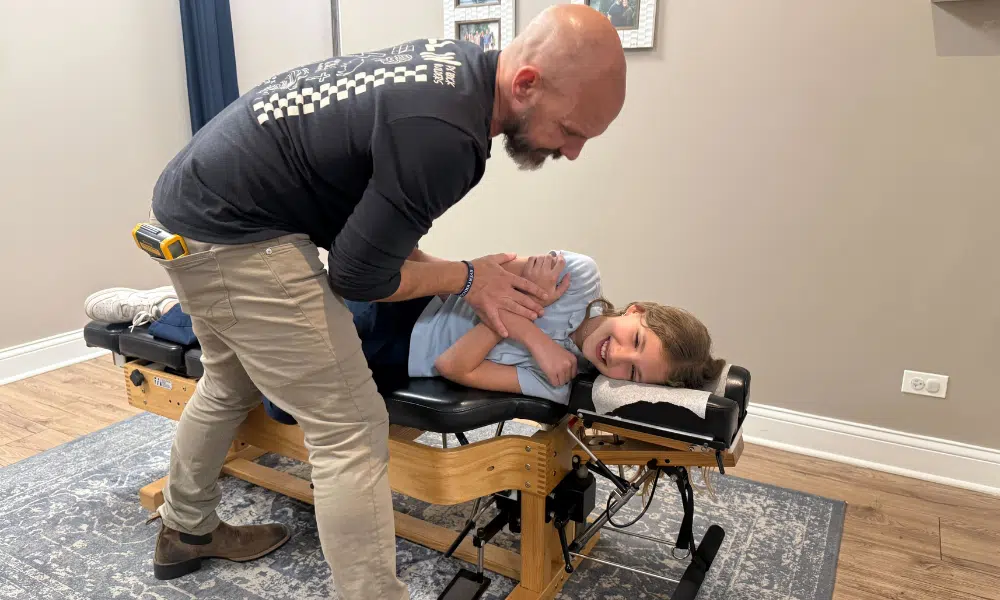
Neurologically-Focused Chiropractic Care addresses PANDAS tics by targeting the foundational layer conventional care often misses—the subluxation patterns and nervous system dysregulation that made the child vulnerable to the autoimmune storm in the first place. By restoring proper communication between the brain and body, improving vagus nerve function, and rebalancing the Autonomic Nervous System, care helps the child’s system become more resilient, less reactive, and better able to recover between flares.
It’s important to note that this technology does not diagnose medical conditions, and Neurologically-Focused Chiropractic Care is certainly not a treatment or cure for PANDAS or any other condition, not even back pain. Instead, these INSiGHT Scans help us track down the root cause of nervous system dysfunction and dysregulation, and build customized care plans and adjusting protocols to help shift the nervous system back into a state of balance, regulation, and resilience.
What parents typically see as the nervous system regulates:
- Fewer and less intense tic episodes
- Shorter recovery between flares
- Better sleep and emotional regulation
- Improved digestion and immune resilience
- Return of previously lost skills.
Caleb’s family knows this firsthand. After a PANDAS diagnosis brought major motor tics, mood swings, and focus struggles that left him feeling like an outcast at school, his family found their local PX Doc and finally felt heard again. With a customized care plan and continued care, his mom reports his tics have decreased by 90%, his grades are climbing, and his mood is far more stable.
What Are INSiGHT Scans and How Do They Help with PANDAS?
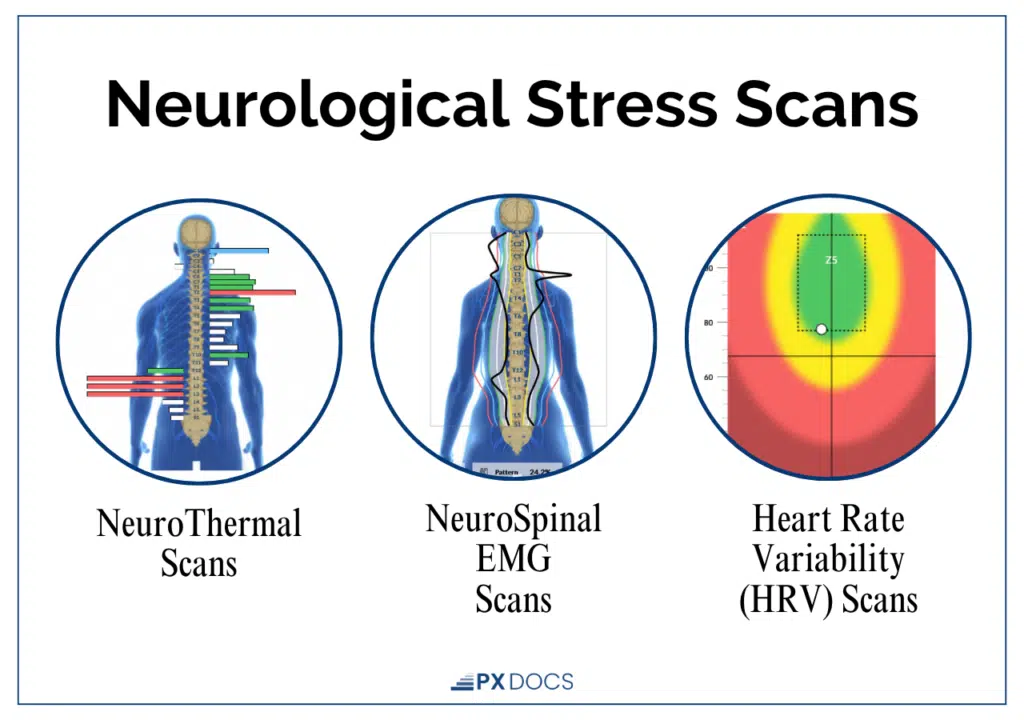
INSiGHT Scans are a set of three neurological assessment technologies used by Neurologically-Focused Chiropractors:
- NeuroThermal scans (infrared thermography)
- NeuroCore sEMG scans (surface electromyography)
- Heart Rate Variability (HRV) testing.
Together, they objectively measure nervous system function, subluxation patterns, and autonomic balance.
For PANDAS families, these scans finally answer the question parents have been chasing: what’s actually going on in my child’s nervous system, beneath the surface of the symptoms?
HRV measures the gas-pedal/brake-pedal balance and tracks whether the autonomic system is shifting back toward regulation. NeuroThermal scans reveal where subluxation is interfering with autonomic function. NeuroCore sEMG measures the muscle tone patterns consistent with chronic fight-or-flight activation.
Together, they give families an objective map—not a diagnosis of PANDAS, but a clear picture of the dysregulation underneath.
Moving Forward with Hope for Families Navigating PANDAS Tics
PANDAS tics aren’t a life sentence. They’re a signal that something deeper in your child’s nervous system needs attention, and that the body has the capacity to heal when the root causes are finally addressed. “The Perfect Storm” that set the stage can be unwound. Subluxation can be corrected. The vagus nerve can come back online.
Work with a PANS/PANDAS-literate provider for acute care, and consider adding a Neurologically-Focused Chiropractor to your team to address the foundational nervous system regulation that makes long-term recovery possible.
To find a qualified practitioner in your area, visit the PX Docs Directory and begin the conversation.