

There’s a question I get from parents more than almost any other. It usually comes in a whisper or as a long message typed late at night, after the kids are finally asleep. It sounds something like this:
“I feel like I need to stop giving my child so many supplements… but stopping any of these is terrifying. What should we be watching for?”
I call it the million-dollar question. Not because it’s complicated — but because everything hinges on how you answer it.
Here’s the question underneath the question: When your child seems to need a supplement to function, is that a sign the supplement needs to stay? Or is it a sign your child’s body became dependent on the supplement to do the job the body was designed to do itself?
One of the primary reasons that millions of families have moved away from medication, and do all they can to save those as a last resort, is because they do not want their child to be dependent upon them. Therefore, it’s important we sit with those questions above, because the answer changes everything about what you do next.
The 30,000-Foot View of Wellness in 2026
Let me paint the picture of where so many of us have landed.
Perfect diet. Zero toxins. Sauna in the morning, cold plunge at night. Red light. Grounding mats. A supplement shelf that runs into the thousands of dollars. And somewhere in the back of your mind, a low hum that says: if I just find the next thing, the right thing, then maybe…
I’m not mocking it. I live in this world. I love this world. But I’ll tell you what I’ve watched happen, over and over — the further we travel down the natural, holistic, functional, biomedical road, the easier it becomes to lose sight of home base. We get so good at adding that we forget the body was built to do most of this on its own.
There really is such a thing as too much of a good thing.
I Didn’t Always Teach It This Way
I want to be honest with you, because this isn’t a theory for me. It’s a confession.
There was a season in my career — I call it the Multidisciplinary Clinic Phase — where I ran a fully integrated practice. We stacked everything. Neurologically-Focused Chiropractic Care plus functional neurology plus biomedical protocols plus aggressive supplementation. On paper, it should have been the best of every world.
And you know what I watched? Results got worse.
Not better. Worse. The kids who were the most sensitive — the ones we’ll talk about in a minute — got more dysregulated, not less. It took me a long time and a lot of humility to admit what was happening. “Less is more” wasn’t a slogan I read somewhere. It was born out of my own clinical failure and the correction that followed.
So when I tell you to consider pulling back, I’m not coming at you from some ivory tower. I’m coming at you as the guy who built an entire clinical model around the theory that “more is better” and then had to break it all down, shut it all down, and essentially start over again at square one.
Clean Contrast — Not an Attack
Let me say something clearly, because I don’t want to be misread.
I am the biggest fan of all the 3+ hour, deep-dive podcasts. I love that parents and patients today want to learn about MTFHR, methylation, mitochondrial dysfunction, and more.
I love the parents and providers asking hard questions and refusing to accept “he’ll grow out of it.” They always knew in their gut those answers didn’t add up — and now they have access to droves of information that proves just how right that instinct was.
The functional and biomedical world is genuinely excellent at things conventional medicine ignores entirely — the gut, the microbiome, nutrition, toxins, inflammation. Real depth there. Real value.
So this is not me throwing anyone under the bus.
But I have to be honest about a pattern I see constantly. There’s a cookie-cutter version of the functional model that goes like this: run the lab, match it to a protocol, hand the family a pile of supplements (and maybe a laser too). And if you look closely, the supplements are just quietly taking the place of medication. Different bottle. Same outside-in trap. As I’ve said before — they swapped Big Pharma for Big Supplement.
Here’s the fair part, and I mean this. The advanced, individualized functional providers I actually collaborate with? They’d read this and say preach it and teach it.
They want the nervous system foundation handled first — they refer those cases to us. The only people this challenges are the cookie-cutter operations whose entire business relies on parents not knowing what I’m about to tell you. That’s the line in the sand. And it has nothing to do with shaming you for what you’ve tried.
One more layer, specifically on functional medicine: most functional providers have real, earned depth in gut, immune, and inflammation work. But when it comes to true neurological cases — epilepsy, ADHD, anxiety, OCD, autism, sensory processing, PANS/PANDAS — they often don’t grasp just how sensitive a Perfect Storm kid is to supplementation. And that sensitivity is the whole ballgame.
Why Supplements Can’t Lead: The Dependency Science
Okay. Here’s the neuroscience at the core of this whole conversation. Stay with me, because once you see this, you can’t unsee it.
Supplements are an outside-in influence. They can support a dysregulated system. And they can absolutely support remediation (more on that later). What they cannot do is create foundational regulation. Regulation lives on the inside — in the wiring, the reserve capacity, the organization of your child’s nervous system.
So what’s the actual goal? Not dependence. The goal is neurological stability — and its two first cousins, resilience and adaptability. Notice the word that is not on that list: dependence. That’s the word we’re trying to design our way out of.
Now here’s the mechanism, and this is the heart of the whole episode.
Today’s supplements are potent. Genuinely powerful. And the body is brilliant at adapting to whatever you give it consistently — it balances out the dose. Give it a strong outside signal every single day, and it gradually turns down its own production to compensate. The clearest example is melatonin. Give the body melatonin from the outside, night after night, and it starts to expect it from the outside — and quietly powers down its own internal factory.
The same principle is why a runner’s “easy pace” keeps getting faster, and why someone’s tolerance to alcohol climbs over time. Dose-response works for good things and bad things alike. The body always adapts to the dose.
This is exactly why neuro supplements deserve extra caution. What are they actually doing? Two main things:
The first group is trying to rebalance neurotransmitters — the very same target as Ritalin, Concerta, Prozac, and Zoloft. Now, the supplement versions are usually safer, smoother, and have fewer side effects, and I’d choose them over the pharmaceutical every time. But make no mistake: they’re capable of the same kind of neurophysiological dependency.
The second group — magnesium, zinc, ashwagandha and friends — is trying to add a calming response to an overactive stress system. And those can be wonderful. But the deeper question is the one almost nobody asks: why is the nervous system stuck on overdrive in the first place? Can we hit the reset so there isn’t such a relentless demand for the calming chemicals from the outside?
Like we’ve said before, stay with me all the way through this article because it gets a bit extra tricky with this second group. Used too early and on top of an unstable foundation, things like magnesium, zinc, and ashwagandha will look like they’re not doing any good at all. But when you choose the right product and deliver it at the exact right time in the healing sequence, they are incredibly powerful and helpful in just the right way.
The Inside-Out Answer: Foundation First
So if supplements can’t lead, what does?
Picture a baseball team. I grew up playing baseball, so I’m going to have some fun with this one. Simply put, you don’t put the big fat guy who mashes homers in the leadoff spot. The leadoff spot goes to the short, scrappy, do-whatever-it-takes to get on base guy. When he gets on base, the big hitters come into play next and bring him home! That’s how you score runs in baseball.
Or picture a contractor walking into a house with a cracked foundation. No good contractor brings in the painters, covers up the cracks in the foundation, and starts remodeling the kitchen on a foundation that’s still shifting. You stabilize the foundation first. Always.
The foundation, in your child, is the nervous system.
Neurologically-Focused Chiropractic Care addresses that foundational root. And here’s the part people miss — the adjustments themselves don’t do the healing. They’re the catalyst. It’s the combination of time, repetition, and neuroplasticity — the full series of care — that allows the nervous system to reset, reorganize, and regulate. That’s why it’s long-lasting and not dependency-forming. It’s the direct opposite of the supplement that has to keep coming back to keep working.
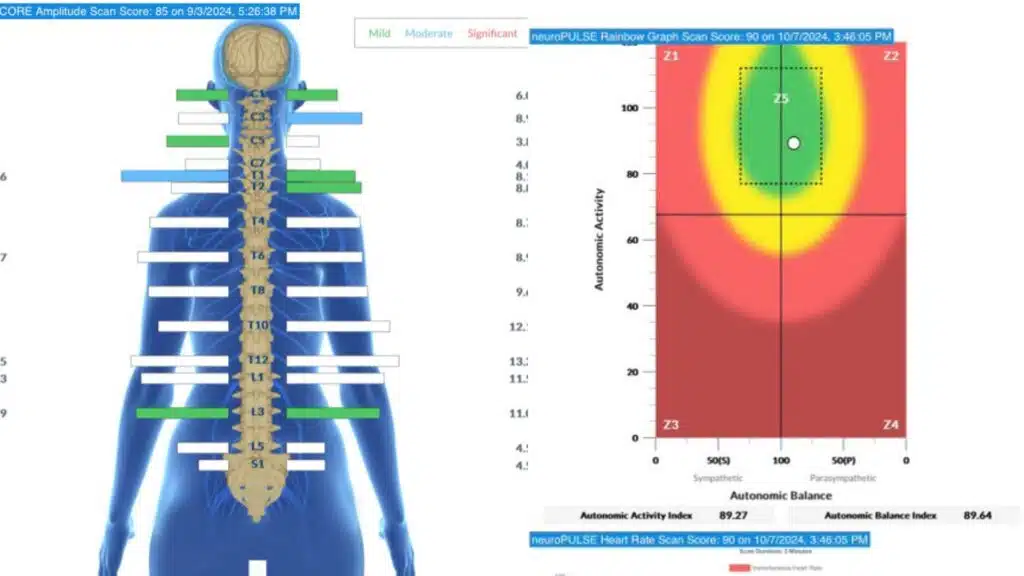
And we don’t guess — we test. This is where INSiGHT scanning comes in. The scans show us, objectively, when a child’s system is starting to regulate and stabilize on its own. That’s the green light. That’s the moment you can begin pulling supplements back without blowback — because the nervous system is now doing the job the supplement was doing. That’s not regression. That’s growth.
The Missing Map: Where Is Your Child Actually At?
Here’s where I want to give you the thing almost nobody ever hands a parent.
Most families have been told what to try. Diet, this therapy, that supplement, this protocol. What almost no one gives them is the sequence — the order and timing that decides whether any of it actually works. And that’s the whole game, because here’s the truth that took me years to learn:
The same intervention can fail in one phase and flourish in another. Not because the supplement or therapy changed. Because your child’s nervous system has changed.
That’s not a small idea. Doing the right things in the wrong order is the single biggest reason so many kids stay stuck while their parents are doing everything right. So let me show you the map. We use a 4-Phase Healing Model, and once you see how it’s built, you’ll start to sense exactly where your child is right now — and that tells you what to do next, what to wait on, and what maybe not to do at all just yet.
Phase 1 — Restoration & Repair
Restore regulation. Rebuild the foundation.
This is the starting point for nearly every child. The focus is on repairing the foundational neurological dysfunction — subluxation — that keeps the nervous system locked in exhausted, dysfunctional survival mode. Through Neurologically-Focused Chiropractic Care, the goal is to move the system out of survival physiology and into a regulated, stable state. And the first signs it’s working show up in the body before the brain: better sleep, digestion, breathing, immune strength. This is exactly where the Core Four basics belong — and where the heavy neuro-support and detox supplements do not.
Phase 2 — Reorganization & Integration
Teach the child to use that new and improved foundation.
Once the foundation is stable, the work shifts to reorganizing proper neuro-sensory-motor patterns and unwinding the compensations and workarounds the body built just to survive.
This is where we shift our adjusting protocols to be more reorganizing and reconnecting in nature, and also where movement-based therapies can finally take root — PT, OT, speech, and sensory work become far more effective now than they ever could have been before the nervous system was ready for them.
Phase 3 — Remediation & Detox
Clean up and clear out what the storm left behind.
This is the phase that addresses the downstream burden — toxins, heavy metals, mold, gut and immune stress — that years of dysregulation left in their wake. This is where most of the neuro-potent and detox supplements you’re worried about actually belong — here, on a regulated foundation, not at the very beginning.
Attempting this before Phases 1 and 2 is the single most common “wrong order” mistake, and it’s exactly why a sensitive kid gets worse instead of better. When the foundation is genuinely ready, the rule is slow, gentle, less-is-more — never overwhelming a system that’s only recently found regulation.
Phase 4 — Wellness
Support and enjoy resilience for life.
The long game — a child living a thriving life, with a nervous system functioning well, a trajectory pointed toward lasting health, adaptability, and reserve capacity.
Do you see what this map does to the supplement question? It answers it. That pile of bottles you’re staring at isn’t good or bad — most of it is just out of sequence. The detox and methylation work that’s overwhelming your child today might be exactly right in Phase 3. And the reason it’s backfiring now is simply that the foundation underneath it isn’t ready yet.
The Practical Answer: When to Start, What to Watch, When to Pull Back
Let me get concrete, because I know that’s what you came for.
In my experience, the parents asking this question fall into three camps:
Camp one — you’ve seen no real progress. You’re spinning your tires, spending the money, and nothing’s moving.
Camp two — your gut is telling you it’s actually making things worse. More sensory issues. Gut went sideways. More seizures, not fewer.
Camp three — you’re genuinely seeing progress, but you’re worried that the forever-dependency itself is the warning sign.
Here’s the thing: all three camps arrive at the same place. All three are a signal to pause and check the foundation — to ask which phase are we really in, and am I trying to run a Phase 3 play on a Phase 1 nervous system?
What to watch when you add, remove, or change anything
This is your concrete checklist. When you change a supplement, watch — in this order:
- Sleep quality — falling asleep easier, staying asleep longer, more restful sleep
- Digestive motility and immune strength — yes, that means pooping and how often they’re getting sick
- Stress tolerance — emotional recovery, how they handle transitions
- Body signals — movement and postural patterns, tension, breath-holding, generally looking more stressed in their own skin
And know this: the neuro-potent supplements are the ones most likely to stir things up when you change them. That’s the detox and methylation category — biocidin, chelation, oxygen-based products — and the B-vitamin family — B12, leucovorin, the nervous-system box. Those are the ones most likely to worsen sensory issues, sleep, behavior, tics, and seizures. Handle those with the most care — and notice, those are your Phase 3 tools, which is exactly why they often backfire when they’re introduced too early.
The two-week protocol
This is the part I most want you to hold onto, because it’s where panic usually wins, and it shouldn’t.
If you pull a supplement and digestion slows down or immunity dips — don’t panic and run right back to the bottle. Instead, take nervous system care up to the nines for two weeks. Extra adjustments. An updated scan. Give the body a real runway to reactivate its own neuro-gastric motility and neuro-immune mechanisms — the systems that were always supposed to do this job.
Then, after those two weeks, if the symptoms are genuinely still there? Bring the supplement back. No shame, no failure. But more often than you’d believe, it turns out the supplement wasn’t truly needed — the body just hadn’t been given the chance to learn the job yet.
What NOT to panic over
A rough day. A growth spurt. A stressful week with a big test or a schedule blowup. Those are life, not regression. Don’t tear apart the whole plan over a hard Tuesday.
The reframe
Here’s how I want you to see pulling back. It isn’t stopping something your child needs. It’s clearing space — in your budget, in your exhausting daily schedule, and literally inside your child’s body — for the healing mechanisms that matter most. You’re not taking something away. You’re making room.
One honest caveat
If you’re working with a truly individualized provider — someone personalizing every recommendation to your child and their phase — you may genuinely never hit “too many supplements.” The problem I’m describing isn’t supplementation itself. It’s the every-symptom-gets-its-own-one-two-three-supplements model, applied with no regard for sequence. That’s the trap.
Don’t Throw the Baby Out: The Core Four
Now let me say this out loud, because I never want to be misheard: this is NOT “all supplements are bad.” I don’t want anybody throwing the baby out with the bathwater.
In my own house, we think about it as two shelves.
The lower shelf — the Core Four. These are the daily basics, and the research on them is clear:
- A whole-food multivitamin
- An effective (not crazy, not megadose) probiotic + gut support
- Omega-3s — fish oil or cod liver oil
- Vitamin D
Four in winter. Three in summer — drop the Vitamin D when the sun comes back and your kids are outside in it. These, we genuinely need on a daily basis. And notice — these are the one category that’s foundation-safe from day one. They can gently support your child all the way back in Phase 1, while everything else waits its turn.
The in-between shelf — neuro-support. This is magnesium, zinc, B vitamins, ashwagandha, etc. And here’s the rule: these are for phases or seasons, not for life. A hard sports-training block. The two weeks of final exams. Short runs, with purpose. What creates dependency — and what burns out their potency — is running these all day, every day, 24/7/365. That’s exactly the pattern we’re trying to avoid.
A quick, honest note on sourcing
If you’re going to keep the Core Four on the shelf, source them from somewhere clean and trustworthy. The practitioner line I personally stand behind for sourcing those foundational basics well is Kingdom Health Sciences. That’s a clinical recommendation with my name behind it — and I’m deliberately keeping it to the foundational, phase-safe basics.
The gut-detox and neuro-support pathway they also offer? That belongs to the Phase 3 conversation, once your child’s foundation is genuinely ready for it — never to be thrown at a dysregulated system, hoping it sticks.
And that’s the bigger map: foundational whole-food macros first, then neuro and gut support, then detox — slow, gentle, its own whole conversation. Always in that order. A before B. Always.
So… Where Is Your Child Right Now?
Read these and just notice how many feel true for your child right now. Be honest — there are no wrong answers, only useful ones.
Foundation signs (Phase 1):
- Sleeping noticeably better than a few months ago
- Digestive motility and elimination have improved or stabilized
- Getting sick less often, or bouncing back faster
- INSiGHT Scans showing measurable improvement (HRV, Thermal, EMG)
- The big meltdowns and “wound up + worn out” crashes are less frequent
Stability signs (Phase 2):
- Can handle a little more activity, input, or change without falling apart
- PT, OT, or speech is starting to “stick” better than before
- Forward motion in coordination, motor skills, or communication
Readiness signals (Phase 3):
- The progress is real — but your gut says there’s still something underneath
- Calmer overall, yet keeps cycling back into “wound up” mode
- History points toward gut, immune, inflammatory, or toxic burden
If you’re checking mostly the first group, your foundation is still forming — and that’s wonderful. It also means the priority is staying the course on Phases 1 and 2. Remediation can wait; pushing it now is the exact “wrong order” that backfires.
If you’re strong across all three groups — especially that swing back into “wound up” mode after real progress — that’s often a re-energized nervous system that finally has the capacity to notice what it was too exhausted to deal with before. That’s the moment to confirm with your provider, because readiness is something we test, not guess.
And hear me on this: that self-check is a compass, not a diagnosis. It’s built to help you have a better conversation with your doctor — not to replace one. The whole point of this model is that sequence and timing are individual, and the safest, most effective next step is always a real clinical decision made with your PX Doc.
Your Next Step
You don’t have to figure out your child’s phase alone — and you definitely don’t have to figure it out by drowning in other parents’ stories of what worked for their kid.
First, find your PX Doc. If your child isn’t yet under Neurologically-Focused Chiropractic Care, that’s the real starting line. A PX Doc can run the INSiGHT Scans and tell you — objectively, not by guesswork — exactly which phase your child is in and what comes next. Everything in this article depends on knowing where you actually stand, and that’s something we measure.
Then, take the self-assessment. Already under care, or want to walk in with a head start? Take our 4-Phase self-assessment quiz. It’ll help you locate your child on the map and deliver our free 4-Phase Healing Model guide — so you can read your child’s progress like a pro and have a sharper, more confident conversation at your next visit.
Your child isn’t stuck. They’re in between phases. And now you know how to find out which one comes next.
Expect Miracles. Every Patient Counts.
— Dr. Tony Ebel + The PX Docs Network
Always work directly with your chiropractic doctor to review your child’s specific supplement list — what to keep, what to pause, what to add — based on their neurological scans. None of this replaces individualized care.