
If your child had an adverse reaction, you already know the question. You’ve asked it at 2 a.m. with the monitor on and the lights off. You’ve asked it in the parking lot after another appointment where nobody had an answer for you.
Why my child?
Why did my baby, who was crawling and babbling and pulling up on the coffee table, come home from that appointment, spike a fever, scream all night, and then just… stop? Why did their gut fall apart? Why did the sickness start piling on and never really let up? And why is the kid down the street, same age, same schedule, same shots, running around like nothing ever happened?
You’ve probably been given two responses to that question. Either it didn’t happen, or it was bad luck and bad genes. Neither one is an answer. And after almost two decades of sitting knee to knee with families, taking case history after case history, I can tell you there’s a much better answer available. It’s just that almost nobody is asking the question in a way that gets you there.
So let’s ask it properly today.
The Question Nobody Is Asking
Here’s what should be obvious and somehow isn’t: in the vaccine conversation, parents should be allowed to ask questions. Encouraged to, actually. Any time a conversation gets shut down instead of opened up, that alone tells you something worth paying attention to.
But I want to point at a specific gap, because it’s the one I care about most.
Even among the people who are wide open to questions, the researchers, the attorneys, the doctors, the parent advocates, I’ve asked this one over and over: why do you think some kids react so severely, and others don’t? And it lands as the hardest question in the room. Not the safety question. Not the schedule question. This one. The differential question.
Why are we giving the same dose on the same schedule to every child when we already know their genetics, their pregnancy, their birth, their gut, their immune function, and their neurodevelopment are all different going in?
Nobody has done the research to answer that, because research follows questions. Somebody has to ask first. So I’m asking, and I’m going to give you the best answer I have, from the place I actually have it.
Where I’m Teaching From Today, And Where I’m Not
I want to be straight with you before we go one paragraph further, because you deserve to know what kind of information you’re getting.
I don’t have randomized controlled trials for you today. I don’t have a meta-analysis to link in the show notes. When I have that kind of evidence, I teach from it, and I cite it. Today I don’t, because the question hasn’t been studied.
What I have is our brick-and-mortar practice. Thousands of case histories. The granular details of what shows up on intake paperwork, in chronological order, again and again and again, before the day the parents circled on the calendar.
That’s evidence too. Clinical observation is a real part of evidence-based care, right alongside published research and the parent’s own experience and preferences. It’s the part that generates the questions the research eventually gets around to testing. I’d love nothing more than for real studies to be done on what we see. Until then, I’m going to tell you what we see and be clear about exactly what it is.
Both Sides of a Coin, And You’ve Only Been Shown One
When a family comes in and tells me about their child’s adverse reaction, they’ve usually done their homework. They can tell me the ingredients. They can tell me about adjuvants and preservatives, the number of doses on the schedule, and how young their baby was. They’ve read about allostatic load, that idea of total accumulated stress on the body. Many of them have found out their child carries genetic variants that limit detox and methylation pathways.
And they land where almost everyone lands: it was the toxic load. Too much, too early, too often, and their child’s body couldn’t clear it.
That’s one side of the coin. It’s the side you already know, and I’m not here to argue with it. Is our environment more toxic than it was a generation ago? Yes. Are kids getting more exposures earlier and more often? Yes. You knew that in your gut before anyone confirmed it for you.
But there’s a second side to that coin, and I’ve almost never heard anyone talk about it.
Any reaction, to anything, is a function of two variables. Not one. There’s the size of the stressor coming in. And there’s the capacity of the system receiving it.
We have talked about the stressor for thirty years. We have barely said one word about the capacity.
Health Is Not the Absence of Symptoms
Before I can explain the capacity side, I need you to let go of a definition you’ve been handed your whole life.
Most of us were raised to believe that healthy means “nothing is currently wrong.” No fever, no diagnosis, no complaints, healthy kid. That’s the definition the conventional model runs on, and it’s the reason so many families get blindsided.
Real health isn’t the absence of stress or the absence of symptoms. Real health is capacity. It’s how much stress a child’s system can absorb and still hold its shape.
In our world, we call that reserve capacity. You’ll also hear it called adaptability or resilience, and for our purposes, those all point at the same thing. Think of it as slack in the system. Fortitude. Room in the bucket before it overflows. Strength in the camel’s back before that last straw does anything at all.
Here’s why this matters so much for the question we’re asking. Two children can walk into the exact same appointment on the exact same day and receive the exact same thing. One has a full battery of reserve capacity. The other has been running near empty for eighteen months. Same stressor in. Wildly different outcome out.
And capacity is not random. It gets built, or it gets drained, starting well before birth. Which means it leaves a trail. That trail is sitting right there in the case history, and it is the single most overlooked document in pediatric health care.
What We Find in the Case History
This is what we call doing our “Perfect Storm” work.
We don’t wait for the diagnosis. We don’t wait for the symptoms. We swim upstream and look at what was already happening in that child’s nervous system development before anything went visibly sideways. When we do that with families whose children had adverse reactions, three factors show up so consistently that you can’t unsee them.
Factor One: A High-Stress Fertility and Pregnancy Journey
We ask about the fertility journey first. Sometimes there was IVF, or Clomid, or rounds of hormone therapy. Thank God those options exist for families who need them. But where there’s a long medicalized fertility road, there’s almost always a mountain of stress riding along with it.
Then we ask about the pregnancy itself, and this is the hardest part of my job. Because most moms, asked casually, will tell you it was fine. The world has normalized being wound up and worn out at the same time. Being pregnant today can feel less like being celebrated and more like being diagnosed, with a test and a scan and a warning around every corner.
So we ask differently, with enough compassion and enough time for a mom to tell the truth for once. And what comes out is: we lost my dad that spring. Work was brutal. We were financially underwater. My marriage was struggling. I was in school. And I never told anyone how bad it got.
In our practice, we see meaningful fertility or pregnancy stress in the majority of these case histories. Why does that matter neurologically? Studies have shown that sustained prenatal stress shifts mom’s nervous system into sympathetic dominance. Gas pedal down, brake pedal barely working. And baby is developing inside that environment.
The nervous system is one of the first things to form after conception. The neural tube, the brainstem, and the central and Autonomic Nervous System come online first because they’re the systems that tell every other system what to do, how to do it, and when. The nervous system is the mom of the body. Gut, immune function, sensory processing, motor tone- everything downstream takes its instructions from there.
There’s real research pointing this direction. A 2017 study out of UC San Francisco followed 151 pregnant women and found that infants of the highest-stress mothers were measurably more reactive and, notably, showed poorer recovery from stressors. Less resilience. Measured through heart rate variability.
Poorer recovery from stressors. Sit with that phrase for a second, because that’s exactly what we’re talking about.
Factor Two: Birth Trauma and Birth Interventions
Next question in the chronology: how was labor and delivery? What interventions were used?
Forceps. Vacuum extraction. Long labor with a hard pushing stage. Induction. Emergency C-section. This is the factor with the best literature behind it, and it’s the one most often missed entirely, because it’s hidden in plain sight. Everybody knows the birth story. Almost nobody connects it to the neurology.
Physical stress on the upper neck and brainstem region during delivery can create what we call subluxation: misalignment, fixation, and most importantly, neurological interference. All three components. It isn’t just a bone out of place; it’s altered communication in the neurospinal system at the exact location that runs the show.
That location is the brainstem, the cerebellum, and the vagus nerve. Air traffic control for the entire central and Autonomic Nervous System. Motor tone and coordination. Motor planning and milestones. Eye control and balance. Digestion and motility. Immune modulation and inflammation control. Detox and elimination. Social and emotional regulation. Speech and communication. When air traffic control is degraded, every flight in the airport runs late.
In our clinic, birth intervention or birth trauma shows up in the case histories of children who later had adverse reactions at an even higher rate than the pregnancy factor.
Factor Three: Early Struggles That Everyone Called Normal
Then we ask about the first weeks and months, and this is where parents often go quiet, because nobody ever asked them these questions in one sitting before.
How was latching and nursing? Breastfeeding matters for nourishment, obviously. But it’s also co-regulation, one nervous system helping another one learn to settle. That’s capacity being built.
Was your baby colicky? Refluxy? Arching and screaming and never comfortable? Constipated? Eczema? Did they sleep terribly? Did they catch every cold and hold onto it for weeks instead of days? Did the colds turn into ear infections? Did the ear infections turn into antibiotics, and then more antibiotics, and then steroids and nebulizers for croup or RSV?
In the pediatrician’s office, every one of those gets filed under normal. Colicky baby, normal. Chronic ear infections, normal; we’ll do tubes. Constipation managed with MiraLAX, normal. Sensory overload, hard transitions, skipped crawling, late speech, all of it gets a shrug and a “they’ll grow out of it.”
Those aren’t quirks; they are a nervous system telling you, early and often, that it’s already running on empty. Sleep, digestion, immune function, and motor development are the four foundational outputs of a regulated system. When those are struggling in the first year, capacity is low. That child isn’t healthy and symptom-free. They’re depleted and undiagnosed.
Which means when that child walks into an appointment at twelve or eighteen months, they are not walking in with a full battery. They’ve been drawing on an overdrawn account for a year.
I’ve taken a very small handful of case histories over almost twenty years where a child had a significant adverse reaction, and none of these three factors were there. A small handful. That’s the pattern, and it’s the reason I keep talking about this.
Why the Nervous System, And Not the Gut or the Immune System?
A lot of thoughtful parents get most of the way here and stop one system short. They conclude their child’s gut wasn’t strong enough, or their immune system was already dysregulated, or their detox pathways were limited.
All of that can be true. But it raises a better question: why were those systems struggling in the first place?
The gut is not more important than the brainstem. The immune system is not more important than the vagus nerve and the Autonomic Nervous System. Those are downstream systems, and they take their orders from upstream. You can spend years and a small fortune supporting the subsystems, and I understand exactly why families do: they’ve been told to work on the gut, methylation, the microbiome, the diet, the supplements, and the therapies. Some of it helps.
But if the system that runs all of those is offline, you’re renovating rooms in a house with a cracked foundation.
So the question isn’t just “was my child’s gut ready?” The question is: what was the functional state of my child’s nervous system that day? What was its reserve capacity? And nothing in a standard well visit measures that. Height, weight, a few developmental questions, and on to the next thing. Nobody checks the one system that determines how the whole body handles anything.
The Algorithm, Said Plainly
Let me put the whole thing on a whiteboard for you.
More Perfect Storm™ factors in the case history means more subluxation, more sympathetic dominance, more vagus nerve dysfunction, more dysautonomia. That’s the first line.
More of that means less reserve capacity, less adaptability, less resilience. As one arrow goes up, the other goes straight down. That’s the second line.
Put them together, and you get the third line, the one that answers our question: increased susceptibility. Not to one specific thing. To all stressors, of every kind, inside a doctor’s office or outside of it, for as long as the system stays that way. Illnesses. Infections. Environmental exposures. Foods. Sensory load. Any of it.
That’s the answer I have for you. Why did some kids get shoved over the cliff while others walked the same path and stayed on their feet? Because they didn’t start from the same place. One had slack in the system. One had none left.
The Middleman Is the Part You Can Still Change
Now, here’s the part I need you to hear most: there are three variables in that equation, and only one of them is still in play.
You can’t change the case history; there’s no DeLorean. What happened in your pregnancy, your birth, your child’s first year- none of that is available for editing, and I would never ask you to carry guilt about it. You didn’t know, nobody told you, it’s not your fault.
You can’t eliminate the stressors either. You can clean up your home, your food, your environment, and you should. But you can’t put a child in a bubble. Life will keep bringing stress, illness, injury, and exposure.
The middleman is the variable. Reserve capacity, adaptability, resilience. And that one is buildable, right now, today.
I know this from my own family, not just my practice. My son Oliver had a healthy regnancy and a horribly traumatic birth. I would give anything to go back and spare him that. But the reason I can explain his recovery better today than I ever could before is this exact framework: he went into his storm with a full battery. Healthy pregnancy, real reserve capacity, real adaptability. That’s why he didn’t just survive it. That’s why he bounced back and thrived on the other side of it.
So Measure It
If reserve capacity is the variable that decides how your child handles everything, then the obvious next move is to stop guessing about it and start measuring it.
We can do that. INSiGHT Scans, the technology developed by our partners at the Chiropractic Leadership Alliance, give us an objective look at nervous system function. The one I’d point you to first here is HRV, heart rate variability, because HRV is adaptability. It’s the direct measure of how much reserve is actually in the tank.
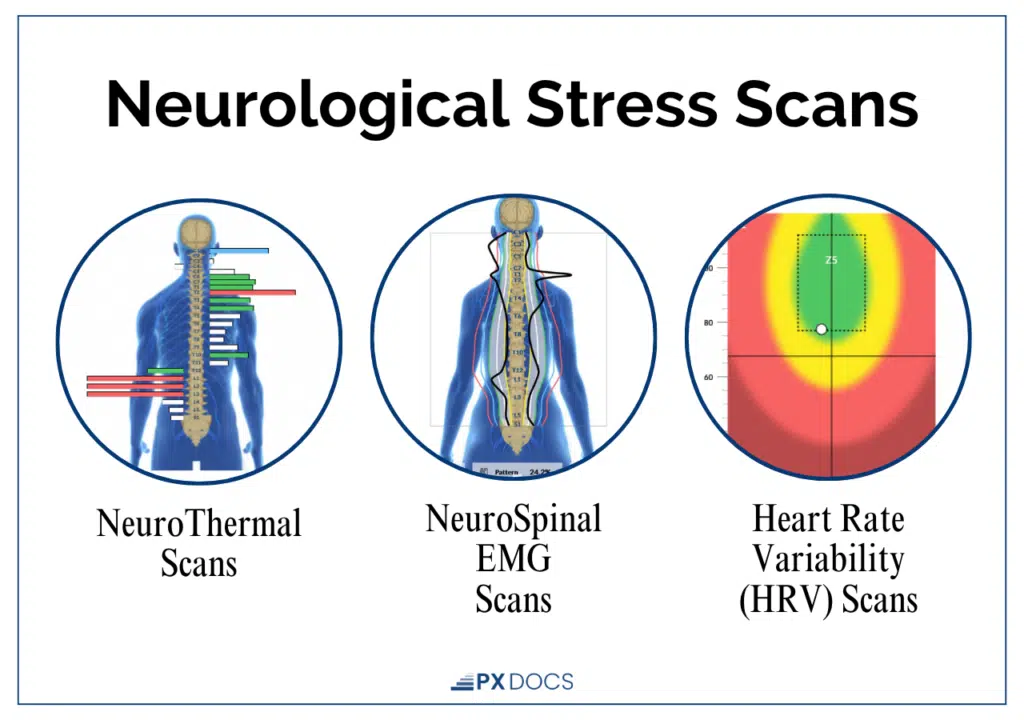
It’s important to note that this technology does not diagnose medical conditions, and Neurologically-Focused Chiropractic Care is certainly not a treatment or cure for adverse reactions or any other condition, not even back pain. Instead, these INSiGHT Scans help us track down the root cause of nervous system dysfunction and dysregulation, and build customized care plans and adjusting protocols to help shift the nervous system back into a state of balance, regulation, and resilience.
We don’t guess. We test. A baseline scan shows where your child’s nervous system actually is right now, not how it looks on a good week. Progress scans tell us whether it’s genuinely responding, whether HRV is climbing, whether the patterns are organizing. If the data says we’re on track, we keep building. If it says something needs to shift, we change the plan.
Where This Leaves You
If your child had an adverse reaction, I believe you. I’ve never dismissed a parent’s lived experience, and I never will. You know what you saw. You know your child changed, and you have been asking a question that deserved a real answer for a long time.
Here’s the answer, as clearly as I can give it: the difference was probably not chance, and it probably wasn’t only what went in. It was what your child had in the tank when it arrived.
That reframe cuts both ways, and the second way is the hopeful one. Because the same question applies to your child right now, today. What is their current reserve capacity? What is their adaptability? What is the functional state of their nervous system this week?
That one you can actually find out. And once you know it, you can do something about it.
If you’ve been in the storm for years, there’s a path out, and it starts with measuring instead of guessing. If you’re pregnant, or planning to be, or you’ve got a baby in the house and nothing has gone wrong yet, please understand that everything in this article is even more true before the storm than after it. Building capacity is available to you right now.
Find a PX Doc near you through our directory, get a set of INSiGHT Scans, and find out what your child’s nervous system is actually working with. Then keep asking these questions. The answers, and the action steps on the other side of the answers, are what change a child’s health.
God bless. Be well.