
Down Syndrome is the most common chromosomal condition in the United States, occurring in about 1 in every 640 babies, which means roughly 5,700 children are born with it each year, according to the CDC. If you’re reading this, there’s a good chance you already know that number personally. You advocate for your child like nobody else on the planet, and you’ve probably learned more about chromosomes, low muscle tone, and feeding challenges than you ever expected to.
So let’s be honest right out of the gates about what this article is and isn’t. Neurologically-Focused Chiropractic Care does not treat or cure Down Syndrome. It’s a genetic, chromosomal condition, and we’re not going to pretend otherwise. What we are going to talk about is a different and, frankly, more useful question for daily life: how do we best support and regulate your child’s nervous system, so their body and brain work as well as they possibly can?
Here’s the truth we build everything on. Genetics are not full destiny.
The expression of that genetic code, how the nervous system functions and regulates day-to-day, has a lot to do with the quality of life. That’s where this kind of care fits in, and that’s what we’ll walk through together below.
Why This Conversation Starts With the Nervous System
Trisomy 21, the extra copy of chromosome 21, sets a genetic baseline for your child. We can’t change the chromosomes, and we’re not trying to. But the way the body expresses that code, through muscle tone, connective tissue, breathing, digestion, and sensory regulation, is shaped by far more than DNA alone. This is the field of gene expression and epigenetics, and it’s why two children with the same diagnosis can lead very different daily lives.
Children with Down Syndrome face a stack of challenges that land squarely on the nervous system. Some of those challenges are chromosomal and fixed. Others are layered on top of one another over time, and those are exactly the ones a well-trained, Neurologically-Focused Chiropractor can help with.
So we shift the question. Instead of “How do we fix Down Syndrome?” we ask, “How do we take the daily quality-of-life disruptions, the sleep struggles, the constipation, the sensory overwhelm, the constant guarding and tension, and help the nervous system handle them better?”
That much, we understand deeply. And on that front, there’s real help available.
What Down Syndrome Does to the Spine and Nervous System
To understand how care works, you first need a clear picture of what’s happening structurally and neurologically. Research consistently shows that most musculoskeletal features of Down Syndrome trace back to three things: generalized ligamentous laxity, joint hypermobility, and low muscle tone (hypotonia). In plain terms, the ligaments are loose, the joints move too much, and the muscles are undertoned and working from a disadvantage.
That combination creates a very specific pattern. Years ago, our mentor Dr. Stu Hoffman taught us a phrase for it that has held up across an entire career of caring for these kids: instability at the top, exhaustion in the core, and hypertonicity in the transitions. Let’s break that down, because each piece matters.
Instability at the Top
The upper neck is the area most parents have already heard about, and for good reason. Atlantoaxial instability (AAI) describes excessive movement between the first and second vertebrae in the neck, C1 (the atlas) and C2 (the axis). This joint depends on strong connective tissue, especially the transverse ligament, to stay stable.
In Down Syndrome, the ligamentous laxity and odontoid bone differences make AAI far more common than in other children. Studies report it in a meaningful share of kids with Down Syndrome, though in most cases it stays asymptomatic, and only about 1 to 2% develop neurological signs from actual cord compression. That distinction matters enormously, and it’s a big part of why the type of chiropractor you choose is not optional. We’ll come back to safety in detail.
Exhaustion in the Core
The middle of the neurospinal region, the thoracic region, tends to run on empty. Low tone here means posture suffers, the head is harder to hold up, and the diaphragm doesn’t work as efficiently as it should. That’s why so many kids with Down Syndrome struggle with breathing, endurance, and the sluggish digestion that comes with poor diaphragmatic function.
The core that’s supposed to provide a stable base is fatigued, which forces other areas to pick up the slack.
Hypertonicity in the Transitions
Here’s the piece people miss. It’s not all loose and low-toned. When you have a weak, hypermobile core, the muscles around the neck, ribcage, and spine have to overwork constantly just to hold things together, keep the head up, and make breathing and swallowing possible. Over time, certain zones become tight, guarded, and irritated, which we’d fairly call myofascial trigger points.
This tension lands in predictable spots called the transition zones: the cervical-thoracic junction (where the lower neck meets the upper back and shoulders) and the thoracolumbar junction (where the midback becomes the lower back, right at the diaphragm). So you end up with a child who is loose and unstable in some areas and locked-down tight in others, all in the same body, all in the same nervous system. Both ends of that spectrum need attention, and many parents are surprised to learn the tightness is often the bigger driver of daily struggles than the looseness.
The Vagus Nerve Connection
Why do those specific zones matter so much for sleep, mood, and the gut? Because of what runs through them. The vagus nerve exits the brainstem at the base of the skull, travels right past that C1-C2 region, and continues down through the lower neck and cervical-thoracic junction, the exact areas that carry the most instability and tension in a child with Down Syndrome.
The vagus nerve is the main driver of the “rest, digest, and regulate” function. It governs healthy digestion, gut microbiome balance, immune regulation, peristalsis (those bowel movements so many families track closely), and the body’s ability to calm down. When the upper neck is unstable and the transitions are locked in tension, that nerve gets interfered with, and you see it show up as reflux, constipation, immune flare-ups, and the kind of nervous system dysregulation and dysautonomia that keeps a child stuck in stress mode.
Think of the nervous system like a car with a gas pedal and a brake pedal. The gas pedal is the sympathetic “fight-or-flight” system; the brake is the vagus-driven “rest and regulate” system. In a lot of these kids, the gas pedal is stuck down, and the brake won’t fully engage. The goal of care isn’t to add more gas; it’s to help that brake start working again so the whole system can finally settle.
Subluxation, INSiGHT Scans, and an Important Note on Scope
When we talk about the neurological interference happening in those zones, the word we use is subluxation. Subluxation isn’t simply “a bone out of place.” It’s a combination of three things: a misalignment, a fixation or restriction in normal movement, and, most importantly, neurological interference that disrupts how the brain and body communicate. That third piece is the one that actually matters for function.
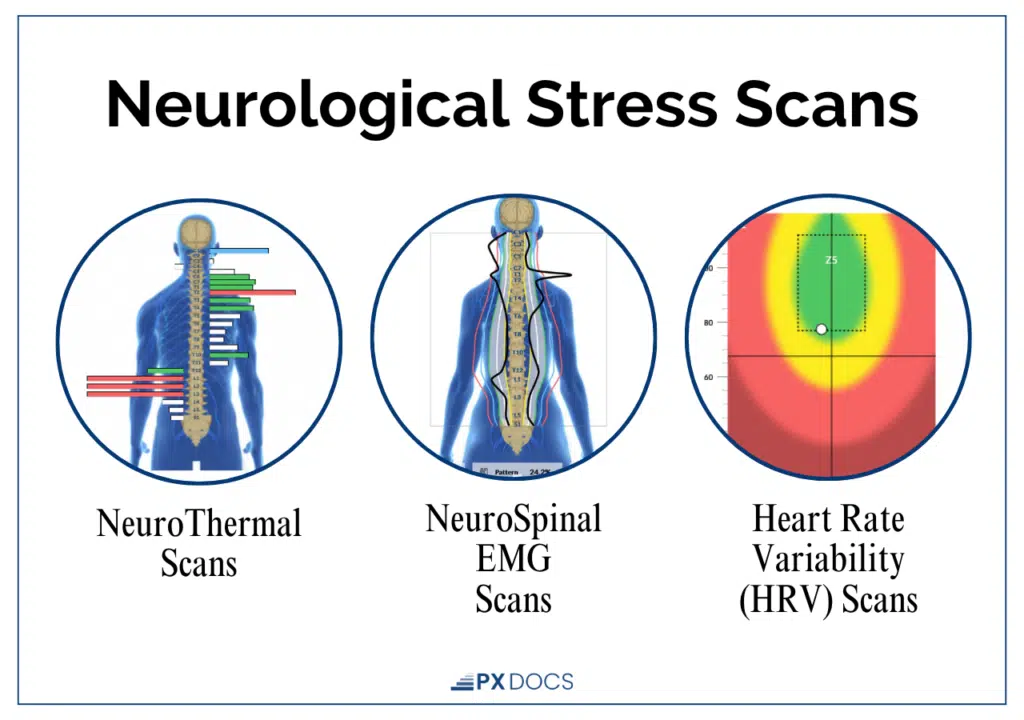
To find it, we don’t guess, and we don’t crack and hope. We measure. INSiGHT Scans give us an objective look at how the nervous system is functioning, using three tools:
- Heart Rate Variability (HRV) measures the balance between the sympathetic (“fight-or-flight”) and parasympathetic (“rest and regulate”) branches of the nervous system, showing how well your child adapts to stress.
- Surface Electromyography (sEMG) reads the electrical activity of the muscles along the spine, flagging the exact zones of tension and altered tone, the transitions we talked about.
- Thermal Scanning uses infrared sensors to read temperature differences along the spine (we call it delta T), revealing areas of dysautonomia and central, upper-cervical stress.
Here’s the part we want to be crystal clear about. It’s important to note that this technology does not diagnose medical conditions, and Neurologically-Focused Chiropractic Care is certainly not a treatment or cure for Down Syndrome or any other condition, not even back pain. Instead, these INSiGHT Scans help us track down the root cause of nervous system dysfunction and dysregulation, and build customized care plans and adjusting protocols to help shift the nervous system back into a state of balance, regulation, and resilience.
That’s why everything is scan-guided and individualized. There is no cookbook that says “child has Down Syndrome, therefore adjust like this.” We read the scans every single visit, build a NeuroSpinal report of findings, show you visually where the stress is, and only work where the nervous system, muscles, and joints can actually respond.
Is Chiropractic Safe for a Child With Atlantoaxial Instability?
This is the question that keeps parents up at night, and it deserves a direct, thorough answer. The short version: in the right hands, yes, and the right hands are everything.
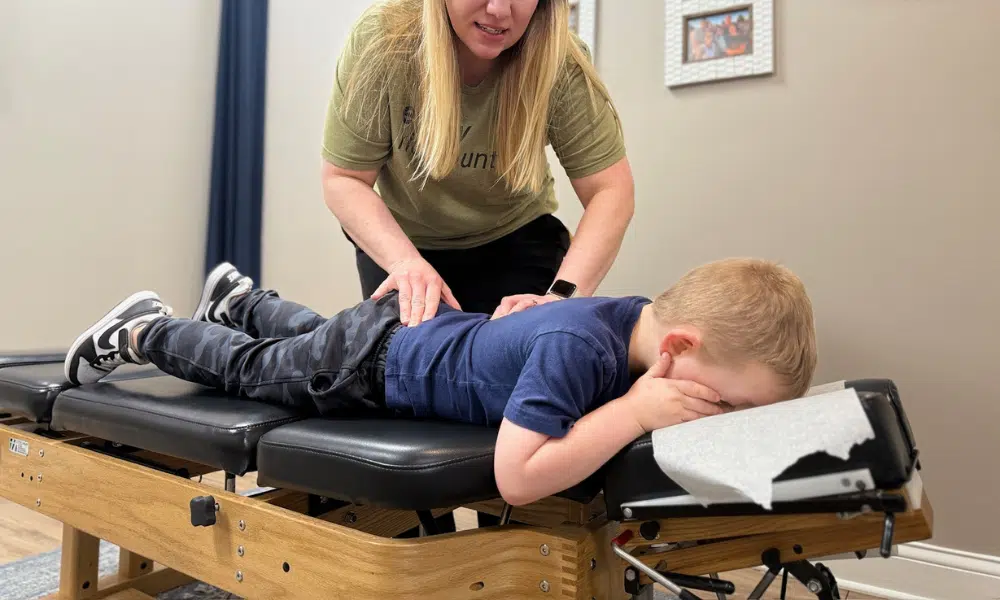
A Neurologically-Focused Chiropractor approaches a child with Down Syndrome completely differently from a high-force, “bone-cracking” adjustment style. We do not force joints. When there’s any suspicion of atlantoaxial instability, the standard of care is to coordinate with your child’s medical team and refer for proper imaging, often open-mouth and flexion-extension films read by a pediatric neurologist or orthopedist, who measures the space between the atlas and axis (the anterior dens interval) and clears the child for activity, including care. Accurately diagnosing instability requires that kind of dynamic imaging, and it is not a chiropractor’s job to read those films.
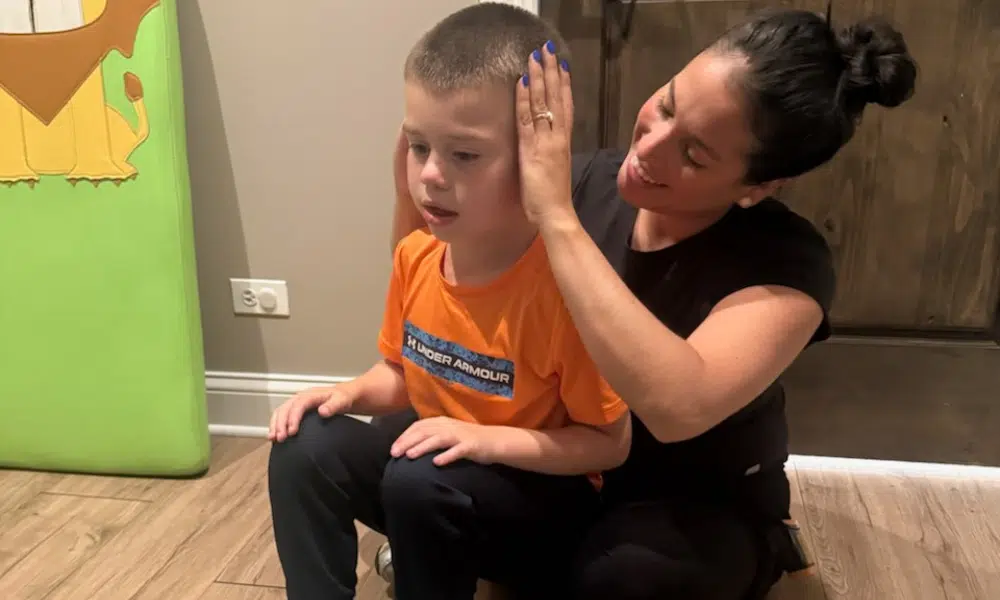
If the medical team does not clear the upper neck, that doesn’t mean your child can’t receive care. It means care gets even gentler. We’d avoid adjusting the atlas entirely and work the rest of the neuro-spinal system with very low-force, specific techniques, often a torque-release approach delivered with a gentle instrument called the Integrator rather than by hand.
There’s also a smarter sequence at play. Before ever working near the upper cervical spine, an experienced chiropractor will spend time releasing the tension and improving the tone in the surrounding zones first, essentially building stability around that vulnerable region before going anywhere near it.
And the safety logic is simple. If you take a joint that’s already loose and force it over and over, that’s over-manipulation, and by definition, it would worsen instability. That is precisely what we don’t do. We always start with the lightest, gentlest input that gets the job done, and we never go above the level the nervous system can handle. This is exactly why an experienced, advanced-trained, scan-guided practitioner matters so much for these kids.
How Neurologically-Focused Chiropractic Care Helps
When the transition zones get adjusted gently and consistently over a care plan, week over week, the nervous system slowly learns to let those areas tone down. As that myofascial tension releases, the biomechanical demand on those overworked joints decreases, and the global exhaustion of the nervous system eases.
That’s when the brake pedal starts working again. The body can shift out of constant sympathetic survival mode and back into the vagus-driven “rest, digest, and connect” state. Breathing improves because the diaphragm and ribcage aren’t locked down. Posture and head control improve because the core isn’t fighting so hard. Better movement means better sensory-motor integration, and better sensory input flowing back to the brain means the whole system can finally regulate instead of staying stuck in alarm.
None of this happens because we’re treating, curing, or fixing Down Syndrome. It happens because the nervous system finally feels safe, connected, and supported, and motor tone, coordination, and planning become smoother, stronger, and more efficient as a result.
What Families Often Notice
Because outcomes vary from child to child, we describe these as the changes families consistently report to us, not guarantees. Across years of caring for kids with Down Syndrome, the patterns hold remarkably steady. Parents tell us they see:
- More calm and better regulation overall, often the very first thing they notice
- Improved sleep, less irritability, and far steadier emotional regulation
- Less anxiety and sensory overwhelm, with better tolerance to touch, sound, smells, and movement
- Better posture and head control, improved coordination and balance, and growing strength and endurance over time
- Improved body awareness and a more settled sense of gravitational security
- Better digestion, more regular bowel movements, and fewer stress-related gut and immune flare-ups
- More engagement with life: stronger eye contact, more social awareness, and gains in speech and communication
When you stack it all up, parents describe it the same way again and again: their child just feels better, their body works better, their brain-body connection works better, so life gets better.
A Catalyst for Everything Else You’re Doing
One of the most encouraging things we see is how this care works alongside everything else in your child’s life. It is not aggressive, not a replacement for medical care or therapies, and not a cure. It’s a team-based piece of a bigger picture.
When a child starts to regulate and move better, it becomes a catalyst. Families who had plateaued in physical or occupational therapy often see new progress. Movement gets easier, which supports staying active and managing the inflammation, respiratory, and immune challenges, and weight struggles that can come with Down Syndrome over the years. Even nutrition can shift because a calmer, better-regulated nervous system often means fewer sensory food battles and more openness to healthier choices.
This is true whether your child is an infant, in the grade-school years, or a young adult. It’s never too late for the nervous system to start working better, and that improvement tends to lift everything else with it.
You Are Your Child’s Greatest Advocate
If Down Syndrome is part of your family’s life, here’s what we want you to walk away with. We can’t change the chromosomes, but genetics are not full destiny, and the daily quality of life for your child has more room to grow than you may have been told. Supporting the nervous system, gently, specifically, and safely, can help your child feel better, move better, digest better, sleep better, and engage with the world more fully.
If you choose to explore this path, choose your practitioner carefully. You want a chiropractor with advanced pediatric and nervous-system training, who works with INSiGHT Scans, who coordinates with your medical team, and who understands the unique landscape of instability and tension that comes with Down Syndrome. That experience is the difference between gentle, scan-guided support and the kind of high-force care these kids should never receive.
To find a qualified Neurologically-Focused Chiropractor near you, visit the PX Docs Directory. You don’t have to navigate this alone, and there’s a whole network of practitioners who love serving these incredible kids and families like none other.