

It starts with dinosaurs. Then it’s trains, or one YouTube channel, or the same four minutes of a movie on repeat. Most children get fixated on things because fixation works: when a child’s nervous system is overloaded and can’t settle itself down, one predictable, deeply familiar activity becomes the fastest available way to feel calm. The fixation isn’t really the problem. It’s the strategy your child’s nervous system landed on for managing a problem underneath it.
That reframe changes what you do next. If you think your child is being stubborn, you’ll keep negotiating. Once you see a system reaching for the one thing that reliably quiets it, you start asking a better question: why does this child need so much quieting? Parents come into our offices describing a kid who can recite every volcano fact but falls apart when it’s time to put shoes on, and nobody has looked at the nervous system doing the fixating.
So let’s look at it: what happens neurologically when a child locks onto one thing, why interrupting it so often ends in a meltdown, when fixation is worth a closer look, and how nervous system dysregulation can be measured instead of guessed at.
Why Does My Child Get Fixated on Things?
Children fixate because intense, narrow focus regulates an overwhelmed nervous system. A 2024 scoping review identified four functions that restricted and repetitive interests serve: they help regulate sensory experiences, help cope with anxiety, introduce certainty and control into an unpredictable environment, and help a child make sense of their world. Fixation, in other words, does a job.
A 2022 review describes these patterns as marked by repetition, inflexibility, and invariance. Read that list again and notice what it’s really describing: a system with limited options.
Think about what a favorite interest actually offers a child. It’s predictable. It never changes the rules. It doesn’t require reading a face, guessing at tone, or bracing for a transition. Everything else in a child’s day asks their brain to process new input and respond appropriately. The fixation asks nothing.
For a child whose system is already running on a chronic stress response, it’s relief rather than just preference.
This is also why “just take it away” backfires so reliably. You’re removing the one place your child’s nervous system knows how to rest, without replacing it with anything.
Here’s the distinction that matters most: there’s a difference between a child who loves something and a child who needs something. A child who loves dinosaurs will happily talk about dinosaurs and then go ride a bike. A child who needs dinosaurs gets dysregulated when dinosaurs aren’t available. Same interest, completely different neurology underneath.
Is It Normal for a Child to Be Obsessed With One Thing?
Yes, and far more often than most parents realize. A study of 177 parents found that nearly one-third of typically developing young children showed what they called extremely intense interests, with an average onset around 18 months. A 2022 systematic review notes that repetitive behavior appears early and shows up in neurotypical development, too.
So the question isn’t whether your child has an intense interest. It’s whether the interest is coming with a regulated nervous system or instead of one.
Common signs that a child’s fixation is being driven by nervous system dysregulation rather than plain enthusiasm include:
- Meltdowns when the activity is interrupted, even with warning
- Difficulty falling or staying asleep, and trouble winding down at night
- Sensory sensitivity to clothing tags, food textures, noise, or lights
- Chronic constipation, reflux, or other digestive struggles
- Anxiety and a strong need to stay physically close to you
- Getting sick often, or holding onto every cold for weeks
- Very few interests overall, rather than one favorite among many
- No ability to self-soothe without the fixation available
If you’re reading that list and nodding at five or six items, this is a pattern. And a pattern that clusters like this, spanning sleep, digestion, immunity, sensory processing, and behavior all at once, points to the one system that runs all of them.
Inside the Nervous System of a Fixated Child
Fixation shows up when the Autonomic Nervous System loses its ability to shift gears. Picture two pedals. The Sympathetic Nervous System is the gas pedal (fight or flight, activation, alertness). The Parasympathetic Nervous System is the brake pedal (rest, digest, and regulate). A healthy system moves between them all day. A child stuck in sympathetic dominance has a gas pedal jammed down and a brake pedal that won’t engage, so they can’t downshift into calm, sleep, digestion, or flexible attention.
The brake pedal runs largely through the vagus nerve, the longest cranial nerve in the body, carrying parasympathetic signals between the brain and the heart, lungs, and digestive system. How well it’s working can be estimated through vagal tone, measured as heart rate variability (HRV).
This is where the research gets interesting for fixation specifically. A 2022 systematic review found that vagally mediated HRV predicted cognitive inhibition and cognitive flexibility more strongly than it predicted working memory. Cognitive flexibility is precisely the capacity a fixated child can’t access: the ability to shift attention off one thing and onto another. Lower vagal tone, less flexibility, is Autonomic Nervous System dysfunction expressing itself as rigidity.
There’s a second piece. A 2015 study reported that more than half of youth with autism experience sensory over-responsivity, and that this hyperresponsivity was driven by a failure to habituate. Most nervous systems tune out a humming refrigerator within seconds. A system that can’t habituate keeps processing it, all day, as new information. Now add a classroom, a sibling, and a grocery store.
A child carrying that load has to find somewhere to put their attention that doesn’t cost anything. So they narrow it down to one thing. When the whole world is loud, the fixation is the only quiet room in the house.
Children who fixate rigidly also frequently show signs of autism, ADHD, or Sensory Processing Disorder, and that overlap isn’t a coincidence. All three share a common thread of Autonomic Nervous System dysfunction: sympathetic dominance, poor vagal tone, and impaired sensory integration. That’s why the same child so often has the fixation, the sensory sensitivities, the sleep struggles, and the digestive issues together. One dysregulated system, several different labels.
Why Does My Child Melt Down When I Interrupt Their Fixation?
Because transitions are neurological work, and a dysregulated system can’t afford them. Stopping one activity and starting another requires a child to perceive a change, decide how to respond, inhibit what they were doing, and shift attention. That sequence runs on the exact regulatory capacity a fixated child is already short on. The meltdown isn’t a protest against your request. It’s the system running out of resources mid-shift.
No child needs a diagnosis to resist leaving a favorite place, toy, or show. That part is universal. What changes with dysregulation is the size of the gap between “I don’t want to stop” and “I cannot stop.”
It’s worth saying plainly: this isn’t defiance, and it isn’t manipulation. A child in the middle of a fixation-interruption meltdown is not calculating. Their brake pedal isn’t engaging, and the demand landed anyway.
Which is also why consequences don’t produce much change here. Discipline addresses choices. This isn’t happening at the level of choice, and no amount of consistency will build a skill the nervous system doesn’t yet have the capacity to run. Behavioral strategies aren’t wrong; they’re aimed one layer above where the problem lives. The same limitation shows up in emotional dysregulation and extreme attention-seeking behavior, where parents do everything right and still watch the behavior hold.
Is Fixation a Sign of Autism or ADHD?
It can be, but fixation alone doesn’t diagnose anything. Autistic children often show restricted interests alongside insistence on sameness and rigid routines, and about 1 in 31 eight-year-olds in the United States is now identified with autism, according to CDC data released in 2025. Children with ADHD more often lock onto highly stimulating activities such as video games, then struggle to disengage. Plenty of children with neither diagnosis fixate too.
The useful question for a parent isn’t which label fits. It’s what’s driving the rigidity, because that’s the part that can actually change.
A diagnosis describes a cluster of behaviors. It doesn’t explain why this particular child’s nervous system can’t downshift. Those answers live at the level of function, not category, which is why two children can carry identical diagnoses and completely different scan patterns.
Where This Dysregulation Actually Starts
Dysregulation this deep almost never starts with one event. At PX Docs, we call the accumulation “The Perfect Storm”: a sequence of early stressors that layer onto a developing nervous system and leave it stuck in sympathetic dominance. It usually runs in four stages.
- Prenatal stress. Maternal stress during pregnancy influences how a baby’s nervous system is built. A 2024 review describes stress-related programming of brain development beginning in utero, with cortisol crossing the placenta and reaching stress-sensitive regions of the fetal brain.
- Birth intervention and trauma. C-section, forceps, vacuum extraction, induction, and prolonged labor all place strain on an infant’s upper neck and brainstem, exactly where vagus nerve fibers exit. Birth trauma here isn’t always dramatic or obvious, and it doesn’t show up on any newborn screen.
- Early childhood stressors. Rounds of antibiotics, chronic ear infections, reflux, formula transitions, falls, and mounting screen exposure keep the gas pedal pressed through the years when regulation is supposed to be getting established.
- Cumulative dysregulation. Once a system has been overloaded long enough, it becomes hyper-reactive to the very environment that overloaded it. That’s the state parents finally see: the meltdowns, the rigidity, the fixation.
Underneath all of it sits subluxation: a stressor in the neurospinal system that includes three components. Physical misalignment. Joint fixation, meaning a loss of normal motion. And neurological interference, meaning disrupted or distorted signaling between the brain and the body. That third component is the one that matters most in children. Subluxation in the upper neck interferes with vagus nerve function, which drives sympathetic dominance and, over time, pediatric dysautonomia: dysfunction of the Autonomic Nervous System that controls heart rate, digestion, immune response, and sleep.
It also explains why the digestive symptoms travel with the behavioral ones. The vagus nerve is the main highway of the gut-brain axis, so a child with poor vagal tone tends to have both constipation and rigidity. Same wire.
Measuring a Stuck Nervous System
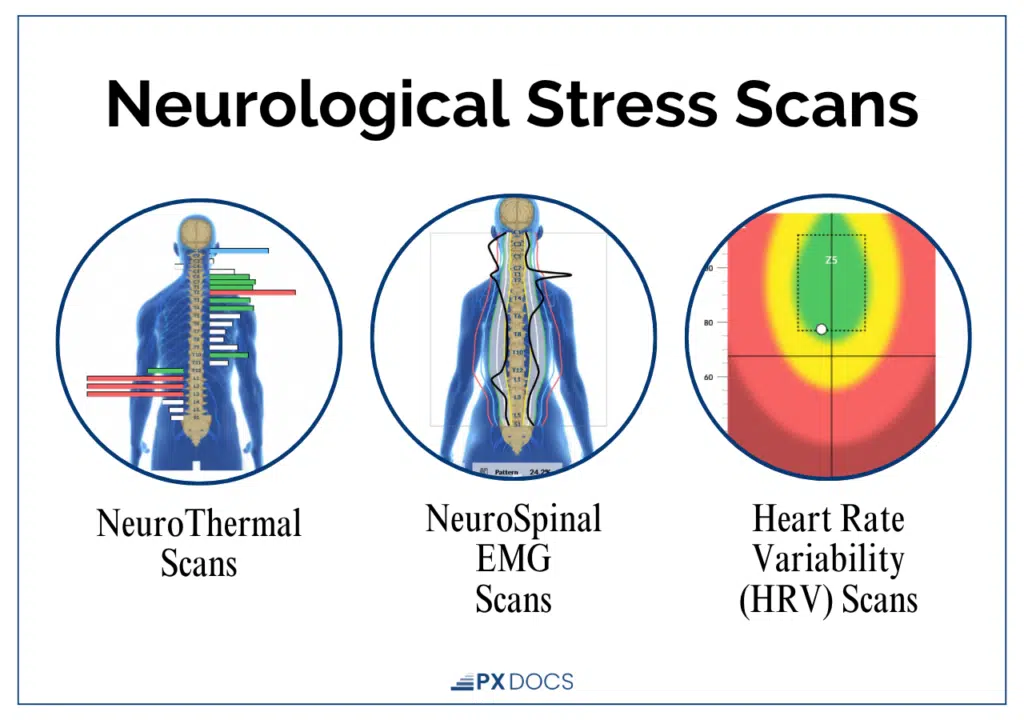
A stuck nervous system can be measured directly, which means you don’t have to keep guessing from behavior alone. INSiGHT scans are a three-part neurological assessment used in Neurologically-Focused Chiropractic Care:
- Heart rate variability to assess vagal tone, autonomic balance, and the adaptability of the nervous system
- Surface electromyography (sEMG) to map tension patterns along the neurospinal system
- Thermal scanning to evaluate regional autonomic function.
Together, they show whether a child is stuck on the gas pedal, and where.
To be clear about what this is and isn’t: INSiGHT scans are not a treatment or a cure for any condition, not even back pain. They don’t diagnose autism, ADHD, OCD, or anything else. They measure how a nervous system is functioning right now, which is a different and more useful thing for a parent trying to understand a fixated child.
What we look for in these kids is a specific picture. HRV is sitting low, showing a Sympathetic Nervous System that won’t stand down. sEMG shows tension patterns concentrated in the upper cervical region. Thermal readings show autonomic imbalance. Clinically, we often see children so overloaded at their first visit that the scanning process itself is too much stimulation, which tells us something important before a single number comes back.
What Actually Helps a Fixated Child
Start by lowering the total load, then address why the system can’t handle the load in the first place. Fixation eases when a child has more regulatory capacity, not when they have fewer interests. Practical steps that help:
- Give transitions runway. Two warnings, then a concrete next step. You’re not being permissive; you’re giving an overloaded system time to shift.
- Stop treating the interest as the enemy. Use it as a bridge into new activities rather than something to be extinguished.
- Protect sleep first. Regulation is built at night. Nothing else works well without it.
- Audit the schedule, including therapies. This one surprises parents. A calendar stacked with well-meaning appointments can add more stress than it removes. More intervention is not the same as more healing.
- Look at the neurospinal system. If the interference is physical, the strategies alone will keep stalling.
That last point is where Neurologically-Focused Chiropractic Care fits. NFCC uses neurological assessment to locate subluxation patterns affecting the Autonomic Nervous System, then applies gentle, child-specific adjustments to reduce that interference so the brake pedal can start working again. Adjustments don’t treat fixation; they address subluxation, and a nervous system with less interference regulates better.
Expect a sequence rather than a switch. The earliest changes are usually physical: better sleep, easier digestion, a body that settles more quickly. Flexibility, smoother transitions, and a wider set of interests tend to follow, because those are brain-based wins that require a stable foundation underneath them. Every child moves at their own pace.
Where This Leaves You
Your child isn’t choosing rigidity. They found the one thing that quiets a nervous system stuck on the gas pedal, and they’re holding onto it because it works. Fixation is the visible part. Sympathetic dominance, poor vagal tone, and subluxation-driven interference are the parts nobody has looked at yet.
Which is why we don’t guess. We test. A baseline set of INSiGHT scans shows where your child’s system actually sits today: how low the HRV really is, where the tension is concentrated along the neurospinal system, how far off balance the autonomic picture has drifted. That’s the starting point, not the whole plan.
From there, repeat scans at regular intervals tell us whether the system is genuinely responding. When HRV starts climbing back toward the green zone and cervical tension patterns begin organizing, we know the foundation is holding, and we keep building. When the numbers say something isn’t moving, we change the plan instead of waiting and hoping. That two-way logic is the whole point. The scans keep your child’s care anchored to what’s happening inside their nervous system, not to how a hard Tuesday made everything look.
You know your child better than any assessment does. You’ve watched the pattern long enough to know it isn’t a phase. Now there’s a way to see the mechanism behind it, and something concrete to do about it. Find a PX Docs-trained chiropractor near you through the PX Docs directory and start with a baseline.