

Do bright lights, loud noises, or crowded spaces leave you feeling drained, anxious, or on edge? If you find yourself hitting a wall in places that don’t seem to bother anyone else, you’re not imagining it, and you’re not weak.
You get overstimulated easily because your brain processes more sensory, emotional, and mental input than it can filter and calm in the moment. For many people, this lower threshold traces back to a nervous system stuck in “fight or flight”—a state called sympathetic dominance—that keeps the volume turned up on everyday sights, sounds, and sensations others tune out automatically.
Research shows that around 20% of people are highly sensitive to sensory input, meaning their brains receive and process information more deeply than average. But heightened sensitivity isn’t always something you’re simply born with. Factors like prenatal stress, birth trauma, and early childhood experiences can shape how your nervous system filters the world for years afterward.
In this article, we’ll explain what overstimulation actually is, why some nervous systems reach overload faster than others, why it can worsen in adulthood, and how Neurologically-Focused Chiropractic Care works to address the root cause rather than just manage symptoms.
What Does It Mean To Be Overstimulated?
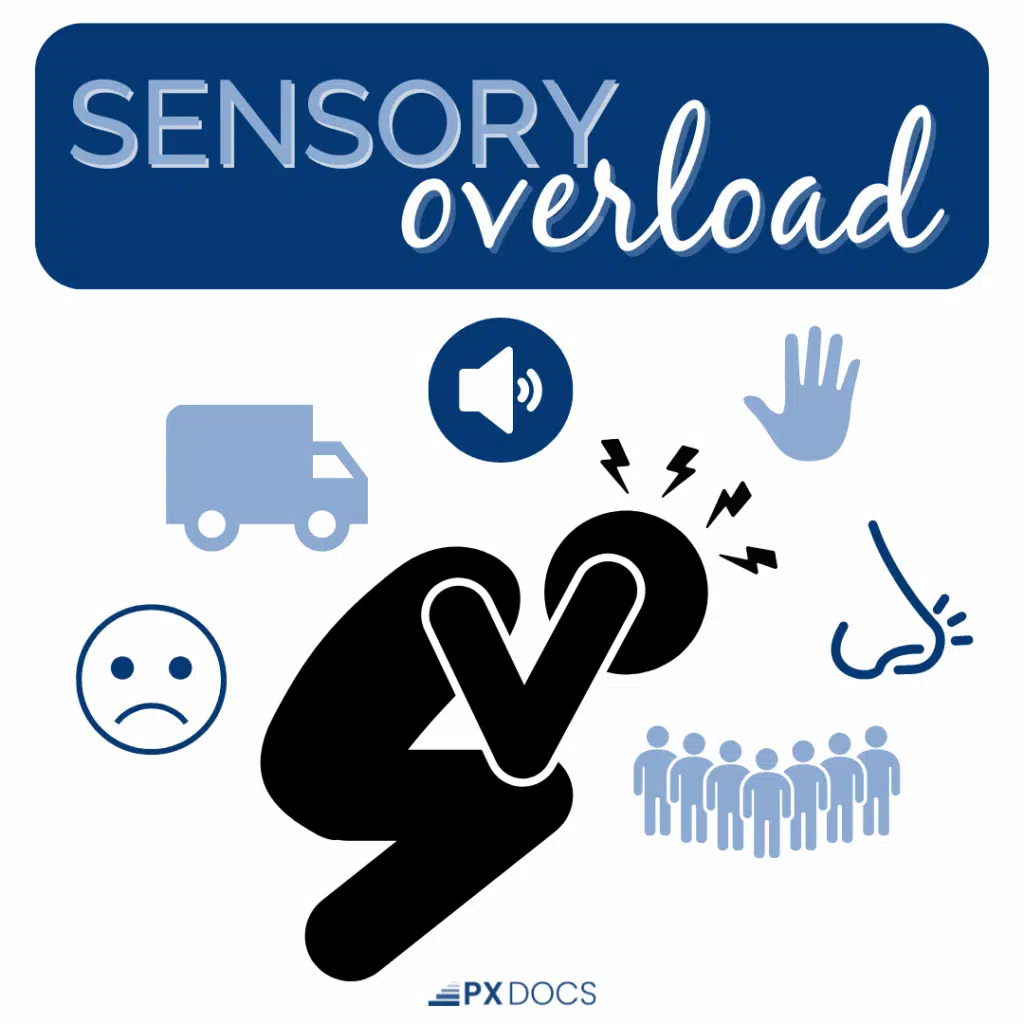
Overstimulation happens when your brain receives more information than it can effectively process. Excessive sensory, emotional, or mental input arrives all at once, overwhelming the nervous system’s ability to filter it and respond calmly.
While the terms are often used interchangeably, sensory overload refers specifically to overwhelming sensory input—sights, sounds, textures, and smells—while overstimulation can also include emotional and mental load. Both create that cornered, can’t-think-clearly feeling. You might hear every sound deeply, feel like the lights are too bright, or notice your clothes feel unbearable, sensations most people unconsciously ignore.
When you’re overstimulated, your body often produces a wave of physical signs:
- Headaches or migraines
- Muscle tension or pain
- Fatigue or exhaustion
- Rapid heartbeat or chest tightness
- Nausea or digestive discomfort
And it shows up cognitively and emotionally, too, as difficulty concentrating, feeling overwhelmed or anxious, irritability or mood swings, withdrawal from social situations, or a sudden, urgent need to escape.
It’s worth knowing that overstimulation isn’t the same thing as Sensory Processing Disorder (SPD). SPD is a more complex neurological pattern, affecting 5–16% of school-aged children, that influences how the brain processes and responds to sensory input over the long term. Overstimulation, by contrast, can happen to anyone—it’s a temporary state of overwhelm rather than a chronic condition. That said, people with SPD, and adults who carry that wiring from childhood, are far more prone to it.
Why Do I Get Overstimulated More Easily Than Others?
You’ve probably asked yourself this exact question while watching other people handle chaos that levels you. Why does the busy grocery store, the open-plan office, or a loud family gathering leave you wrung out when others walk away energized? The answer lives in how your brain filters information, and how regulated your nervous system is underneath it all.
Your Filtering System Runs Differently
In most brains, a process called habituation acts like a selective gatekeeper, automatically ignoring repetitive, non-threatening input. If you’re easily overstimulated, that filter is less efficient. Studies have found that people with sensory processing difficulties have altered pathways for brain connectivity. Think of it as having more sensitive antennae: your sensory cortex processes each signal more intensely, so your threshold for “too much” is simply lower. You reach overload faster—not because you’re weak, but because your brain is moving more data.
Some Of It Is Temperament
Research by psychologist Dr. Elaine Aron describes the Highly Sensitive Person (HSP) trait, present in roughly 15–20% of people, whose nervous systems process sensory and emotional information more deeply. This isn’t a condition; it’s a genetic temperament. If you’re an HSP, you notice the flickering light others miss and hear three conversations at once while your brain struggles to decide which one matters.
And Some Of It Is Acquired
Here’s the part most explanations skip. While some people are born more sensitive, others develop a lower threshold through early nervous system stress. Birth trauma, prenatal stress, and difficult early childhood experiences can leave a nervous system dysregulated in ways that amplify sensory sensitivity well into adulthood. At PX Docs, we call this cumulative pattern the “Perfect Storm,” a concept developed by Dr. Tony Ebel describing how prenatal stress, birth trauma, and early childhood stressors stack up to overwhelm a developing nervous system and lock it into a more reactive state from the start.
What’s Happening In My Nervous System When I’m Overstimulated?
To understand why some people have an overactive nervous system, it helps to look at what’s actually firing when you tip into overload.
When you’re overstimulated, communication inside your brain breaks down. Your amygdala (the brain’s alarm and fear center) detects incoming stimuli—the crowded room, the overlapping voices, the harsh lighting—and sounds the alarm. Normally, your cerebral cortex, the planning and reasoning center, sends back an “all clear.” But under overload, that pathway falters: the cortex can’t send the calming signal, so the amygdala keeps firing. That triggers a fight-or-flight response, releasing cortisol and adrenaline, and your body responds to everyday overwhelm as if it were a genuine threat. You’re in survival mode in the cereal aisle.
The Autonomic Nervous System (ANS) governs this response and operates through two branches. Think of them like the pedals in a car. The Sympathetic Nervous System is the gas pedal—your “fight or flight” accelerator. The Parasympathetic Nervous System, driven largely by the vagus nerve, is the brake pedal—”rest, regulate, and digest.” In a balanced system, you hit the gas when you need to and ease off afterward. When the balance breaks down, the gas pedal stays pressed and the brake won’t fully engage. This stuck-on-the-gas state is known as nervous system dysregulation, or clinically, dysautonomia—a struggle of the autonomic nervous system to properly regulate the body’s internal and external environments. When you live with a chronically dominant gas pedal, you don’t have to be in a stressful situation to feel overstimulated. Your brain is already noisy at rest, so it takes far less to push you over the edge.
Why Does Overstimulation Seem To Get Worse As An Adult?
Many people who felt “sensitive” as kids find it intensifies in adulthood, and there’s a logic to that. A nervous system already running close to capacity has less buffer for everything modern life piles on. Chronic stress, poor sleep, and digital overload tax an already-taxed system.
Digital multitasking is a major amplifier. Answering messages during video calls, scrolling while you cook, fielding a constant stream of notifications—this layers cognitive overload on top of sensory load, and the two compound. Living or working in a consistently loud, bright, or chaotic environment slowly erodes your tolerance, the way running an engine at 80% all day leaves nothing in reserve when something extra hits. And if you experienced early nervous system stress, that lower baseline threshold means demands push you past your limit faster than they would someone whose system regulates easily.
None of this means you’re broken or that it’s permanent. It means the load has outpaced your nervous system’s current capacity to regulate, and that capacity can be rebuilt.
Conditions Commonly Associated with Sensory Overload
While anyone can experience sensory overload, certain neurological and mental health conditions can make individuals more susceptible to overstimulation. Some of the most common conditions associated with sensory processing challenges include:
- Anxiety conditions: Chronic anxiety can heighten sensitivity to environmental stimuli, exacerbating sensory processing issues and overstimulation.
- Post-Traumatic Stress Disorder (PTSD): Trauma can cause the nervous system to become hypervigilant and reactive, making it more challenging to regulate responses to sensory input.
- Sensory Processing Disorder (SPD): a neurological condition that affects how the brain processes sensory information. Some experience hypersensitivity (an overwhelming response to stimuli that leads to avoidance), while others experience hyposensitivity or “sensory seeking” (needing more intense stimulation). Many individuals have a mix of both types.
- Autism Spectrum Disorder (ASD): Many individuals with ASD have difficulty processing sensory input and may be over- or under-responsive to certain stimuli. Individuals with Autism may experience alterations in the cortex—the brain region that processes sensory information—creating heightened sensitivity to light, sound, texture, and smell. In severe cases, overstimulation can lead to a meltdown (external emotional reaction) or shutdown (internal withdrawal and disconnection).
- Attention-Deficit/Hyperactivity Disorder (ADHD): People with ADHD often struggle with filtering out irrelevant sensory information, leading to feelings of overwhelm and overstimulation. In ADHD, lower dopamine levels can lead to overstimulation. Instead of unconsciously ignoring background noise or minor distractions, the ADHD brain processes every stimulus as equally important—the tapping pen, the ticking clock, the conversation across the room—leading to rapid overwhelm. This affects executive function, making it difficult to determine what deserves attention.
It’s important to recognize that while these conditions can increase the likelihood of experiencing sensory overload, not everyone with these diagnoses will struggle with overstimulation. Conversely, some individuals may be highly sensitive to sensory input without meeting the criteria for a specific neurological or mental health condition.
What Actually Helps When You Get Overstimulated Easily?
In the moment, the goal is to lower the input and signal safety to your nervous system. A few evidence-based options:
- Step away. Find a quieter, dimmer space—a bathroom, your car, outside—even for a few minutes. Reducing input lets your system start to downshift.
- Box breathing. Breathe in for 4 counts, hold for 4, out for 4, hold for 4. Slow, even breathing is one of the most direct ways to nudge the brake pedal (your parasympathetic system) back online.
- Ground through the body. Press your feet firmly into the floor, hold something cool or textured, or stretch gently. Physical sensation you control helps bring you back.
- Lower the sensory load proactively. Noise-dampening headphones, sunglasses, dimmable lights, and built-in breaks between demanding activities all reduce the odds of tipping into overload in the first place.
These strategies are genuinely useful, but it’s worth being honest about what they do: they help you manage overstimulation when it strikes. They don’t change the underlying threshold that makes you reach overload so quickly in the first place. For that, you have to address the nervous system itself.
How Does Neurologically-Focused Chiropractic Care Address The Root Cause?
Most approaches to overstimulation work at the level of symptoms. Therapy can teach coping skills, and an occupational therapist can build sensory strategies, both valuable. Neurologically-Focused Chiropractic Care works one layer deeper, on the nervous system dysregulation that may be driving the sensitivity itself.
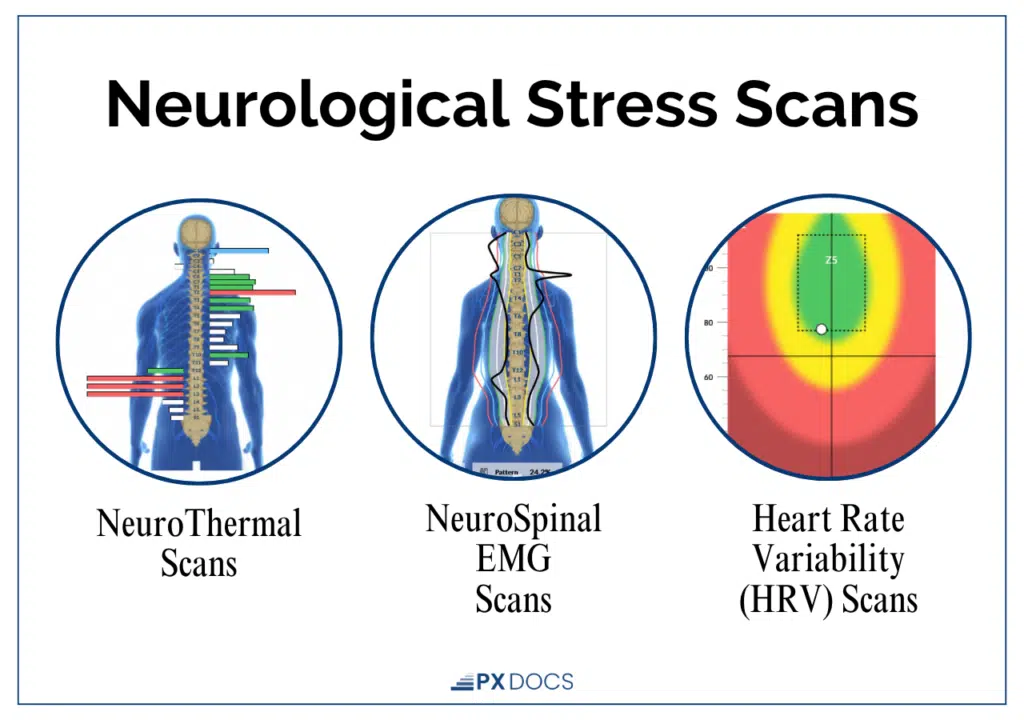
The starting point is measurement. At PX Docs, we don’t guess; we test using a set of three INSiGHT scans.
- Heart Rate Variability (HRV) shows whether your nervous system has lost flexibility and vagal tone.
- Surface EMG maps where stuck tension and sympathetic overdrive are held along the spine.
- Thermal scanning reads autonomic regulation.
Together, they provide an objective window into dysregulation, dysautonomia, and subluxation that no symptom questionnaire can provide.
A quick but important note: these scans don’t diagnose any medical condition, and Neurologically-Focused Chiropractic Care is not a treatment or cure for overstimulation or any other condition—not even back pain. What the scans do is locate the root-cause dysfunction so a care plan can be built around your specific nervous system.
That dysfunction usually involves subluxation, which has three components: a misalignment in the spine, a fixation where that segment isn’t moving as it should, and the resulting neurological interference—a kind of static on the line between brain and body. When subluxation sits in the upper neck and spine, it keeps the sympathetic system revved and suppresses the vagus nerve, the body’s master “brake.” Gentle, specific adjustments aim to release that stuck sympathetic tension and help the parasympathetic, vagus-driven side come back online.
The EMG images PX Docs offices share tell the story visually: a baseline scan of an overstimulated adult shows a sympathetic-dominant, overloaded system, often with a telltale “stress zone” of held tension through the mid-back; a later progress scan shows the same system calmer and more regulated. Research also indicates that chiropractic adjustments can influence brain function, particularly the prefrontal cortex involved in processing input and regulating stress. Studies specific to sensory sensitivity are still limited, and we’re careful to say so—but clinical experience consistently shows that addressing subluxation and supporting nervous system regulation can lower baseline reactivity over time.
We track that change the same way we found it: with repeat HRV and INSiGHT scans, not by how you happen to feel on a given day. The goal isn’t a perfectly quiet world. It’s a nervous system with enough capacity and flexibility for the world to stop feeling like an assault.
You’re Not Stuck With An Overstimulated Nervous System
Navigating the world with a highly reactive nervous system is exhausting, but here’s the truth: you are not weak, you are not alone, and you are not stuck with this forever. The “Perfect Storm” may have helped create your sensitivity, but the same nervous system that learned to stay on high alert can learn to settle.
If you’re ready to find out what’s driving your overstimulation and address it at the root, visit the PX Docs Directory to find a Neurologically-Focused Chiropractor near you. The first step is simply measuring what’s really going on, so you can stop guessing and start regulating.