
A baby who won’t latch is usually dealing with a neurological problem, not a milk-supply problem, and not a “bad mom” problem. Latching is a full-body neurological event. It takes five cranial nerves, more than two dozen pairs of muscles, and a brainstem all firing in sync to coordinate suck, swallow, and breathe. When birth tension and stress interfere with those nerves, a baby can’t organize the latch, no matter how hard mom tries.
If you’re reading this at 3 a.m. with a crying baby who keeps popping off the breast, take a breath. Most moms who start out breastfeeding run into trouble, and 60% of mothers stop sooner than they planned to.
Breastfeeding is the baby’s very first milestone, and like every milestone that follows, it’s built on nervous system function. We want you to understand why babies won’t latch from a neurological angle, what birth has to do with it, the signs to watch for, and how Neurologically-Focused Chiropractic Care works to fix the root cause so your baby can feed the way they were designed to.
Why Won’t My Baby Latch Onto The Breast?
Think about what your newborn is actually being asked to do. Latch on deep, pull milk, swallow it, and slip a breath in without choking, over and over, in a steady rhythm. A healthy baby usually settles into a pattern of one suck, one swallow, one breath. It looks simple. It is anything but.
A baby won’t latch when the nerves that run feeding aren’t working together. Sucking, swallowing, and breathing are coordinated by central pattern generators in the brainstem, driven by five cranial nerves and dozens of muscles in the face, jaw, tongue, and throat. If any part of that circuit is under tension or interference, the baby physically can’t run the sequence, even when they want to.
That’s why breastfeeding is such an early window into how a baby’s nervous system is doing. Researchers actually study a newborn’s sucking pattern as an early sign of neurological function because it’s one of the first complex functions the brain has to coordinate. A baby who can’t get the latch going isn’t being difficult, and neither are you. Something upstream is making an already hard job even harder.
Why A Bad Latch Isn’t Really The Mom’s Fault
In the vast majority of cases, a poor latch traces back to the baby’s nervous system, not the mother’s body. Breastfeeding runs on supply and demand: the baby’s suckling tells mom’s body how much milk to make. If the baby can’t put a strong, organized demand on the supply, the supply naturally starts to drop, and then it looks like a milk problem when it started as a coordination problem. It helps to see how common the drop-off is: about 86% of U.S. babies start out breastfeeding, yet only around one in four are still breastfeeding exclusively at six months. That gap tells you most families are hitting a wall, not that most moms lack milk.
The blame almost always lands on mom, and it lands in the wrong place. “My latch is off.” “My supply is low.” “My nipples are the wrong shape.” Those things get all the attention, while the baby, who is actually driving the latch, gets overlooked. It’s heartbreaking, because moms carry guilt for something that was never theirs to fix alone.
When you shift the lens to the baby’s neurology, the whole picture changes. The question shifts from “what’s wrong with me?” to “what’s making it hard for my baby to coordinate this, and how do we help their nervous system do its job?”
And it explains something parents notice later. Babies with latch struggles often go on to experience colic, reflux, torticollis, and disrupted sleep, and some of these same kids later show up with Sensory Processing Disorder, ADHD, or Autism traits. This co-occurrence runs along a single thread: an Autonomic Nervous System that got stuck in a stressed, dysregulated pattern from the very beginning, so the same wiring that struggled to feed also struggles to calm, digest, and organize as the child grows.
The Role of Birth In A Baby’s Latch
Almost every latch struggle we see traces back to the birth itself.
The passage through the birth canal, and especially interventions like C-section, forceps, vacuum extraction, induction, or a very fast or very long labor, are a common source of birth trauma that places real mechanical stress on a newborn’s head, upper neck, and brainstem. That’s the exact region where the cranial nerves for feeding originate. Even a smooth, natural birth puts real force on a baby’s body.
That mechanical stress can create subluxation: a pattern in the neurospinal system that includes three things together: a physical misalignment, fixation (a loss of normal motion), and neurological interference (disrupted signaling between the brain and body). The piece that matters most for feeding is the neurological interference, because it’s the static on the line between the brainstem and the muscles of the mouth and tongue.
Birth intervention rates make this common, not rare. Roughly one in three U.S. births is now a cesarean delivery. C-section birth is also linked to delayed milk production, which stacks another challenge on top of a baby who may already be working through tension. This is one reason so many families start behind before they even get home.
What Are The Signs My Baby’s Latch Problem Is Neurological?
Neurological latch struggles show up as a cluster of feeding and body-tension signs, not just “trouble at the breast.” Because the issue is the baby’s coordination and tension, you’ll usually see clues in how they hold their body and how quickly they tire, alongside the latch itself.
Trust your gut here. If something feels off, it usually is.
Common signs that a latch problem is neurological include:
- Latches on, then falls asleep or pops off within a couple of minutes
- A shallow, clamping, or clicking latch that never feels deep
- Strong preference for one breast, or difficulty turning the head to one side
- A flat spot on the head or a persistent head-turn preference (plagiocephaly and torticollis)
- A tight or recessed jaw, or a tongue that doesn’t move smoothly
- Fussiness, arching, and pulling off during feeds
- Poor milk transfer despite long time at the breast
- Reflux, spit-up, gas, or colic alongside the feeding trouble
- Painful latching for mom that positioning changes don’t solve
One or two of these can be a normal newborn wobble. A cluster, especially paired with a hard birth, is your signal that the nervous system deserves a real look. These are the same early signs of hidden stress that standard well-baby checks aren’t designed to catch.
The “Perfect Storm” of Factors Setting Up Latch Struggles Before Birth
Latch struggles are often the first visible sign of the “Perfect Storm,” a framework from Dr. Tony Ebel that explains how nervous system dysregulation builds in children. It follows a pattern: prenatal stress, then birth trauma, then early childhood stressors, each one stacking on the last until the nervous system tips into a dysregulated state. Feeding is simply the first milestone where that stress becomes obvious.
It helps to picture the nervous system as a car with two pedals. The Sympathetic side is the gas pedal (fight or flight, activation), and the Parasympathetic side is the brake pedal (rest, digest, and regulate). A baby carrying prenatal stress and birth tension is often born with the gas pedal stuck down, a state called sympathetic dominance. A stressed, revved-up baby can’t drop into the calm, focused state that feeding requires, so latch is one of the first things to suffer.
The vagus nerve sits at the center of this. As the body’s main “rest and digest” nerve, healthy vagal tone during early development supports feeding, digestion, and calming. When birth stress lowers vagal tone and tips a baby toward autonomic nervous system dysfunction, you can get the whole early cluster at once: hard latch, reflux, colic, and poor sleep. This is what pediatric dysautonomia looks like at the starting line, and it’s why we care for a latch struggle as a nervous system message, not just a feeding inconvenience.
The Role of Neurologically-Focused Chiropractic Care
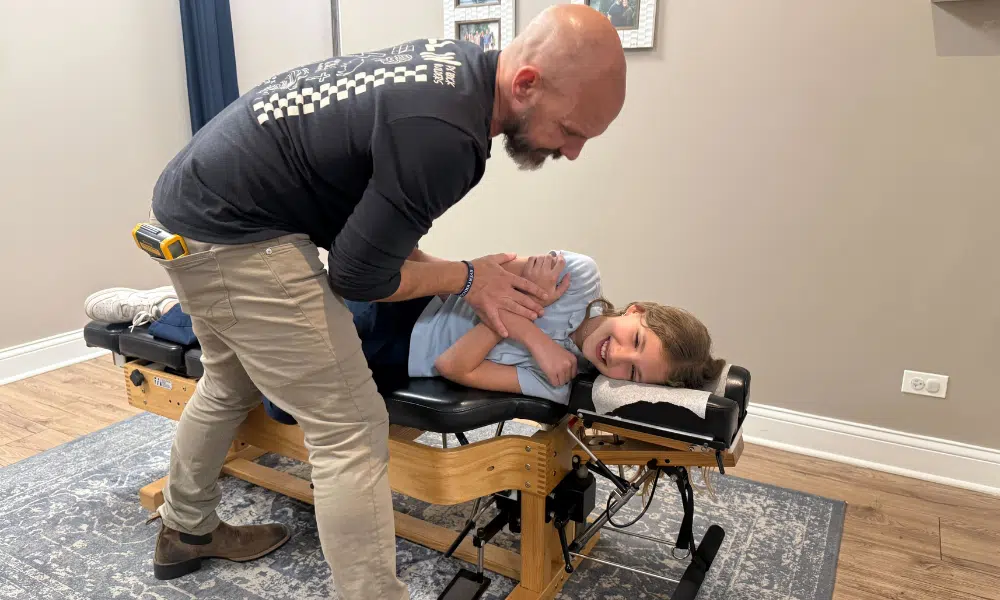
Neurologically-Focused Chiropractic Care helps a baby latch by finding and addressing the subluxation and tension interfering with the nerves that run feeding, so the brainstem and mouth muscles can coordinate again. Rather than working around a poor latch, this approach works on the reason the latch is often poor in the first place. The goal is to reduce neurological interference and let the baby’s own nervous system do the job it was built for.
This is worlds apart from the usual advice. Repositioning tricks, nipple shields, and special holds can be genuinely helpful, but they manage the symptom- the difficult latch and coordination of feeding- without touching the tension underneath. A lactation consultant and a PX Doctor working together is a powerful combination: the lactation support keeps feeding going today, while the neurological care resolves an underlying neurological root cause, so the workarounds are often no longer needed.
Babies respond remarkably well, because they’re new and their systems are primed to adapt. Newborn care uses gentle, specific contact, nothing like an adult adjustment, because babies are not little adults. Their anatomy and neurology are completely different. Clinically, we often see a baby’s latch, comfort, and feeding rhythm shift within a care plan built around their individual starting point, because every baby comes in with a different mix of birth history and tension. This is also why many families have their newborn checked soon after birth, while the nervous system is at its most responsive and the tension from delivery is easiest to address.
Additionally, we use INSiGHT scans.
INSiGHT scans are a set of neurological assessments used across Neurologically-Focused Chiropractic Care to measure how a baby’s nervous system is actually functioning. For babies, they combine two gentle, non-invasive readings:
- Heart rate variability (HRV), which reflects autonomic balance and vagal tone
- Thermal scanning, which reads autonomic function and where neurological interference is taking place.
Together, they turn “something feels off” into objective information.

To be clear: INSiGHT scans are not a treatment or a cure for any condition, not even back pain. They don’t diagnose Autism, reflux, or feeding conditions. They measure nervous system function, sympathetic dominance, tension patterns, and autonomic balance, so care can be aimed at what’s genuinely happening rather than guessed at. For a baby who won’t latch, that means seeing whether the nervous system is stuck in a stressed pattern and, over time, whether it’s shifting.
Your Baby Just Needs Some Help
A baby who won’t latch is almost always sending a nervous system message, one that started before you ever sat down to feed. The struggle traces back through birth tension to the nerves that coordinate suck, swallow, and breathe, which is why the fix isn’t another positioning hack. It’s helping the baby’s neurology work again.
Here’s how we make sure we’re actually helping, not just guessing. We don’t guess; we test. A baseline set of INSiGHT scans shows where your baby’s nervous system sits right now, whether the gas pedal is stuck down, and vagal tone is low. From there, repeat scans across the care plan tell us whether things are genuinely shifting: HRV climbing back toward a calmer, greener range, tension patterns organizing, the foundation holding. If the data says we’re on track, we keep building. If it says something needs to change, we adjust the plan. That’s what keeps your baby’s care anchored to what’s real inside their nervous system, not just how a feed looked this morning.
Your baby has been overwhelmed, and now you have a map. If latch struggles sound like your story, find a PX Doctor near you and have your baby’s nervous system checked by someone trained to look.
This article is educational and not medical advice. Consult your healthcare provider about your child’s individual needs.