
As a parent, you’ve watched your child explode over the smallest things—a tag in their shirt, the “wrong” cup, a slight change in routine. Or maybe it’s the opposite. Your child zones out completely, stares blankly when you call their name, sits at the dinner table like the lights are on, but nobody’s home.
Your pediatrician says it’s just a phase. “Try more structure.”
But you know this isn’t about discipline. These aren’t behavior problems your child can control. They’re survival responses from a nervous system stuck in fight, flight, or freeze mode.
You’ll learn what the three nervous system states are, how to recognize which rung your child’s trapped on, and what actually helps them regulate. But here’s what every other explanation misses—the WHY. Why does your child get stuck while other kids navigate stress effortlessly?
The answer lies in how your child’s nervous system developed from day one.
What Is the Polyvagal Ladder?
The polyvagal ladder visualizes the three states your child’s Autonomic Nervous System cycles through every day. Dr. Stephen Porges discovered this system while researching why some people respond to stress with fight-or-flight, while others freeze or shut down. His polyvagal theory revolutionized our understanding of how the nervous system prioritizes safety and threat responses.
Think of it like a three-rung ladder your child’s nervous system climbs based on what it perceives as safe or threatening.
The Three Levels of Nervous System Regulation
- At the top of the ladder is the ventral vagal state, the “safe and social” zone. Your child’s Parasympathetic Nervous System creates connection, calm, and learning. The ventral vagal pathway runs from the brainstem through the heart, lungs, and digestive system. When your child’s here, they make eye contact, respond to their name, play with siblings, and absorb what therapists teach them.
- Middle of the ladder is the Sympathetic Nervous System state, fight or flight. Your child’s body floods with adrenaline, heart rate spikes, blood pressure rises, and digestion shuts down. This is mobilization for survival. In this state, your child might run from situations, hit when overwhelmed, argue over everything, or resist any transition.
- Bottom of the ladder is the dorsal vagal state, freeze or shutdown. This is the oldest evolutionary survival strategy. Your child’s heart rate drops, they disconnect from their surroundings, and they check out. The lights are on, but nobody’s home.
Your child doesn’t choose which rung they’re on. Their nervous system makes that decision unconsciously.
How This Works in Children
The key concept is neuroception; your child’s nervous system constantly scans the environment for cues of safety or danger without conscious awareness.
Adults can sometimes override these automatic responses. Anxious before a presentation? You use breathing or self-talk. Your prefrontal cortex can influence your Autonomic Nervous System.
Your child can’t. Their prefrontal cortex won’t be fully mature until their mid-twenties. When your four-year-old melts down over a sock seam, or your eight-year-old won’t make eye contact at the family gathering, they’re not choosing that response. Their Autonomic Nervous System detected a threat and automatically moved them down the ladder.
The real question isn’t “What state is my child in?” It’s “Why does my child get stuck in these lower states when other kids bounce back?”
That’s where most explanations stop—and where our understanding begins.
Recognizing Where Your Child Is on the Ladder
Each rung of the polyvagal ladder has distinct physical and behavioral signs that tell you exactly where your child’s Autonomic Nervous System has landed.
Top Rung: Safe and Social (Ventral Vagal)
When your child’s in the ventral vagal state, you see a different kid. Their face is relaxed and expressive. They make eye contact naturally. Their voice has a normal tone and inflection. They respond when you call their name, tolerate frustration without falling apart, and seek connection.
Physically, their heart rate variability is high—meaning their Autonomic Nervous System is flexible and responsive. Their breathing is deep and even. Digestion works properly. Their immune system functions optimally because the vagus nerve coordinates immune activity.
This is the ONLY state where learning, therapy, and skill-building actually work. When your child’s on the top rung, their brain can process new information, form memories, and develop new pathways. Occupational therapy? Speech therapy? ABA? All require this safe and social state.
If your child spends most of their day in sympathetic or dorsal vagal territory, you’re asking them to learn while running from a bear or playing dead. The nervous system won’t allow it.
Does this sound like your child most of the time? Or are these moments of regulation few and far between?
Middle Rung: Fight or Flight (Sympathetic Nervous System)
The sympathetic state isn’t inherently bad. Your child needs this mobilization response for actual threats. The problem is when they get stuck here, living in chronic survival mode, where everything feels like an emergency.
You’ll see constant movement—fidgeting, pacing, running, jumping, and crashing into things. Their body’s burning off the adrenaline flooding their system. Many kids diagnosed with ADHD are experiencing chronic sympathetic activation. The hyperactivity, impulsivity, and inability to focus aren’t attention deficits—they’re a nervous system stuck on high alert.
Emotionally, these kids are reactive. Small frustrations trigger big meltdowns. Transitions are battles. Any demand or change sends them into fight mode (aggression, arguing, defiance) or flight mode (running away, hiding, refusing). They’re not being difficult on purpose. Their Autonomic Nervous System determined that the world isn’t safe.
Physically: increased heart rate even at rest, shallow chest breathing, digestive issues like diarrhea. Their body dumps resources into survival, which means everything else—digestion, immune function, growth, healing—gets deprioritized. Sleep is usually terrible. They resist bedtime, take forever to fall asleep, wake frequently, or wake exhausted because their nervous system never downshifts into true rest.
If the perceived threat doesn’t resolve and they can’t move back up to ventral vagal safety, their nervous system makes a last-resort decision: shut down completely.
Bottom Rung: Freeze and Shutdown (Dorsal Vagal)
This is the state that terrifies parents most because your child seems unreachable. They stare blankly when you talk. They don’t respond to their name. They sit motionless during activities that should engage them. They’re disconnected from their body, their surroundings, and the people around them.
The dorsal vagal shutdown state is your child’s nervous system playing dead. When fighting won’t work and fleeing isn’t possible, immobilization is the only survival strategy left. Heart rate drops. Blood pressure lowers. Muscle tone decreases.
Some kids shut down during overwhelming sensory experiences, such as the noise of a birthday party, the chaos of a grocery store, demands of a school day. Others disconnect during emotional stress. The Autonomic Nervous System determines that the best chance of survival is to not be present at all.
You’ll also see selective mutism—kids who speak normally at home but go silent at school. Their vocal cords are controlled by the ventral vagal pathway, and when that system shuts down, speech production stops.
Chronic dorsal vagal activation can present as persistent fatigue, excessive sleep, slow movement, a monotone voice, and a lack of facial expression. Physical manifestations: chronic constipation, weakened immune function leading to constant infections, slow healing, and failure to gain weight.
The Real Reason Your Child Can’t Climb the Ladder
It’s not genetics. It’s not bad parenting. It’s not random.
It’s the “Perfect Storm,” three factors creating conditions for nervous system dysfunction: prenatal stress, birth trauma, and early childhood stressors.
The “Perfect Storm” Framework
Think back to your pregnancy. Were you stressed? Anxious? That stress didn’t just affect you; it affected your developing baby’s nervous system.
When you’re dealing with prenatal stress, cortisol and adrenaline cross the placenta and impact fetal brain development. Your baby’s nervous system is programmed in a stressed state before birth. The sympathetic system develops earlier and stronger—the gas pedal works great, the brake pedal barely functions.
Then came the birth. Was it long? Interventions? Induction with Pitocin? Epidural? C-section? Forceps or vacuum? Even “normal” hospital births often involve significant trauma to your baby’s delicate neck and spine.
The vagus nerve—the main parasympathetic nerve controlling the social engagement system—exits the skull at the base of the head and travels through the neck. Birth trauma creates subluxation (neurological interference) at exactly this location, suppressing vagus nerve function from day one.
This isn’t about blame. This is about understanding the mechanism. When your baby’s vagus nerve gets compressed during birth, it can’t regulate heart rate, control digestion, coordinate immune function, enable speech, or create the physiological state for social connection.
Finally, early childhood stressors compound the dysfunction. Your baby with an already-stressed nervous system now faces normal infancy challenges—vaccinations, illnesses, antibiotics, sleep deprivation, toxins. The nervous system never gets to reset.
How a Dysregulated Ladder Shows Up
Autism & social engagement
- The ventral vagal system controls facial expression, eye contact, voice, sound filtering, and social connection
- When suppressed, kids struggle with eye contact, speech, facial cues, and sensory overload
- These aren’t deficits in intelligence—this is a nervous system stuck in protection mode
- Sensory input is routed through the brainstem
- Dysregulation creates a “traffic jam”: some sensations come in too strong (hypersensitivity), others barely register (hyposensitivity)
- Same root issue, different signs
Speech delays
- The vagus nerve controls the soft palate, pharynx, and larynx
- Kids may understand language but struggle to produce speech due to poor motor coordination
- Often linked to early nervous system or cervical stress
Sleep, digestion, and immunity
- All are governed by the parasympathetic (vagal) system
- Poor vagal tone commonly leads to:
- Trouble falling or staying asleep
- Digestive issues like reflux, constipation, or food sensitivities
- Frequent illnesses and infections
How to Know Where Your Child Is (Beyond Observation)
PX Docs providers use INSiGHT scanning to objectively measure nervous system function:
- Heart Rate Variability (HRV) measures autonomic adaptation to stress. High HRV means flexible regulation. Low HRV means a stuck system. Kids with chronic sympathetic dominance or dorsal shutdown show dramatically reduced HRV.
- Thermal scanning shows an autonomic imbalance along the spine. Temperature differences reveal where the system is dysregulated.
- EMG (electromyography) measures neuromuscular tension patterns from subluxation, and often shows chronic exhaustion in the core that correlates with dorsal shutdown.
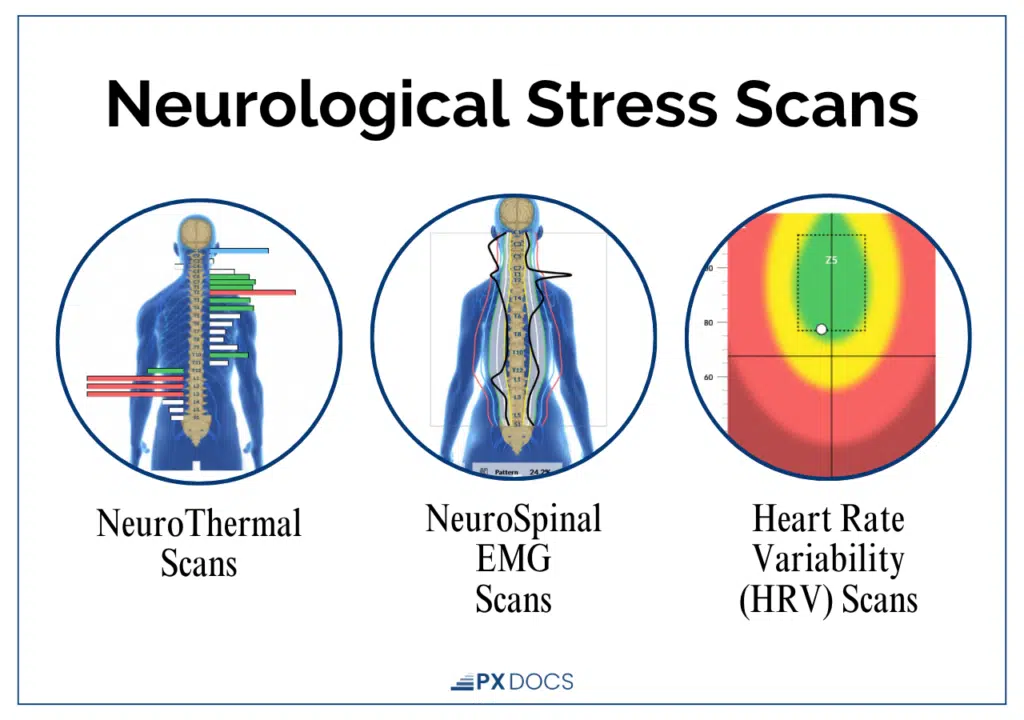
The scans are completely non-invasive — no needles, no radiation. By gathering this detailed information, we can see how a child’s nervous system is functioning and create a customized care plan that addresses their specific needs. Parents often tell us, “This is the first time anyone has shown me objective proof of what’s going on.” From there, we can build a clear plan and take meaningful action moving forward.
Supporting Your Child’s Nervous System Regulation with Neurologically-Focused Chiropractic Care
Neurologically-Focused Chiropractic Care doesn’t just manage symptoms. It works to remove interference at the source — the subluxation affecting vagus nerve function and autonomic balance. When subluxation is adjusted, and the nervous system can regulate more effectively, the vagus nerve can do its job, and the body regains the foundation it needs to heal and adapt.
We see this play out in real life all the time.
One family came to us after months of speech therapy and occupational therapy that just weren’t sticking. Their son had words in therapy sessions, but at home, he was frustrated, dysregulated, and often shut down. Everyone was working hard, but his nervous system was stuck in a constant stress state.
Once we began calming and regulating his nervous system through Neurologically-Cocused Chiropractic Care, something changed. His parents started noticing that he was calmer, sleeping better, and more engaged with the world around him. Then, the therapies that had once felt like a struggle suddenly started working better for him.
When a child’s nervous system can access the “safe and social” state, speech therapy works better. OT strategies stick. Behavioral interventions actually begin to change behavior — because the child can finally access the state where learning and development happen.
Your Child Isn’t Broken
The polyvagal ladder gives you a new way to understand your child’s struggles. They’re not manipulative, defiant, or difficult. They’re stuck in survival states, their Autonomic Nervous System deemed necessary.
But stuck doesn’t mean permanent.
When you address the Perfect Storm factors—especially the birth trauma and subluxation suppressing vagus function—you give your child’s nervous system the chance to climb the ladder. To access the safe and social state where learning happens, where connection feels good, where their brilliant mind can work with a nervous system that cooperates.Ready to take the next step? Visit our directory to find a PX Docs provider who can perform a neurological assessment with INSiGHT scans. You’ll see exactly where your child’s nervous system is stuck and get a specific care plan to remove the interference keeping them trapped on the lower rungs.