
An alarming reality for millions of parents today is that what first seemed like a few simple ear infections and acute viral infections, over time, builds to their child struggling with a chronic illness and autoimmune conditions.
This all-too-common path starts with your conventional pediatrician continuing to brush off your child’s recurrent infections or chronic inflammation as “normal” and something they’ll “grow out of” over time. But for most parents, deep down, they knew all along something wasn’t “normal” after all, and bigger issues were brewing.
Looking at things on a broader scale, the explosive rise in pediatric autoimmune conditions didn’t happen by chance, and genetics alone can’t explain why approximately 30% of children now battle chronic health challenges.
The answer is multi-faceted and certainly centers on our current toxic lifestyle and environment, but that’s not the only place to look for answers. While many holistic and natural-minded approaches focus externally—such as removing toxins, improving nutrition, and using supplements—there is also a critical internal connection.
Specifically, your child’s vagus nerve is directly linked to their immune system’s capacity to manage and regulate inflammation.
When the vagus nerve isn’t functioning properly, the body can struggle to turn off inflammatory responses, and over time, autoimmune disorders can settle in, even for our children.
At PX Docs, we’ve seen thousands of kids whose autoimmune struggles trace back to a “Perfect Storm” of early stressors, prenatal stress, birth trauma, and developmental challenges that damaged their nervous system’s ability to regulate inflammation from day one.
In this article, you’ll discover how the vagus nerve controls the immune response, why dysfunction leads to chronic inflammation and autoimmune conditions, and what you can do to address the root cause rather than managing the signs.
What Is the Vagus Nerve?
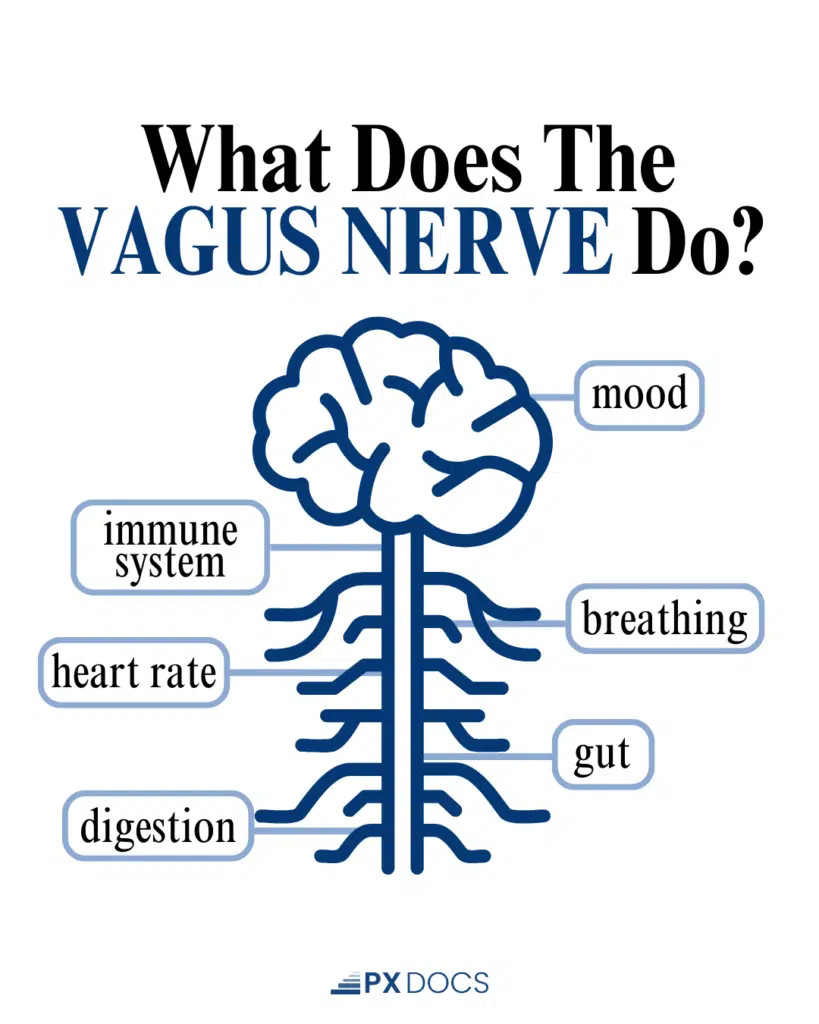
The vagus nerve is the longest cranial nerve in your body, connecting your brain to your heart, lungs, digestive system, and immune organs. The name comes from Latin for “wandering.” This nerve literally wanders from your brainstem through your neck, chest, and abdomen—making it as far “south” as your diaphragm, endocrine system, and the gastrointestinal system.
It’s the primary component of your Parasympathetic Nervous System, what we call the “brake pedal.” While your Sympathetic Nervous System acts like a gas pedal (fight or flight), the vagus nerve puts on the brakes to help you rest, digest, heal, and regulate. It controls heart rate, breathing, digestion, immune responses, and emotional regulation.
The vagus nerve exits your brain through the brainstem and travels down through your upper cervical spine. Any physical trauma or subluxation in this area, which often happens during birth, can interfere with vagus nerve signaling before your child even takes their first breath.
When the vagus nerve can’t function properly because of physical stress at the brainstem, the entire parasympathetic system goes offline. Your child loses their ability to “put on the brakes,” stay calm, digest food properly, regulate their immune system, and control inflammation.
This creates nervous system dysregulation and dysautonomia, the foundation for chronic health challenges that conventional medicine cares for as separate conditions when they’re all connected to this one thing — vagus nerve dysfunction.
The Cholinergic Anti-Inflammatory Pathway
The discovery that changed everything happened more than 20 years ago at the Feinstein Institutes for Medical Research on Long Island. Dr. Kevin Tracey and his team were testing an experimental drug meant to prevent brain inflammation in rats when they noticed something unexpected: the drug also stopped inflammation throughout the rest of the body. The reason turned out to be a neural signal traveling down the vagus nerve from the brain—essentially, the brain was telling the immune system to calm down.
This led to the discovery of what scientists now call the cholinergic anti-inflammatory pathway, a hardwired nervous system mechanism that controls your immune response.
Here’s how it works: when inflammation starts in your body, afferent (incoming) vagus nerve fibers detect the inflammatory molecules and send signals up to your brain. Your brain processes this information and then sends signals back down the efferent (outgoing) vagus nerve fibers, which release a neurotransmitter called acetylcholine.
Acetylcholine attaches to special spots on immune cells, especially in the spleen, and tells them to slow down inflammation. It does this by blocking the release of inflammatory proteins such as TNF, IL-6, and IL-1, which can cause swelling and pain.
It works like a built-in feedback system. When inflammation rises, the vagus nerve responds by releasing acetylcholine to calm it back down.
Why Proper Vagus Nerve Function Matters for Your Child
But here’s where it gets critical for kids with chronic health challenges: this inflammatory reflex only works when the vagus nerve is functioning properly. If there’s interference with vagal signaling, whether from physical compression (subluxation) at the brainstem and neurospinal system or chronic stress keeping the nervous system in sympathetic overdrive, this natural anti-inflammatory pathway goes offline.
When that happens, your child’s immune system loses its off switch. Inflammation that should have been controlled and resolved instead becomes chronic. The body keeps producing inflammatory cytokines without the vagal brake to stop them.
This sets the stage for everything from recurrent infections and allergies to full-blown autoimmune conditions like PANS/PANDAS, where the immune system attacks the body’s own tissues.
How Vagus Nerve Dysfunction Leads to Autoimmune Disease
When the vagus nerve can’t properly regulate the inflammatory response, the immune system loses its ability to distinguish between healing inflammation and destructive inflammation. This creates a cascade leading directly to autoimmune conditions.
When the vagal brake pedal stops working, the cholinergic anti-inflammatory pathway goes offline. Immune cells in the spleen and throughout the body no longer receive the acetylcholine signal telling them to calm down. Pro-inflammatory cytokines like TNF-α and IL-6 continue to be produced without the normal regulatory shutdown.
At the same time, the Sympathetic Nervous System, the gas pedal, stays stuck “on.” This is dysautonomia: sympathetic overdrive meets parasympathetic suppression. Kids stuck in this pattern have bodies constantly in perceived threat, with stress hormones elevated and the immune system primed for action.
This chronic inflammatory state creates a “cytokine storm,” excessive inflammatory molecules attacking tissues throughout the body. It triggers molecular mimicry, in which antibodies created to fight infections begin to cross-react with the body’s own proteins, leading to autoimmune attacks on joints, organs, and tissues.
And here’s the vicious cycle: chronic inflammation itself causes further damage to the vagus nerve, worsening subluxation and nerve interference, which in turn suppresses vagal function, leading to more uncontrolled inflammation.
We see this pattern constantly. The baby with severe colic and reflux becomes the toddler with constant ear infections who becomes the school-age child with allergies, asthma, and eventually autoimmune markers. At each stage, conventional medicine cares only for the signs, while the underlying vagus nerve dysfunction gets progressively worse.
The “Perfect Storm”: Early-Life Origins of Vagus Nerve Dysfunction
Mainstream medical research on the vagus nerve and autoimmune disease overlooks the critical question: why did the vagus nerve stop functioning properly? They’ve discovered mechanisms, they’re developing stimulation devices, but they’re not asking what damaged it to begin with.
At PX Docs, we call it the “Perfect Storm,” a convergence of environmental factors during critical developmental periods that overwhelms the nervous system. It’s a cascade that begins before birth and progresses through early childhood, with each stressor building until the nervous system can’t compensate.
- Prenatal stress is the first component. Maternal stress, anxiety, or trauma during pregnancy sends stress hormones like cortisol across the placenta, directly impacting the developing fetal nervous system. These hormones affect how the vagus nerve develops in utero, setting dysfunction patterns before birth.
- Birth trauma: Far more common than most parents realize. Beyond obvious complications like emergency C-sections or forceps, even routine interventions like Pitocin induction or prolonged pushing generate enormous pressure on the infant’s head, neck, and brainstem. The vagus nerve exits through the brainstem and travels down through the upper cervical spine. During birth, pulling forces can create subluxation in the upper neck and brainstem. This physical stress directly impacts vagus nerve function from day one.
- Cascade of early stressors: Babies with vagus nerve dysfunction can’t regulate digestion (colic, reflux, constipation), calm their nervous system (sleep difficulties, excessive crying), or maintain proper immune function (frequent ear infections). Each round of antibiotics disrupts the gut microbiome, which communicates with the brain through the vagus nerve, creating more dysfunction.
By school age, these kids operate with a nervous system dysregulated since birth. Vagal tone is suppressed, the sympathetic system dominates, and the inflammatory reflex is offline. Some develop obvious autoimmune conditions. Others show precursor patterns, chronic allergies, eczema, recurrent infections, indicating immune dysregulation even before full autoimmune disease manifests.
Vagus Nerve Stimulation Research for Autoimmune Disease
Research into vagus nerve stimulation (VNS) for autoimmune diseases has exploded over the past decade. When you restore vagal function, even artificially, the immune system can regulate itself properly again.
There are two types:
- Invasive VNS (surgically implanted device wrapping around the vagus nerve)
- Transcutaneous VNS (non-invasive stimulation through the ear or neck).
A trial with 242 patients showed dramatic results: active stimulation significantly improved disease activity scores, dropped inflammatory markers substantially, and slowed joint damage progression.
Crohn’s disease studies showed reductions in disease activity, decreased levels of inflammatory proteins, and even improvement in intestinal inflammation, visible on endoscopy.
Lupus trials found transcutaneous VNS reduced pain and fatigue scores while decreasing certain inflammatory markers. The non-invasive nature makes it appealing—no surgery, minimal side effects, home use possible.
Safety has been favorable. Invasive VNS causes occasional voice changes, throat pain, or headache. Transcutaneous VNS causes even fewer issues, maybe skin irritation. Serious complications are rare.
In comparison, Neurologically-Focused Chiropractic Care has an even stronger safety profile, and recent research is beginning to show the incredible benefits of this drug- and surgery-free intervention in repairing long-standing neuroimmune system dysfunction.
The Research Behind Chiropractic & Immune System Support
Over the past several years, research has begun to catch up with what many families have been observing clinically for decades — that when you improve nervous system function, immune system regulation improves as well.
One recent randomized controlled trial followed adults who received 12 weeks of chiropractic adjustments and measured objective biomarkers of stress, inflammation, and neuroplasticity. The researchers didn’t just ask participants how they felt — they measured blood markers like:
- BDNF (Brain-Derived Neurotrophic Factor) – a key protein that supports brain adaptability and resilience
- Cortisol – the body’s primary stress hormone
- Inflammatory cytokines like TNF-α and IL-6 — the same inflammatory messengers involved in autoimmune conditions
What they found was powerful.
After 12 weeks of chiropractic care, participants showed:
- Increased BDNF levels (supporting improved brain adaptability and neuroplasticity)
- Reduced TNF-α levels, a major inflammatory cytokine involved in autoimmune processes
- Favorable shifts in cortisol patterns over time, suggesting improved stress regulation
In simple terms?
The nervous system showed signs of greater adaptability, and inflammatory markers shifted toward better regulation.
That’s not “symptom chasing” or suppression. That’s upstream physiology.
Why This Matters for Autoimmune Families
Autoimmune challenges are not just immune system problems.
They are neuro-immune regulation problems.
The immune system does not operate independently — it constantly receives instructions from the brain through pathways such as the vagus nerve and the autonomic nervous system.
When brain-body communication improves, immune behavior can change.
Another comprehensive systems biology review explored this exact connection — describing how spinal dysfunction can influence neuroendocrine-immune signaling and how chiropractic adjustments may help restore healthier communication between the brain, stress system, and immune system.
The review highlights something many parents instinctively understand:
The body is not a collection of separate parts. It is an integrated, communicating system.
If the communication improves, the regulation improves.
Bringing It Back to Your Child
Now, let’s be clear.
This research was conducted in adults with spinal dysfunction — not children with autoimmune disease. We have to be responsible and honest about that.
But what it demonstrates is something critically important: When you support nervous system regulation, you influence immune system behavior.
And when we talk about vagus nerve dysfunction and the cholinergic anti-inflammatory pathway, this is exactly the mechanism we’re referring to.
The goal is not to “stimulate” the immune system. The goal is not to suppress it.
The goal is to help the nervous system regulate it.
Because a well-regulated nervous system has the capacity to:
- Turn inflammation on when needed
- Turn inflammation off when appropriate
- Adapt to stress
- Recover from challenges
That’s resilience. That’s regulation. That’s restoration of function from the inside out.
And for families walking the autoimmune road, that shift in understanding changes everything.
The Critical Question They’re Not Asking
Here’s what the conventional research around vagus nerve stimulation consistently misses: if electrically stimulating the vagus nerve reduces autoimmune inflammation this effectively, what does that tell us? The problem isn’t that the immune system is fundamentally broken; it’s that the nervous system’s control over immunity isn’t working.
They’re treating vagus nerve dysfunction by artificially stimulating the nerve without asking why it stopped working. It’s like using a pacemaker without investigating what damaged the heart’s natural pacing. The device forces the vagus nerve to fire and release acetylcholine, but doesn’t address the underlying cause.
What if the vagus nerve isn’t firing because there’s physical interference from subluxation at the brainstem and upper cervical spine? What if birth trauma created compression, disrupting its signaling? Before devices that artificially stimulate, shouldn’t we check whether physical stress prevents it from working naturally?
Natural Ways to Support Vagal Tone
While research focuses on electrical devices, natural approaches can support vagal tone:
- Deep breathing exercises (especially extending the exhale)
- Cold exposure (splashing face with cold water, cold showers)
- Anti-inflammatory foods (omega-3s, fermented foods)
- Stress management (meditation, yoga)
- Quality sleep
- Positive social connections.
But, a critical point, these can’t correct structural interference. If subluxation at the brainstem or upper cervical spine physically interferes with this critical nerve function, breathing exercises and dietary changes won’t fix that mechanical problem. They might support remaining vagal function, but can’t remove physical interference preventing proper nerve function.
This is why parents say, “We tried everything, diet, supplements, stress reduction, and it helped a little, but our child still struggles.” They were supporting a dysfunctional system rather than correcting the dysfunction itself.
Neurologically-Focused Chiropractic Care for Vagal Function
This is where everything comes together into a solution that addresses the root cause rather than managing symptoms or artificially stimulating the nervous system. We remove the interference preventing the vagus nerve from functioning naturally.
The vagus nerve’s path makes it vulnerable to physical stress and subluxation. It exits the brain through the jugular foramen at the skull base and travels down through the upper cervical spine. Any interference, fixation, or tension in the upper neck can create direct mechanical stress on the vagus nerve.
Subluxation isn’t just bone displacement. It’s a complex pattern of:
- Structural and neuromuscular tension and alterations in tone
- Restricted movement (fixation), preventing normal proprioceptive signaling
- Neurological interference disrupting normal sensori-motor and autonomic nerve firing patterns, including the vagus nerve
Neurologically-Focused Chiropractic adjustments work to restore proper neurological function and communication, clearing subluxation and sympathetic dominance out of the way, and stimulating or activating vagal nerve tone and parasympathetic function. This specialized care allows subluxation patterns to unwind, reduces surrounding inflammation, and helps address the “internal” root cause of chronic neuroimmune system dysfunction.
Measuring Progress Objectively
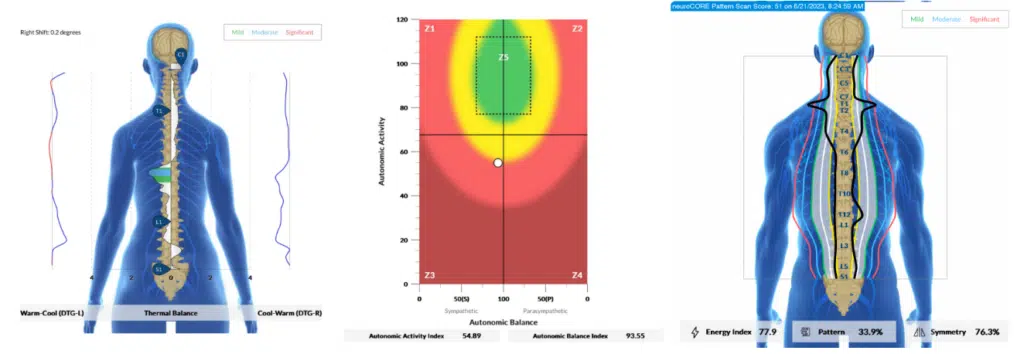
We measure nervous system function using INSiGHT scanning technology. These scans show exactly where the nervous system is dysregulated, what level or stage of subluxation is present, and exactly where subluxation is creating interference.
Typical NeuroThermal Scans in kids with vagal dysfunction and immune challenges show extreme sympathetic dominance, red and heat patterns indicating stress and inflammation throughout the nervous system. The upper cervical area often lights up bright red, showing exact subluxation location and nerve interference. Additionally, the DTG shows the chronicity of the subluxation and neurological dysfunction.
When it comes to the EMG Scan, the same is true — with red (or even black) lines of tension often showing up in the brainstem and cervical regions, but then asymmetry and exhaustion showing in the transitional zones and core region — indicating both tension and exhaustion.
Finally, it’s the 3rd and final INSiGHT Scan that really tells the story of long-standing vagus nerve dysfunction and autoimmune conditions. For most patients struggling with autoimmune disorders and chronic illness, their HRV (even for children) shows complete depletion and global neurological exhaustion, just like the scan below.
You can see these 3 scan examples below:
Why This is Different
This differs fundamentally from artificially stimulating the vagus nerve with devices. We’re not forcing the nerve to fire. We’re removing interference preventing natural firing. We’re restoring proper function and range of motion to the neurospinal system, which in turn stimulates proprioceptive input and activates vagal nerve tone.
This creates such a more potent and foundational impact on the vagus nerve and autonomic nervous system, and since it’s truly about restoring function from the “inside out” — the body does not become attenuated to it and start to experience diminished returns over time, which should be expected with any “outside in” vagus nerve stimulation device of any kind.
Kids who get this care don’t just see neuroimmune function improve. They get their natural healing capacity back. Their bodies regulate inflammation properly, fight infections effectively, digest food optimally, and handle stress appropriately, all because their vagus nerve can finally do what it was designed to do!
Restoring Function from the Inside Out
The connection between your child’s vagus nerve and immune system is established in neuroscience, and it’s something Neurologically-Focused Family Chiropractors have been talking about for a very long time. The cholinergic anti-inflammatory pathway is real, and vagal dysfunction has been linked to autoimmune conditions.
Conventional medicine typically focuses on suppressing the immune system and inflammation with potent medications that often carry significant side effects. Similarly, the functional or integrative medical approach primarily addresses autoimmunity through nutritional interventions such as diet modification, detoxification, and supplements.
However, a crucial and foundational element often overlooked in most autoimmune care protocols is addressing nervous system dysregulation and vagus nerve dysfunction. This vital aspect can be effectively addressed through targeted, specific chiropractic adjustments.
At PX Docs, we’ve seen thousands of children told their condition was genetic or lifelong, or that their family had to adhere to a strict diet and almost perfect lifestyle to avoid flare-ups and inflammatory foods or triggers.
Clearly, genetics, nutrition, and lifestyle play a vital role in all of our health and the functioning of the immune system — but right there “hidden in plain sight” this whole time is perhaps the single most important player in this whole conversation — the vagus nerve and autonomic nervous system.
This is where Neurologically-Focused Chiropractic Care shines: going deeper and addressing the root cause more effectively and strategically than any other intervention.
If you or your child struggles with chronic inflammation or any sort of autoimmune conditions or health challenges, start by asking whether their nervous system is truly functioning as it should, because lasting change begins at the deepest layer and foundational root cause. Find a PX Docs provider near you through our directory and get you or your child’s nervous system checked. The body knows how to heal when the interference is removed. Your job is to find someone who knows how to remove it.