
There’s a reason breathing exercises and calm-down corners haven’t fully helped—and it’s not because you’re doing anything wrong. Your child’s nervous system may be stuck in a heightened state, making it hard to shift into calm and regulation on their own. No amount of strategies, routines, or therapy tools will work fully until the underlying nervous system communication is supported.
Polyvagal therapy offers a new lens for understanding stress and regulation, focusing on the body’s Autonomic Nervous System rather than just talk therapy. Developed by Dr. Stephen Porges in the 1990s, polyvagal theory revolutionized how we understand the connection between the nervous system, our sense of safety, emotional regulation, and our ability to connect with others.
But applying this framework to children requires a different approach. Their nervous systems are still developing, and the ways they compensate, adapt, and express stress don’t always look like what we see in adults. Understanding these differences is key to helping children regulate, thrive, and feel more at ease in their bodies and minds.
What Is Polyvagal Therapy?
Polyvagal therapy isn’t a single, certified care modality. It’s a framework for understanding how the Autonomic Nervous System drives behavior, emotions, and our capacity to feel safe.
Dr. Stephen Porges developed polyvagal theory in 1994 after decades of studying the vagus nerve’s role in emotional regulation. His research revealed that our nervous system constantly evaluates safety and danger without conscious awareness, and this evaluation drives most of our responses.
Today, polyvagal principles are integrated into somatic experiencing, sensorimotor psychotherapy, and trauma-focused therapy. While Porges focused on adult applications, the principles apply throughout development—starting before birth.
Understanding the Autonomic Nervous System
Your Autonomic Nervous System controls everything that happens automatically—heart rate, breathing, digestion, immune response, and emotional state. It constantly shifts between different states based on perceived safety or threat.
The Three Neural Pathways
- Ventral Vagal Complex: Safe and Social – This is your optimal state where you feel calm, connected, and capable of engaging with others. Kids in this state can learn, play, and self-regulate.
- Sympathetic Nervous System: Fight or Flight – When your nervous system detects a threat, this mobilization system activates. Heart rate increases, breathing quickens, and blood flows to muscles. When this system stays activated chronically, it creates anxiety, panic, hyperactivity, and an inability to settle.
- Dorsal Vagal Pathway: Shutdown and Freeze – When a threat feels overwhelming, this oldest defense activates: immobilization, shutdown, collapse. When it activates inappropriately, it manifests as depression, dissociation, and emotional numbing.
How the Vagus Nerve Regulates Your State
The vagus nerve is the longest cranial nerve in your body, connecting your brainstem to your heart, lungs, and digestive system.
Think of the Sympathetic Nervous System as your gas pedal—it mobilizes you, speeds everything up. The Parasympathetic Nervous System is your brake—it slows things down, promotes rest, regulation, and recovery. When both work properly, you smoothly accelerate and decelerate through your day. But when the nervous system gets stuck, you’re either driving with the gas pedal pressed to the floor and failing brakes, or you’re stuck in neutral.
Vagal tone refers to your nervous system’s flexibility and adaptability. High vagal tone means your nervous system can shift smoothly between states. Low vagal tone means you’re stuck. Heart rate variability (HRV) measures this—the variation between heartbeats reflects vagal nerve function.
Polyvagal Theory and Trauma Response
Traditional trauma therapy focused on processing memories. But for many people, their bodies still react as though the threat persists. Polyvagal theory explains why: trauma isn’t stored primarily in memory. It’s stored in the nervous system.
Neuroception is your nervous system’s unconscious threat detection. When functioning properly, it accurately distinguishes safety from threat. But trauma can damage this system, sending danger signals even when you’re safe.
The window of tolerance is the range in which you can function optimally. Outside this window—in hyperarousal or hypoarousal—you’re in survival mode. Trauma narrows this window.
When stuck in sympathetic dominance, people experience anxiety, panic, hypervigilance, and an inability to relax. When stuck in dorsal vagal shutdown, they experience depression, dissociation, numbness, and fatigue. Both states block access to the ventral vagal complex—your social engagement system.
How Polyvagal Therapy Works
Polyvagal therapy uses a bottom-up approach. You can’t think your way out of a nervous system state. When you’re in fight/flight or shutdown, your thinking brain has reduced function.
Bottom-up processing addresses the physiological state first. Safety, in polyvagal terms, isn’t cognitive—it’s a biological state detected through specific cues.
Co-regulation is key: one person’s nervous system influences another’s. The therapist’s regulated nervous system provides safety cues that help shift the client out of a defensive state.
Common techniques include:
- Listening protocols (Safe and Sound Protocol)
- Rhythmic breathing to activate the vagus nerve
- Biofeedback for real-time nervous system data
- Somatic therapies to release trauma stored in the body
These approaches can be effective for adults with PTSD, anxiety, and trauma. But there’s a significant gap when it comes to children.
But What About Children’s Nervous Systems?
Adult therapy often assumes a fully developed nervous system that is later disrupted by specific traumatic events. Children’s nervous systems, however, are still forming—often while stressors are present.
Kids aren’t just small adults. Their autonomic systems are actively developing during the very experiences that create dysregulation. They can’t always articulate what they’re feeling or consciously practice regulation strategies. As a result, their challenges show up differently—often as colic, sensory overwhelm, sleep disturbances, or meltdowns.
This naturally raises an important question: how do children experience stress? It’s not just from major emotional traumas or dramatic events. In reality, stress is far more nuanced, and many of the same factors that influence a child’s nervous system early in life—emotional challenges, physical strain, and chemical or environmental stressors—can continue shaping how their nervous system functions well into adulthood.
The “Perfect Storm”: When Polyvagal Disruption Begins Early
At PX Docs, we call this developmental cascade “The Perfect Storm“—the missing link in understanding childhood nervous system dysregulation.
It’s rarely a single factor. It’s the cascade: prenatal stress affecting the developing nervous system, physical trauma during birth creating neurospinal interference, and early childhood stressors overwhelming an already-stressed system.
Prenatal and Birth Stress
Maternal stress hormones cross the placenta, affecting fetal nervous system development. The autonomic system develops during this stress.
Then comes birth. Whether through C-section, forceps, vacuum extraction, induction, manual assistance, or prolonged labor, the physical forces can create trauma to the infant’s upper cervical spine and brainstem—exactly where the vagus nerve originates.
After birth, additional stressors such as environmental toxins, antibiotics, infections, and emotional stress continue to shape how the nervous system adapts and regulates.
All of these stressors can create subluxation—neurological interference that keeps the nervous system stuck in a sympathetic stress response. That interference can affect the vagus nerve’s ability to activate the calming, regulating parasympathetic nervous system.
At the earliest stage, this explains why some babies never settle. They’re stuck in sympathetic dominance (colic, poor sleep) or dorsal shutdown (failure to thrive, low tone). Their nervous system developed with interference blocking proper regulation. And the symptoms and challenges change and evolve as the child gets older.
Polyvagal Dysregulation in Childhood Conditions
From a polyvagal perspective, many childhood challenges represent stuck autonomic states:
- Colic – Early polyvagal disruption showing dorsal vagal response to birth trauma. Digestive dysfunction, sleep problems, and inconsolable crying reflect a nervous system stuck in distress.
- Sensory Processing Disorder: A nervous system stuck in threat detection. Sympathetic overdrive means every sound feels too loud, every touch too intense. Meltdowns are dorsal vagal shutdown—the nervous system collapsing when fight/flight fails.
- Autism – Social engagement requires a functional ventral vagal pathway. Many children with Autism show dorsal vagal dominance or difficulty accessing safe social engagement. The vagus nerve also regulates digestion, explaining common gut issues.
- ADHD – Sympathetic dominance creates hyperactivity and impulsivity. Poor vagal tone means difficulty in self-regulating. Medications work temporarily but don’t address underlying nervous system dysfunction.
Detecting Polyvagal Patterns
Adult therapy relies heavily on subjective reports and surveys—what someone can articulate about their internal experience, emotions, and symptoms. Case history plays an important role, but it represents only part of the story.
Children, however, often lack the language, awareness, or developmental capacity to explain what they’re feeling. Their nervous system stress shows up through behavior, physiology, and regulation patterns rather than words. That’s why observation and history alone aren’t enough; to truly understand what’s happening, we need to look deeper and assess how the nervous system is functioning beneath the surface.
At PX Docs, we use INSiGHT Scanning Technology to objectively measure nervous system function—precise measurements revealing exactly what polyvagal theory describes.
- HRV scans show sympathetic/parasympathetic balance and measure adaptability and resilience to stress
- EMG scans measure neuromuscular tension and abnormal energy expenditure
- Thermal scans detect autonomic dysregulation along the neurospinal system
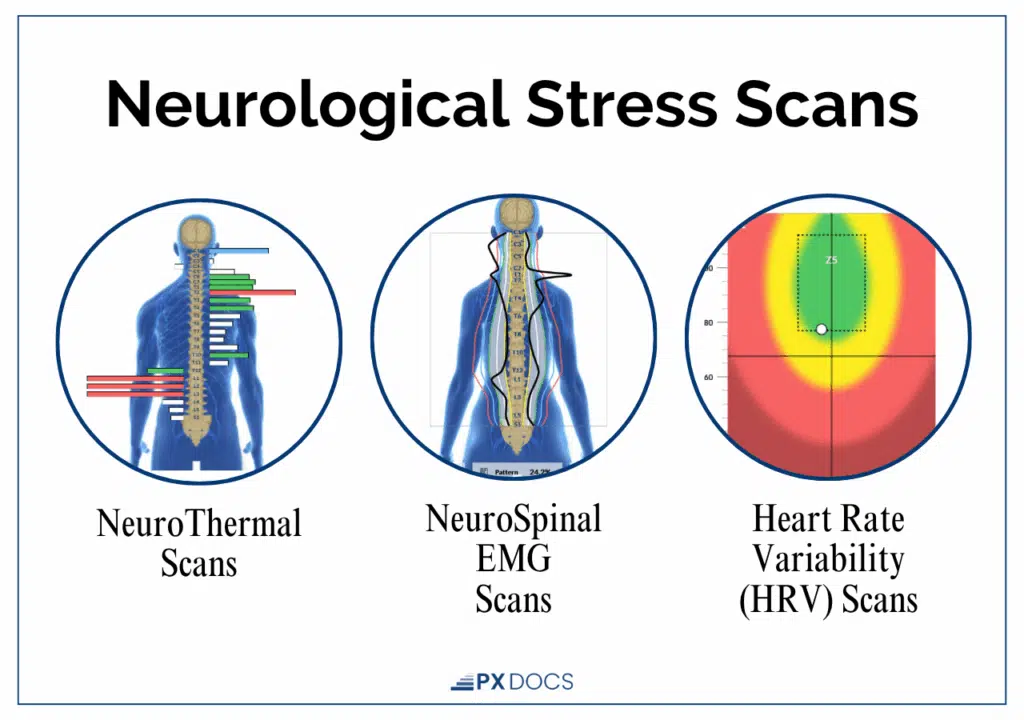
These scans give us objective insight into a child’s nervous system, showing when they’re stuck in sympathetic overdrive or dorsal shutdown. They allow us to track progress over time, correlate changes with symptoms or challenges, and adapt care as needed. By monitoring the nervous system directly, we can see healing in action—even before the changes become noticeable in behavior or daily function.
Addressing the Root Cause
This is the missing piece in conventional polyvagal therapy. You can teach breathing exercises, use therapy techniques, and provide co-regulation, but if subluxation is internally interfering with and altering vagus nerve function, the nervous system can’t utilize that input or shift states.
The vagus nerve exits the brainstem at the base of the skull, travels through the upper cervical spine, and all the way into the thorax and abdomen. When subluxation patterns exist, especially along this pathway, they create interference right at the source. It’s like static on a phone line. Nerve signals are distorted, delayed, and diminished.
Therapy techniques require a nervous system capable of responding. If subluxation interference occurs, techniques won’t work fully or optimally.
Regulation strategies work best when the nervous system has the capacity to respond. By reducing interference and supporting clear communication within the nervous system, the body becomes better able to regulate itself. This allows calming tools, therapy, and connection to actually do what they’re meant to do—support your child’s ability to feel safe, calm, and regulated.
Neurologically-Focused Chiropractic Care
At PX Docs, we’re not doing polyvagal “therapy” in the traditional sense. We’re removing interference so the child’s polyvagal system can function as designed.
Neurologically-Focused Chiropractic Care uses gentle adjustments to remove subluxation patterns, restore proper nervous system communication, and allow the Autonomic Nervous System to self-regulate. We’re not forcing changes—we’re removing interference that blocks the body’s innate healing capacity.
We begin with a comprehensive neurological examination and INSiGHT scans to identify stress patterns. Specific adjustments and unique care plans address the findings revealed by scans. Progress tracking shows nervous system changes.
Parents report better sleep, fewer meltdowns, enhanced social engagement, improved digestion, and reduced sensory overwhelm. And critically—sustained changes, not temporary relief.
When needed, we also encourage families to work with a full support team. When the nervous system is free to function, all other therapies—occupational therapy, speech therapy, behavioral therapy—become more effective.
Moving Forward with Hope
Polyvagal theory revolutionized our understanding of trauma and regulation. But the application requires recognizing that children’s nervous systems develop during stress, not just respond to it. And addressing subluxation, if present, is necessary for optimal vagus nerve function, healing, and thriving.
Your child’s nervous system isn’t broken. It adapted to early stress. But that adaptability means healing is possible. When we remove interference and support the structures that enable proper nerve communication, the nervous system can reorganize itself toward regulation rather than survival.
If your child struggles with challenges that haven’t responded to conventional approaches, investigate whether structural interference is the missing piece. Visit our directory to find a PX Docs practitioner for comprehensive neurological evaluation and INSiGHT scans.
You’re not alone. You’re not imagining the struggles. And most importantly, you haven’t tried everything yet.