

That sharp, shooting pain that starts in your lower back and zaps down your leg like an electric shock? That’s not just “normal pregnancy discomfort.” When you can barely stand up from the couch, when rolling over in bed makes you gasp, when that burning sensation radiates to your ankle, you’re dealing with sciatica during pregnancy, and it’s more than your baby pressing on a nerve.
Here’s what most women don’t know: while sciatica is officially diagnosed in only about 1% of pregnant women. Many more actually experience sciatica symptoms during pregnancy, which are often dismissed as general back pain. Too many moms-to-be hear “it’s normal” or “it’ll go away after delivery.” Or even worse, “Just take some Tylenol or a muscle relaxer to ease the pain.” So they suffer through it, take some pain medication, and think there’s nothing else they can do.
What if sciatica during pregnancy isn’t just about mechanical pressure, but about how your nervous system is functioning under stress, too?
What Is Sciatica?
The sciatic nerve is the largest nerve in your body and is about as thick as your thumb. It starts in your lower back, where five nerve roots come together, then travels through your pelvis, down through your buttocks, along the back of each thigh, all the way to your feet. It controls your ability to walk, stand, bend your knees, and move your feet while carrying sensation from your legs back to your brain.
When something compresses or irritates this nerve, you experience:
- Sharp, shooting pain from your lower back down through your buttocks and leg
- Burning or tingling along the back or side of your thigh
- Numbness in your leg, ankle, or foot
- Weakness, making it hard to lift your foot or stand on your toes
- Pain is worse when sitting for long periods, standing quickly, or rolling over in bed
- That electric shock feeling when you cough or sneeze
The pain usually stays on one side and can range from a dull ache to sudden, intense jolts. Some mornings you wake up okay, others you can barely get out of bed. It often worsens as the day goes on, and nighttime is when many women struggle most.
What Your Doctor Isn’t Telling You
Your OB has probably explained that sciatica comes from your growing baby putting pressure on the nerve, combined with hormonal changes. These factors do contribute, but the question is whether that’s the whole story.
- The Relaxin Hormone: Relaxin peaks during your first trimester and stays elevated, loosening ligaments throughout your body to prepare for childbirth. When the ligaments of the spine and pelvis become loose, joints become unstable. Your pelvis shifts more than usual, potentially putting pressure on the sciatic nerve.
- Mechanical Pressure: As your uterus grows, it can press directly on the nerve, especially in the third trimester. Added pregnancy weight and body shifts compresses spinal discs. Your center of gravity shifts forward, forcing your lower back to curve more and back muscles to work overtime, creating tension that irritates the nerve. Many women unconsciously lean back to counterbalance their belly, pinching the nerve through the piriformis muscle—a condition called piriformis syndrome.
- Standard Care: The conventional approach focuses on symptom management with physical therapy, prenatal yoga, pregnancy-safe pain relievers, heat therapy, pregnancy pillows, swimming, and support belts. These can help manage symptoms, but don’t address why the problem started.
Most doctors say sciatica should resolve after delivery. For many women, that’s true. But for others, pain persists months postpartum, which the mechanical model can’t explain.
In many cases, the same neurological dysfunction that contributed to the pain may also play a big role in other pregnancy and postpartum challenges, including constipation, sleep struggles, hemorrhoids, difficulty restoring hormone balance, and more.
What the Conventional Explanation Can’t Answer
If sciatica is simply about mechanical pressure and relaxin, why doesn’t every pregnant woman experience it? All pregnant women have growing babies, produce relaxin, and experience postural shifts. Yet only some get sciatic nerve pain.
Why do some women get sciatica in their first trimester when mechanical pressure isn’t a factor? Why does it sometimes persist, or worsen, postpartum when the baby’s out and relaxin drops? Why do women who didn’t have it in their first pregnancy get hit hard in their second?
And here’s what probably stumped practitioners too: the tips and tricks that should work often don’t. Physical therapy, stretching, heat, supportive belts, maybe they helped a little, maybe not at all. You’re still dealing with pain disrupting your sleep and daily life.
The conventional model cares for sciatica as purely biomechanical, a nerve getting squeezed. But what if your nervous system is already dysregulated, making it overreact to normal pregnancy changes? What if sciatica isn’t being caused by pregnancy, but revealed because of an already unstabilized neuromuscular system?
The Nervous System Connection
Here’s what conventional medicine misses: your nervous system regulates your body’s response to stress, including pregnancy.
Think of your nervous system like a car with two systems: the gas pedal (Sympathetic Nervous System) and the brake pedal (Parasympathetic Nervous System). The gas pedal revs everything up when you’re stressed, your fight-or-flight response. The brake pedal calms everything down, your rest-and-digest system that helps your body heal.
When these systems work when they’re supposed to, you’re regulated. But when your nervous system gets stuck with the gas pedal pressed down, a state called nervous system dysregulation, everything becomes hypersensitive. Research on pain processing shows that the nervous system can amplify signals, making what would usually feel like normal pressure feel excruciating.
This doesn’t start when you get pregnant. It often begins much earlier— from teenage years, hormonal changes, sports, dance, the work force, medications, fertility struggles, and all of the other interventions that womanhood can bring. Over time, this creates dysregulation that pregnancy brings to the surface.
That’s why two women can have the same baby position, the same relaxin levels, and the same postural changes, but only one gets sciatica. It’s about whether the nervous system can handle that pressure without overreacting.
When pregnancy adds its demands to an already stressed nervous system, the body’s alarm bells go off. The sciatic nerve becomes hypersensitive. Normal pressure becomes unbearable. And symptom management can only do so much because it doesn’t address the underlying nervous system state.
When you address nervous system function, your body regains the ability to adapt. You’re not stuck managing symptoms; you’re actually changing how your nervous system responds, so that you can get out of the storm faster.
How INSiGHT Scans Reveal What’s Really Happening
INSiGHT scanning technology provides a window into your nervous system that goes beyond symptoms.
It’s important to note that this technology does not diagnose medical conditions, and Neurologically-Focused Chiropractic Care is certainly not a cure for sciatica.
Instead, these Neurological INSiGHT Scans help us track down the root cause of nervous system dysfunction and dysregulation, and build customized care plans and adjusting protocols to help encourage the nervous system to heal and shift back into a state of balance, regulation, and resilience. After the nervous system is regulated, the body has momentum to heal conditions like sciatica.
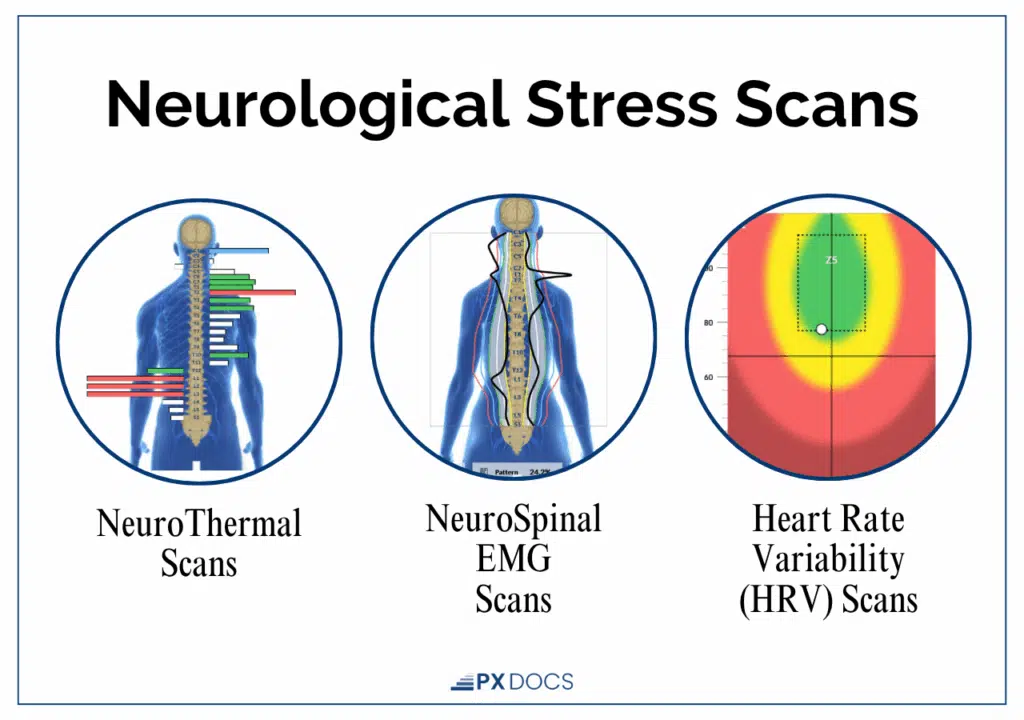
The Three Components of INSiGHT Scanning:
- Heart Rate Variability (HRV): This measures the balance between your sympathetic (“gas pedal”) and parasympathetic (“brake pedal”) nervous systems.
- Surface Electromyography (sEMG): This assesses the electrical activity of muscles within your neuromuscular system, showing where tension and altered neuromuscular function exist. In pregnant women with sciatica, sEMG typically reveals significant tension patterns in the lower back and pelvis—not just from pregnancy, but from long-standing subluxation creating abnormal muscle firing patterns.
- Thermal Scanning: Using infrared sensors, thermal scans measure temperature differences along the neurospinal system that indicate areas of dysautonomia—where your autonomic nervous system isn’t regulating properly. For sciatica, these scans often show significant thermal asymmetries in the lower spine and sacral regions, revealing autonomic dysfunction in the exact areas affecting the sciatic nerve.
The PX Docs Difference
What makes these scans so valuable for pregnant women is that they provide objective data about what’s happening beneath the surface. You’re not just describing symptoms and hoping someone believes you. You’re seeing measurable dysfunction that explains why normal pregnancy changes have become unbearable for you.
And here’s what’s encouraging: when care begins to restore nervous system function, the scans show improvements before your pain completely resolves. They detect changes in neurological function while you’re still experiencing symptoms, which helps you know that real healing is happening even when you’re not feeling 100% better yet.
For many women struggling with pregnancy sciatica, these scans provide the validation they’ve been searching for—proof that something measurable is wrong and confirmation that it can be addressed at the root level.
Your Next Step
Neurologically-Focused Chiropractic Care addresses the nervous system dysregulation that makes normal pregnancy changes unbearable.
Visit the PX Docs directory to find a provider who understands the connection between nervous system function and pregnancy challenges. They can assess whether dysregulation is contributing to your sciatica and help you move from managing symptoms to actually restoring function.
Your nervous system has the capacity to regulate, adapt, and heal. Sometimes it just needs the right support.