
W sitting is a floor-sitting position where a child sits with both knees bent and legs rotated outward and behind them, forming the shape of the letter “W.” While commonly dismissed as a harmless habit, persistent W sitting is often a visible sign of underlying nervous system dysregulation affecting motor control, core stability, and postural balance.
As a parent, you’ve probably noticed your child drop to the floor and sit with their legs splayed out behind them in the shape of a “W.” Maybe you’ve mentioned it to your pediatrician or a friend and gotten a mixed bag of responses. Some say it’s no big deal, others say it should be corrected immediately, and a few might suggest it’s just a phase they’ll grow out of.
Here’s what most of those responses are missing. W sitting isn’t just a quirky preference or a bad habit. For many children, it’s a visible clue that something deeper is going on with their nervous system, their motor development, and their ability to coordinate and stabilize their body. Understanding why your child defaults to this position, rather than just forcing them out of it, can change everything about how you support their development.
What is W sitting?
W sitting is a floor-sitting position in which a child sits on their bottom with both knees bent and their legs rotated out and back, forming the letter “W” when viewed from above. The child’s bottom rests flat on the ground between their feet, with their knees pointing forward and feet flaring out to each side.
Most children move fluidly between several floor-sitting positions during play, including criss-cross, side-sitting, and long-sitting. What concerns parents and professionals is when a child consistently defaults to the W position and rarely uses other sitting postures.
W sitting is most commonly seen in children between ages 3 and 6, though some continue well into their school-age years, which often signals that the underlying issues driving this pattern haven’t been addressed.
Why Children W Sit
The standard explanation focuses on a few key factors. W sitting provides a very wide, stable base of support, so the child doesn’t have to work as hard to maintain balance. It also locks the trunk in place, freeing the child’s hands and attention for play. And some sources point to structural factors like femoral anteversion, an inward rotation of the thighbone that’s common in young children.
But these explanations miss something important. They describe what the position does, but they don’t explain why a child’s body naturally gravitates toward it in the first place. And that’s where things get really interesting.
The Real Reason Behind W Sitting
Here’s what most articles about W sitting won’t tell you. The position itself is rarely the actual problem. It’s a compensation, a workaround that the child’s body creates because their nervous system isn’t coordinating motor control, balance, and postural stability the way it should.
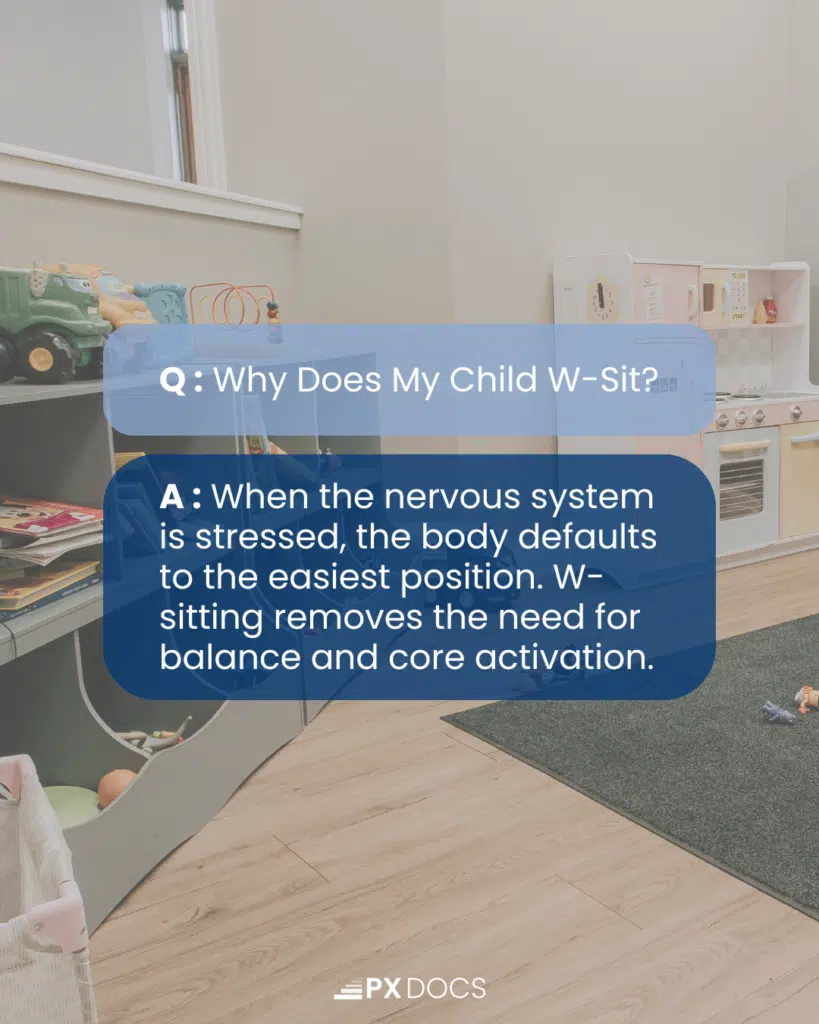
Your child’s nervous system is like the operating system running every function in their body. It controls muscle tone, balance, coordination, sensory processing, and motor planning simultaneously.
When that operating system is running smoothly, a child can sit in a variety of positions and shift between them easily. But when the nervous system is stuck in a stressed, dysregulated state, it has to prioritize survival over development. The body defaults to patterns that require the least neurological effort, and W sitting is one of the most neurologically “easy” positions a child can find. It takes balance and core stabilization almost entirely out of the equation, freeing up a nervous system that’s already overwhelmed just trying to keep up.
This is why W sitting so frequently shows up alongside other signs of neurological stress, such as difficulty with coordination, delayed motor milestones, sensory seeking or avoiding behaviors, poor handwriting, and difficulty sitting still at school. These aren’t separate, unrelated issues. They’re all branches of the same tree, a nervous system that’s struggling to do its job.
And that means addressing any one of these concerns in isolation, without looking at the nervous system underneath, will only get you so far.
Why Isn’t Core Strengthening Enough to Fix W Sitting?
One of the most common things you’ll hear about W sitting is that it’s a “core strength issue.” And while there’s some truth to that, it’s an incomplete picture. Core strengthening alone doesn’t fix W sitting because the underlying issue isn’t muscle weakness; it’s disrupted neurological signaling.
Children who w sit often demonstrate reduced core stability, but why aren’t those muscles activating properly? Muscles don’t just turn on and off randomly. They respond to signals from the nervous system. Every muscle contraction starts as a nerve impulse, an electrical signal that travels from the brain, down the spinal cord, and to the muscle fibers. If there’s interference along that communication pathway, the signal doesn’t reach the muscles clearly, and they can’t respond the way they’re supposed to.
You can do all the core strengthening activities in the world, but if the neurological signal telling those muscles to engage isn’t getting through, they won’t function optimally. It’s like trying to improve your cell phone reception by getting a louder speaker. The issue isn’t the speaker. It’s the signal.
Research confirms that postural control in children depends heavily on the integration of sensory information, including proprioceptive feedback from muscles and joints, vestibular input from the inner ear, and visual information. When these sensory systems aren’t processing efficiently due to nervous system dysfunction, compensatory patterns like W sitting emerge.
How Does The “Perfect Storm” Lead to W sitting
At PX Docs, we see W sitting not as an isolated habit but as one piece of a much bigger puzzle. We call it The “Perfect Storm,” a specific, predictable sequence of neurological stress that begins during pregnancy and birth and accumulates through early childhood.
- Prenatal stress is the first factor. During pregnancy, a mother’s stress hormones cross the placenta and influence the developing baby’s nervous system. Research shows that high prenatal stress can shift the baby’s Autonomic Nervous System toward sympathetic dominance, essentially putting the gas pedal and brake pedal out of balance before the baby is even born.
- Birth trauma is often the most significant factor. During delivery, particularly when interventions like forceps, vacuum extraction, C-sections, or induction are involved, tremendous physical forces are applied to the baby’s head, neck, and upper spine. This area houses the brainstem and upper cervical spine, the control center for muscle tone, postural reflexes, balance, and coordination. These forces can create subluxation, a combination of misalignment, fixation, and neurological interference that disrupts motor development signals from day one.
- The early childhood cascade adds further stress. A baby whose nervous system is already compromised often struggles with early milestones like nursing, sleeping, and digestion. The medications commonly prescribed for issues like ear infections, reflux, and constipation (antibiotics, acid blockers, steroids) can add further strain to an already overwhelmed system. As these stressors accumulate, the nervous system stays stuck in sympathetic overdrive, and developmental milestones like crawling, cruising, and dynamic sitting don’t develop as robustly as they should.
By the time a child starts sitting on the floor to play, if their nervous system has been through this “Perfect Storm” sequence, their body will naturally seek the position that requires the least neurological effort. That’s W sitting.
How Does Neurologically-Focused Chiropractic Care Help Children Who W Sit?
This is where Neurologically-Focused Chiropractic Care takes a completely different approach, starting with the understanding that the sitting position is a signal, not the problem itself.
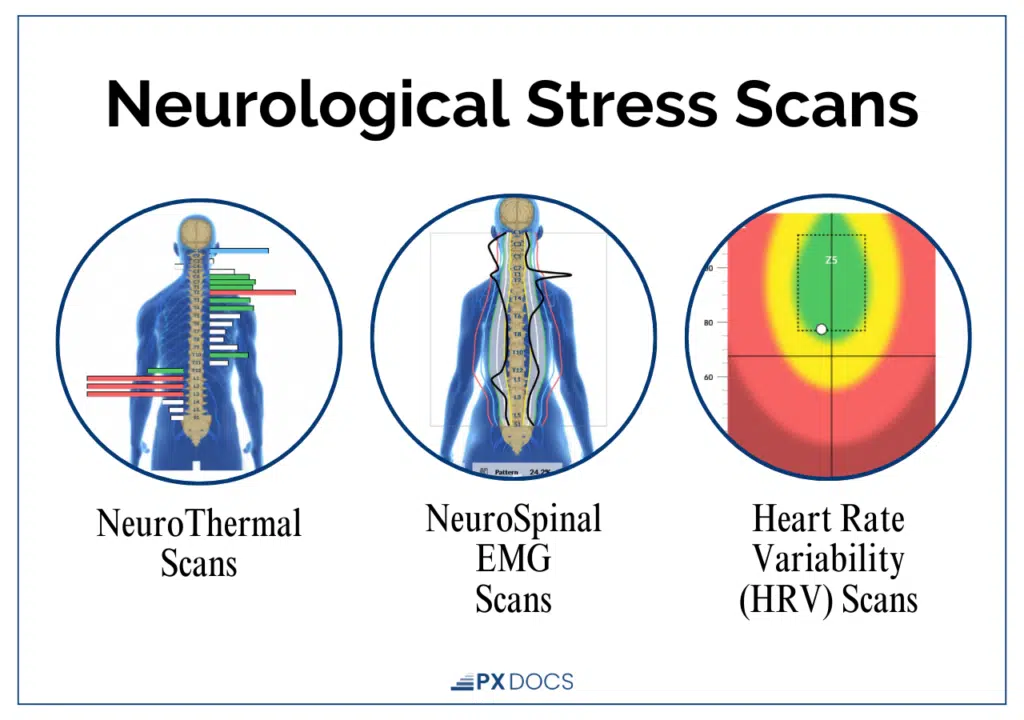
The first step is a thorough neurological assessment using advanced technology called INSiGHT scans. It’s important to note that this technology does not diagnose medical conditions, and Neurologically-Focused Chiropractic Care is certainly not a treatment or cure for W sitting, motor delays, or any other condition, including back pain. Instead, these INSiGHT Scans help us track down the root cause of nervous system dysfunction and dysregulation, and build customized care plans and adjusting protocols to help shift the nervous system back into a state of balance, regulation, and resilience.
The system includes:
- NeuroThermal scans that measure autonomic nervous system balance
- NeuroSpinal EMG that reveals muscle tension and compensation patterns
- Heart Rate Variability (HRV) measures the nervous system’s overall adaptability, how well the body can shift between “gas pedal” (sympathetic) and “brake pedal” (parasympathetic) modes.
For children who w sit, these scans typically reveal patterns of increased tension and reduced adaptability that correlate directly with the motor challenges parents observe.
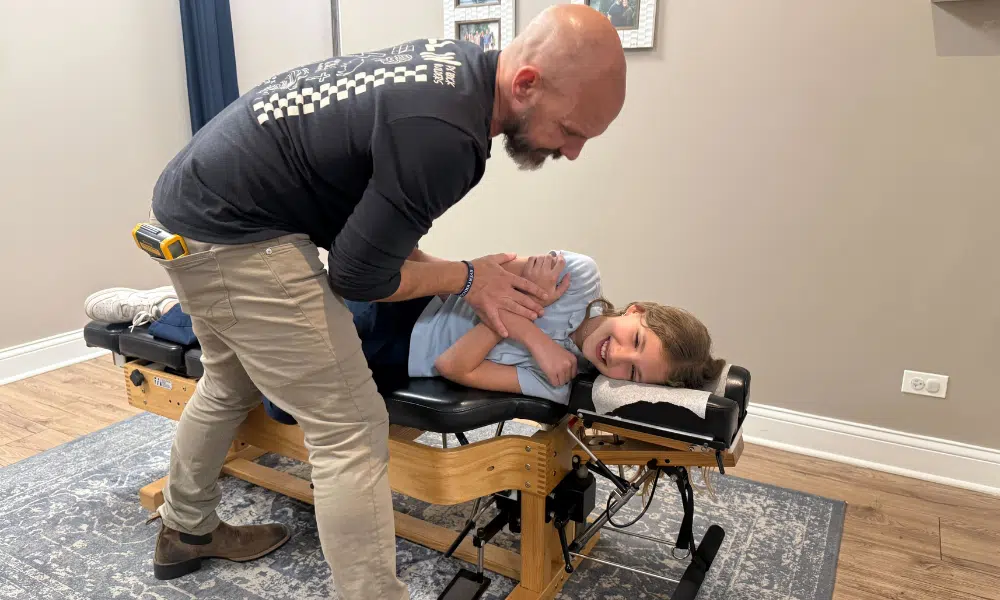
Based on these findings, a Neurologically-Focused Chiropractor creates a specific, gentle adjusting protocol to address the areas of subluxation interfering with optimal nervous system function. These adjustments are nothing like what most adults picture when they think of chiropractic. They’re incredibly gentle, precise, and tailored specifically for a child’s developing spine and nervous system.
As the nervous system begins to shift out of its stressed, compensatory state, parents typically notice changes that go well beyond sitting posture. Improved balance and coordination, better core activation, increased confidence with physical activities, and more fluid movement patterns often emerge as the nervous system regains its ability to support dynamic motor control. Many parents describe watching their child naturally start choosing different sitting positions on their own, without being prompted, as one of the first signs that things are shifting.
What Can Parents Do at Home to Help with W Sitting?
While addressing the neurological root cause is the most important step, there are practical strategies to support your child alongside care.
Encourage floor time with variety. Rather than correcting W sitting in frustration, gently guide your child into alternative sitting positions, such as criss-cross, side sitting, or kneeling. Make it playful rather than corrective. “Can you sit like a pretzel?” works a lot better than “Fix your legs!”
The goal is to build the habit of making position changes, not to create anxiety around sitting.
Prioritize dynamic movement. Activities like wheelbarrow walks, bear crawls, climbing, and obstacle courses challenge core stability in functional ways while providing rich proprioceptive and vestibular input that supports sensory processing development.
Young children aren’t designed to sit still for long periods, so frequent movement breaks and active outdoor play should be a daily priority.
Watch for the bigger picture. W sitting rarely shows up in complete isolation. If your child also struggles with sensory challenges, coordination difficulties, delayed milestones, digestive challenges, or emotional regulation, these patterns are connected. A comprehensive neurological assessment can help you understand the full picture rather than chasing each concern individually.
What Should You Do If Your Child W Sits All the Time?
W sitting is one of those parenting concerns that seems simple on the surface but opens the door to a much deeper understanding of your child’s development. It’s not just about a bad habit, and it’s not something you can fix by just moving their legs. For many children, W sitting is a window into how their nervous system is functioning, a visible sign that their body is compensating for underlying challenges with motor control, balance, and neurological regulation.
The good news is that when you address the root cause rather than just the position itself, real change becomes possible. You can help your child build the foundation they need for better movement, coordination, confidence, and development across the board.
If your child’s W sitting concerns you, don’t wait for them to grow out of it. Take the next step and visit the PX Docs directory to find a trained, Neurologically-Focused Chiropractor near you who can help you get to the root of what’s really going on.
Frequently Asked Questions About W Sitting
Is W sitting bad for my child?
Occasional W sitting during play is common and typically not a concern. Persistent W sitting, in which a child consistently defaults to this position and rarely uses other sitting postures, can indicate underlying nervous system dysregulation affecting core stability, balance, and motor coordination. When W sitting is the dominant sitting pattern, it warrants a neurological evaluation rather than simply correcting the position.
Can W sitting cause hip problems?
W sitting places the hip joints in extreme internal rotation, which may contribute to femoral anteversion and tightness in the hip rotators over time. However, the sitting position is often a symptom of neurological dysfunction rather than the primary cause of structural issues. A 2025 systematic review found that while W sitting is associated with orthopedic concerns, the evidence for direct causation remains limited.
Will my child grow out of W sitting?
Some children naturally transition away from W sitting as their motor systems mature, typically by age 7 or 8. However, children whose W sitting stems from nervous system dysregulation, subluxation, or autonomic imbalance often don’t outgrow the underlying neurological patterns without intervention. If W sitting persists alongside other developmental concerns, a comprehensive neurological assessment can clarify whether the pattern is likely to resolve on its own.
What’s the connection between W sitting and sensory processing issues?
W sitting and Sensory Processing Disorder share a common neurological root. When subluxation and dysautonomia disrupt the brain’s ability to integrate proprioceptive, vestibular, and visual information, children struggle with both postural control and sensory regulation. The W position compensates for poor proprioceptive feedback, while sensory seeking or avoiding behaviors reflect the same nervous system dysfunction.
Is chiropractic care safe for children who W sit?
Neurologically-Focused Chiropractic Care for children involves gentle, precise adjustments specifically tailored for a child’s developing spine and nervous system, nothing like the adjustments most adults picture. These adjustments are designed to address subluxation and restore neurological communication, not to treat W sitting directly. As the nervous system shifts out of a stressed state, parents often observe improved sitting posture, along with better balance, coordination, and motor confidence.
How long does it take to see improvement in W sitting with chiropractic care?
Every child’s nervous system responds on its own timeline, depending on the severity of subluxation, the length of time the patterns have been present, and whether The Perfect Storm factors are involved. Many parents report noticing their child naturally choosing different sitting positions within the first several weeks of consistent care, often alongside improvements in sleep, digestion, and emotional regulation.