
Your child isn’t hitting milestones the way you expected. Maybe motor skills are lagging. Maybe speech hasn’t come along. Maybe the behavioral, sensory, and social pieces just aren’t matching their peers. And the answer you keep getting is some version of “don’t worry, they’ll catch up.”
Here’s what almost nobody tells you: most developmental delays aren’t a timing problem. They’re a neurological problem. Neurological developmental delays happen when a child’s brain and nervous system get stuck in a stress state that makes normal development hard to complete. Not because of bad genes, bad luck, or anything you did wrong.
According to the CDC, roughly 1 in 6 children in the U.S. has a developmental disability or delay. That’s a lot of families being told to wait and see.
This article breaks down what’s actually happening in the nervous system when development goes off track, why so many kids plateau in therapy, and what to look for when “wait and see” isn’t good enough.
What Are Neurological Developmental Delays?
A neurological developmental delay means a child is behind in one or more areas of development because the nervous system that drives those skills isn’t functioning the way it should. You’ll also see this called neurodevelopmental delay, or sometimes neuro-motor immaturity.
That’s a meaningful distinction. A delay describes what you’re seeing. A neurological delay points to why.
Delays show up across four areas that parents and pediatricians track: gross and fine motor skills, speech and language, social-emotional development, and cognitive skills. If you want the full age-by-age breakdown, we’ve mapped those out in our guides to baby milestones and developmental milestones.
But here’s the part those checklists miss. All those skills run on the same hardware. The brain, brainstem, and neurospinal system. When a toddler takes a wobbly first step, that’s not a leg thing. That’s thousands of neurons coordinating, integrating sensory input, and building pathways. When that system is under stress, the skills built on top of it come slowly, unevenly, or not at all.
That’s why kids rarely have just one delay. Motor challenges travel with sleep problems. Speech delays travel with sensory struggles. Digestive issues travel with behavior. Conventional care treats those as separate problems on separate referral lists. We see one system underneath all of them.
Timing matters here because the window is genuinely narrow. Research from Harvard’s Center on the Developing Child indicates that the young brain forms more than a million new neural connections every second in the earliest years, and pathways strengthen or prune based on what gets used. The American Academy of Pediatrics has also noted that motor delays and unusual movement patterns often serve as early indicators of broader developmental concerns, which is exactly why motor sits so early in the sequence we’ll walk through below.
If you’re looking for a broader overview of types and contributing factors, we cover that in our guide to what causes developmental delay in children.
Signs That Point Toward a Neurological Root Cause
Some variation in timing is completely normal, and we’ll get to why in a moment. But certain patterns deserve a closer look:
- No babbling or gesturing by 12 months
- No single words by 16 months, or no two-word phrases by 24 months
- No response to their name by 12 months
- Loss of language or social skills a child previously had
- Not walking by 18 months, or walking only on toes
- Floppiness, stiffness, or very limited movement
- Frequent falling and difficulty with stairs
- Persistent drooling or very unclear speech
And a few signals conventional screening tends to skip entirely, the ones that point most directly at nervous system stress:
- Your baby skipped crawling or crawled asymmetrically
- Head turning preference, flat spots, or difficulty latching on one side
- Chronic constipation, reflux, or recurring ear infections
- Never slept well, from day one
- Big reactions to sound, texture, or transitions
That second list matters because those aren’t unrelated symptoms. They’re what a dysregulated nervous system looks like in a small child.
If something about your child’s development just doesn’t feel right, trust that. You know your child better than any 15-minute checkup does.
Why “Wait and See” Costs So Much Time
Almost every family we meet has heard some version of it. They’ll catch up. They’ll grow out of it. Let’s check again at the next well visit.
Sometimes that’s reasonable advice. Often it isn’t, and here’s why.
Standard pediatric checkups are built to catch the obvious and the urgent. Growth curves, gross red flags, vaccine schedule. They’re not built to catch subtle neuromotor findings, asymmetric tone, poor postural control, sensory processing differences, a dysregulated nervous system running hot. Clinically, we see those findings get missed for months before anyone makes a referral.
Then the referral itself takes time. Waitlists for early intervention evaluation, more waitlists for PT, OT, and speech. By the time a child actually starts therapy, a meaningful chunk of the most plastic window has passed.
So the cost of “wait and see” isn’t the waiting. It’s that waiting consumes the exact months when the nervous system is most responsive to change.
None of this means your pediatrician is doing a bad job. It means the standard screening model is looking for different things than we are. A well visit asks is this child within normal limits? A neurological assessment asks how is this child’s nervous system actually functioning? Those are different questions, and they turn up different answers.
Sequence Matters More Than the Calendar
This is the piece Dr. Tony Ebel teaches first, and it’s the piece almost nobody else talks about.
As parents, we fixate on when. Should be walking by now. Should be talking by now. But when you understand neurodevelopment, you learn that the order of a child’s development matters more than where they land on the calendar.
Think about building a house. You don’t get to skip the foundation because you’re excited about the kitchen. The brain and nervous system work the same way; each stage has to be integrated before the next one can be built properly.
The sequence runs roughly like this: sleep and digestion come first, then immune function, then motor tone and coordination, then speech and communication, then socialization and emotional regulation, and cognition last.
So if your child skipped crawling, isn’t sleeping, has digestive challenges, or has an immune system that’s a mess, they’ll have a harder time with everything that comes next. The behavior and communication challenges showing up at age four often trace back to foundations that never fully set at four months.
The flip side is reassuring. Plenty of kids develop at their own pace for perfectly normal reasons. Some are born early. Some are just big, and a ten-pound baby trying to learn head control with a bowling ball on top of their neck will take longer than a smaller baby. Clinically, we consistently see that bigger, taller, heavier kids move through motor milestones more slowly, and that’s not a red flag.
A child who’s a little behind but moving through the sequence in the right order is usually fine. A child who’s technically “on time” but skipped steps is the one we want to look at.
Growth Mode and Protection Mode
Here’s the phrase that ties this whole thing together, and it’s the one Dr. Tony comes back to constantly:
You can’t be in growth and protection at the same time.
A child’s Autonomic Nervous System has two basic settings. The sympathetic branch runs protection—fight or flight, threat response, gas pedal down. The parasympathetic branch runs growth—rest, digest, heal, develop. That’s the brake pedal.
Kids are supposed to spend the overwhelming majority of those first three, five, seven years in growth mode. That’s when the wiring gets laid down.
But when a nervous system gets stuck in protection mode, what we call nervous system dysregulation, or dysautonomia when the imbalance becomes chronic, resources that should go into development get spent on threat monitoring instead. The gas pedal is stuck down, and the brake doesn’t work.
That’s the single biggest driver of neurological developmental delays we see. Not a missing gene. A nervous system that never got to stand down.
And it’s measurable. This is exactly what INSiGHT neurological assessment is built to show — whether a child’s system is spending its days in protection or in growth. More on that in a moment.
The Perfect Storm™: How Kids Get Stuck
So what puts a child in protection mode and keeps them there? At PX Docs, we call this combination of factors The Perfect Storm™: a series of early-life stressors that stack up during the most sensitive windows of development.
Before we go further: it’s not bad luck, it’s not genetics, and it’s not bad parenting. This was never supposed to be your specialty. You weren’t supposed to know that stress during pregnancy and a difficult birth could push your child’s nervous system into a state it couldn’t get out of on its own.
Prenatal Stress and Maternal Health
The foundation gets laid before birth. A developing baby is closely attuned to mom’s physical and emotional state, and stress hormones like cortisol cross the placenta.
Dr. Tony puts it simply: the umbilical cord is the power cord. Baby is a hitchhiker on mom’s nervous system for nine months. If her system is running in sympathetic dominance through a stressful fertility journey or a high-risk pregnancy, baby’s developing system is riding along in that same state.
Research using fetal MRI has found that higher maternal prenatal stress is associated with measurable alterations in fetal brain connectivity, and review evidence links prenatal stress to increased susceptibility to later neurodevelopmental challenges.
Birth Trauma and Interventions
This is the most overlooked, under-identified contributor to neurological developmental delays, and we ask about it in nearly every case history.
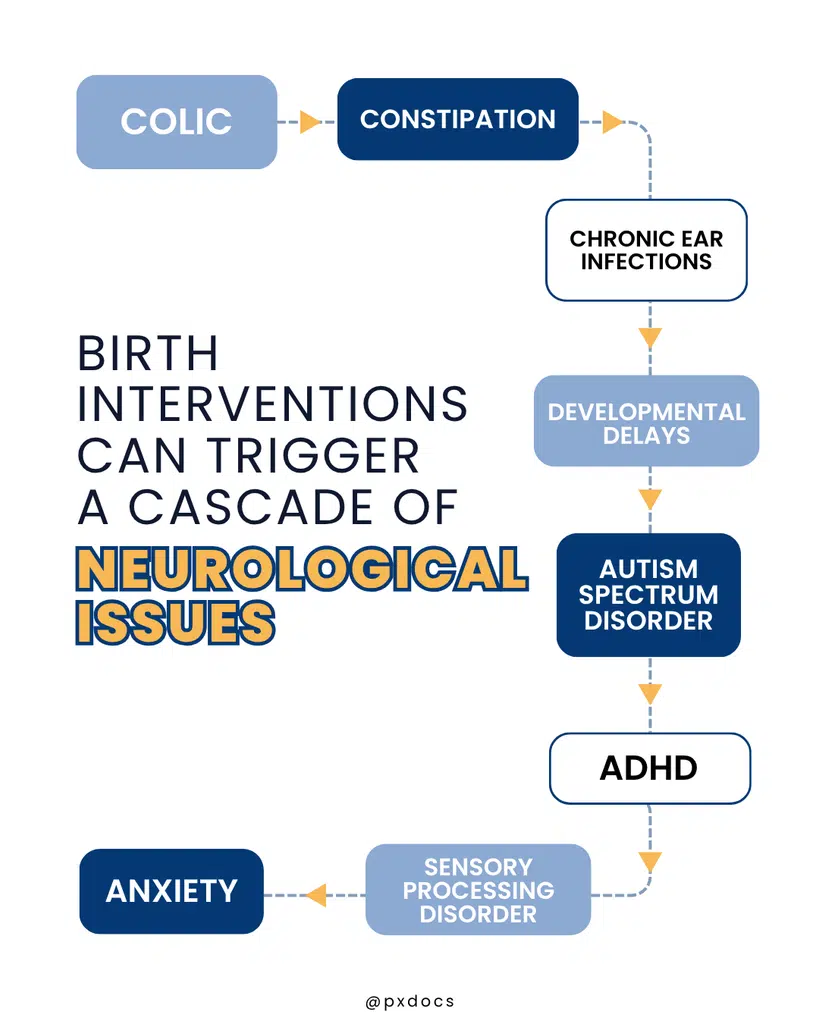
Interventions like induction, forceps, vacuum extraction, and C-section place significant compression and torsion on a baby’s upper neck and brainstem. Even in an uncomplicated vaginal delivery, prolonged labor, malposition, or cord compression can do the same.
That region is not incidental. It’s the control center for neuromotor tone and coordination, the foundation everything else gets built on.
How common is this? One study of 100 healthy newborns found that 99 showed evidence of somatic dysfunction, concentrated in those upper cervical and cranial regions. Ninety-nine out of a hundred babies were considered perfectly fine.
Early Childhood Stressors
The storm doesn’t stop at birth. In the first few years, a still-developing nervous system stays vulnerable to:
- Chronic illness and repeated rounds of antibiotics
- Poor nutrition and food intolerances
- Environmental toxin exposure
- Family stress, instability, or disrupted attachment
- Sensory overload from screens and overstimulating environments
- Falls and injuries during those early wobbly years
Any one of these on its own may not do much. Stacked on top of prenatal stress and a rough birth, they’re what keep a child locked in protection mode.
Subluxation and the Vagus Nerve: The Mechanism
When stress overwhelms the nervous system’s ability to adapt, what results is subluxation. And subluxation is not a bone-out-of-place story.
Subluxation is three things happening together:
- Misalignment in the neurospinal system
- Fixation or loss of normal motion, and the part that actually matters
- Neurological interference that disrupts communication between brain and body.
That third component is why this shows up as developmental delay rather than as pain.
The nerve at the center of this is the vagus nerve, and it runs right through the region most affected by birth trauma. Dr. Tony describes the upper cervical and brainstem area as air traffic control; everything routes through it. When that tower is compromised, flights don’t land on time.
The vagus nerve governs an enormous amount of what we call “development”:
- Digestive motility, absorption, and elimination
- Immune regulation and inflammatory balance
- Motor tone and postural coordination
- Sensory input from the eyes, ears, and mouth
- Social engagement, emotional regulation, and word formation
That’s why vagus nerve dysfunction so often shows up first as torticollis, plagiocephaly, colic, constipation, reflux, or chronic ear infections, and only later as the speech, sensory, and gross motor delays that finally get a referral.
The delay was never the beginning. It was the part that got noticed.
Why So Many Kids Plateau in Therapy
This is the conversation we have constantly during case history intake.
Families come in having done everything right. PT, OT, speech, developmental therapy, early intervention, sometimes ABA. They saw real gains early. And then it stopped. “We’ve seen some changes, but we’re stuck. We’re plateaued. We want to see bigger changes.”
That plateau is not a failure of the therapy, and it’s not a failure of the child. Those therapies are genuinely valuable. But they’re built to train skills on top of a functioning foundation. If the foundation is still running in protection mode, you can drill the skill all you want; the system doesn’t have the capacity to consolidate it.
Fix the foundation, and the same therapies often start working again. That’s the sequence we mentioned earlier, applied to care instead of development.
Identify the Root Causes of Your Child’s Challenges
Perfect for parents of children with neurological challenges and frustrated by the lack of answers. Get your natural, drug-free approach to help your child’s nervous system relax, unwind, and get back on track developmentally. This quick, action-oriented webinar is for you!
How We Measure It Instead of Guessing
Most families arrive having spent years on a loop of “try this, see if it helps.” We don’t guess. We test.
PX Docs offices use INSiGHT scanning technology, developed by the Chiropractic Leadership Alliance (CLA), to get an objective picture of how a child’s nervous system is actually functioning. Three scans, three different windows:
- Heart Rate Variability (HRV) shows how much adaptive reserve a child has, and how balanced their gas pedal and brake pedal really are
- Surface EMG (sEMG) measures motor tone and how much energy the system is burning just to hold itself together
- Thermal scanning assesses autonomic control of digestion, immune function, and organ regulation
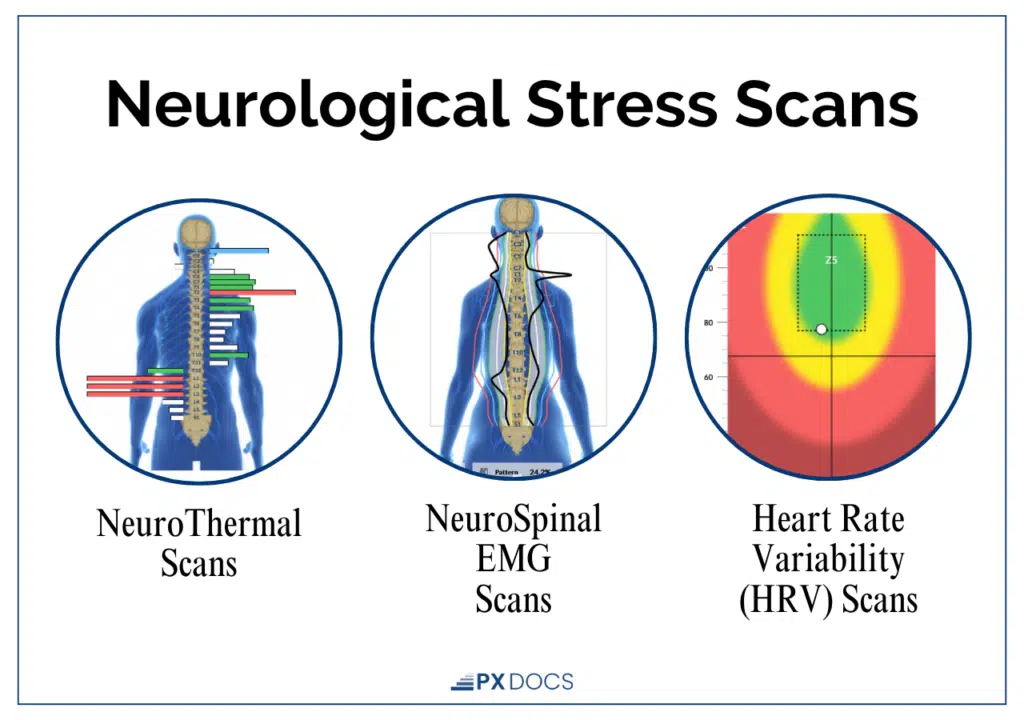
It’s important to note that this technology does not diagnose medical conditions, and Neurologically-Focused Chiropractic Care is certainly not a treatment or cure for developmental delays or any other condition, not even back pain. Instead, these INSiGHT Scans help us track down the root cause of nervous system dysfunction and dysregulation, and build customized care plans and adjusting protocols to help shift the nervous system back into a state of balance, regulation, and resilience.
For many parents, this is the first time anyone has shown them objective data on the system driving their child’s challenges, instead of another behavioral checklist.
And we don’t stop at the first scan. Progress scans at regular intervals tell us whether the system is genuinely reorganizing: whether HRV is climbing, whether motor tone is settling. If the data says we’re on track, we keep building. If it says something needs to shift, we adjust. That’s the difference between hoping a child is improving and knowing it.
Getting Your Child Back on Track
The first years of life are a period of extraordinary neuroplasticity, which is why early identification matters so much. Research from the CDC indicates that early intervention can alter a child’s neural circuits and improve developmental outcomes.
But it is never too late. The brain stays plastic throughout life. We routinely see grade-school kids, teenagers, and young adults with brain-based neurological challenges whose motor tone, coordination, and postural control were never fully developed in the first place, and who respond once that foundation finally gets addressed.
Supporting a child with neurological developmental delays usually means layering a few things together:
- Addressing nervous system dysfunction and subluxation through Neurologically-Focused Chiropractic Care
- Continuing targeted therapies for specific lagging skills
- Nutritional and lifestyle changes that reduce inflammation and support gut health
- Adjusting the environment to match your child’s actual sensory capacity
Your child isn’t broken, and they aren’t behind because of something you did. Their nervous system got stuck in protection when it was supposed to be in growth — and that’s a root cause worth finding, not a diagnosis to wait out.
If you want to know what’s actually happening in your child’s nervous system, find a PX Doc near you and start with a scan. And if you’d like to see what this looks like for other families, our stories of hope are worth your time.
PX Docs has established sourcing guidelines and relies on relevant and credible sources for the data, facts, and expert insights and analysis we reference. You can learn more about our mission, ethics, and how we cite sources in our editorial policy.