

If your child can’t seem to settle down, struggles with constant meltdowns, or seems overwhelmed by everyday situations that other kids handle just fine, you’re not alone.
Many parents watch their kids battle through each day, covering their ears at loud noises, melting down over transitions, or lying awake at night unable to calm their racing minds, and wonder if something deeper is going on.
The warning signs of what we call “Busy Brain Syndrome” often show up as sensory overload, emotional dysregulation, and an inability to switch off. And if you’ve tried everything, behavior charts, diet changes, sensory tools, with little improvement, it’s time to look at what’s really driving these challenges: your child’s nervous system.
What is Busy Brain Syndrome?
Busy Brain Syndrome means there is so much stress, noise, and interference locked into a child’s brain and body that their brain is completely preoccupied and too busy.
At its core, this isn’t just about behavior or personality; it’s about your child’s Autonomic Nervous System (ANS) stuck in overdrive.
Think of the ANS as having two settings:
- A gas pedal (Sympathetic Nervous System)
- A brake pedal (Parasympathetic Nervous System).
The gas pedal controls your fight-or-flight response; it’s meant for short bursts when you need to react quickly or handle stress. The brake pedal, also called the “rest and digest” system, is what helps you calm down, sleep, process emotions, and heal.
When a child has Busy Brain Syndrome, their gas pedal is constantly pressed down. They’re stuck in a chronic fight-or-flight state, and their brake pedal, controlled largely by the vagus nerve, isn’t working properly. This means their nervous system has a much lower threshold for sensory input than other kids, so things that seem minor to us feel overwhelming to them.
This isn’t the same as a child who’s simply energetic or creative. Kids with busy brains struggle with basic self-regulation that should come naturally, which affects their ability to sleep, learn, connect, and develop properly.
The Signs: How Busy Brain Shows Up in Kids
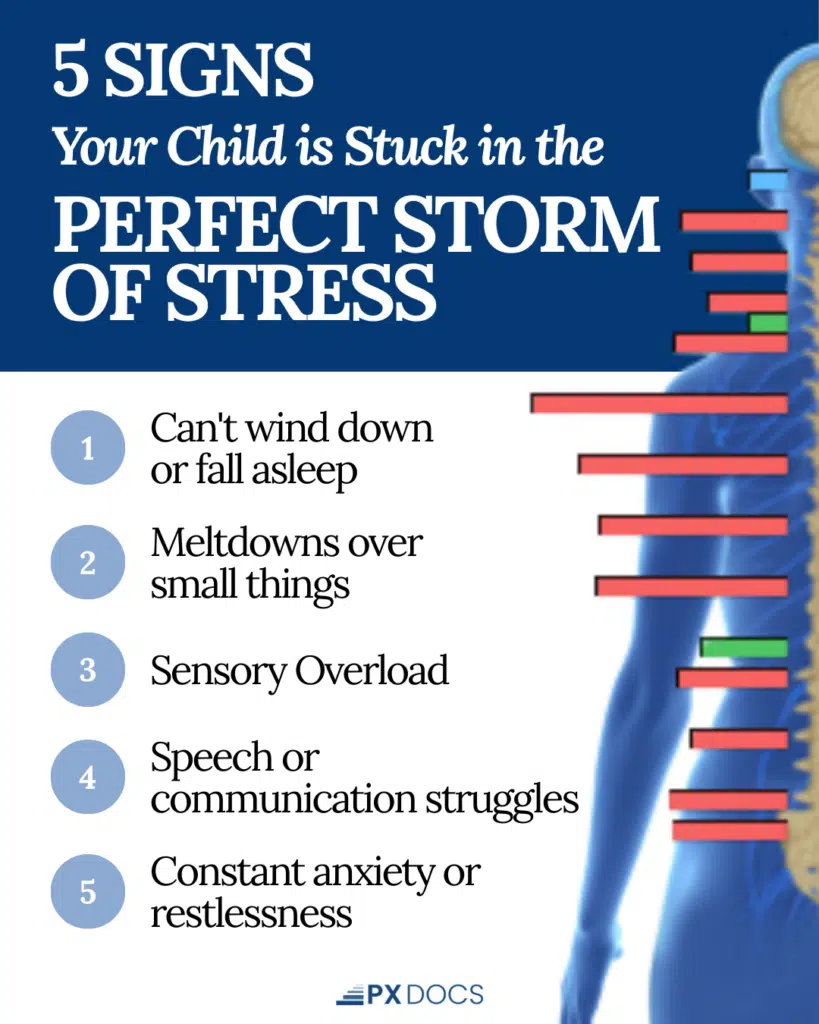
A busy brain can lead to the challenges below for kiddos who are unable to calm their minds and bodies.
1. Sleep Challenges
When you feel like you’re dealing with too much action in your life, it typically manifests as impulsivity, sensory aversions, avoidance of loud noises, anxiety, agitation, emotional tantrums, and meltdowns. Consequently, when the brain is too preoccupied and busy handling all of this noise, it can’t sleep very well, which is the most common side effect.
Physical signs you might notice: Your child tosses and turns for hours, complains of racing thoughts, experiences frequent night waking, or has difficulty winding down even after a calm bedtime routine. Some kids develop headaches or stomachaches at bedtime because their bodies are so tense and wound up.
When you have a stressed out, wound up busy brain, it becomes so stuck there that it can’t calm and quiet itself to sleep. The Sympathetic Nervous System is still firing, keeping them alert and reactive when they should be resting. Kids need their brake pedal (Parasympathetic System) working properly to fall asleep and stay asleep—but when it’s not functioning right, they’re left exhausted but unable to shut down.
2. Speech Challenges
The second challenge is speech, because communication is a very high-level, brain-based function. It’s a high-level motor neuron function, meaning it requires a lot of intricacy and brainpower. Speech requires strong executive functioning and working memory—your child needs to process what they hear, formulate a response, organize their thoughts, and coordinate the physical act of speaking, all while filtering out distractions.
Therefore, when your child has Busy Brain Syndrome, they struggle with speech and communication because their brain is really locked and rocked in that busy brain world. When the nervous system is consumed by managing stress and sensory overload, there’s less capacity for higher-level cognitive functions. You might notice your child knows what they want to say but can’t get the words out, or they struggle to follow multi-step directions because their working memory is overwhelmed.
3. Social and Emotional Challenges
Social and emotional connection is another challenge associated with Busy Brain Syndrome. Again, when you’re dealing with noise, stress, and anxiety, and a child is locked in, they get locked out of socially and emotionally engaging the way we would like to see.
Emotional signs include: frequent meltdowns over minor frustrations, big emotional reactions that seem disproportionate to the situation, irritability and mood swings, feeling out of control during transitions, and difficulty recovering from being upset. These kids aren’t trying to be difficult; their nervous system is simply overwhelmed, and they don’t have the internal resources to regulate their emotions.
Behavioral patterns you’ll see: They can’t sit still even during enjoyable activities, they’re constantly distracted and restless, they avoid social settings because they’re overstimulating, or they seek intense sensory input (crashing, jumping, loud noises) to try to regulate themselves. They struggle with transitions between activities and need excessive warnings or preparation for changes.
Another effect of this Busy Brain Syndrome is a lack of social development, emotional regulation, self-control, and the ability to handle transitions. When a child’s Autonomic Nervous System is stuck in fight-or-flight, their brain prioritizes survival over connection, making it nearly impossible to build friendships, read social cues, or engage in the give-and-take of healthy relationships. This pattern of nervous system dysregulation affects every area of development.
Busy Brain Syndrome and The “Perfect Storm”
At PX Docs, we call all of these compounding factors the“Perfect Storm.” These kiddos go through a vicious cycle early on through pregnancy, birth trauma intervention, like emergency C-sections, forceps, and vacuum extraction induction, that creates so much stress and noise in the brain. Then we throw it into this stressful, toxic world we live in, early on, when the brain is most impressionable.
The Perfect Storm has three phases that build on each other:
- Prenatal Stress: High levels of maternal stress during pregnancy can wire a baby’s nervous system for overreactivity. Research shows that maternal cortisol crosses the placental barrier and affects how the baby’s nervous system develops, with elevated stress hormones associated with alterations in fetal brain structure and increased risk for behavioral and emotional problems later in life.
- Birth Trauma: This is where the vagus nerve often takes the biggest hit. Any intervention that puts pressure or torque on the upper neck—forceps, vacuum extraction, even a long, difficult labor—can create tension and fixation right where the vagus nerve exits the brainstem. This sets up nervous system dysfunction from day one.
- Early Childhood Stressors: Then, we add in environmental stressors. Chaotic environments, overstimulating schedules, excessive screen time, antibiotic overuse, chronic ear infections, food sensitivities, and the constant sensory bombardment of modern life. For a nervous system already compromised, these become overwhelming rather than manageable.
So the brain goes through a pregnancy in a busy, noisy way, then a delivery in a busy, noisy way, and finally through early childhood development in a busy, noisy, stressful way.
The brain gets locked in because it’s in protection or busy mode, so it misses out on development, connection, integration, processing, engagement, sleep, and immune development. As a child gets older, that vicious cycle just keeps brewing because life gets busier and more challenging.
When Should You Be Concerned?
Here’s the thing: all kids are energetic and emotional at times. That’s normal development. But if you’re reading this article, chances are you already know something’s different about your child. You’re not imagining it.
Consider Seeking Professional Evaluation If
Your child’s challenges are persistent and present across multiple settings, not just at home, but also at school, with friends, and at family gatherings. When the nervous system is truly dysregulated, you’ll see the same patterns everywhere.
The behaviors are impacting daily functioning. Is your child missing out on birthday parties because they’re too overwhelming? Are they falling behind academically, not because they aren’t smart, but because they can’t focus or sit still? Are transitions taking 30 minutes when they should take 5?
You’ve tried behavioral strategies, diet changes, and sensory tools with limited success. If you’ve done occupational therapy, tried magnesium and probiotics, created a sensory-friendly bedroom, and implemented reward charts—but nothing is really moving the needle—it’s time to look at the nervous system foundation underneath all of it.
Other professionals or family members are expressing concern. When teachers, therapists, pediatricians, or even your mother-in-law are all noticing the same patterns, that’s a red flag worth investigating.
Your child has been diagnosed with or shows signs of: ADHD, Anxiety, Sensory Processing Disorder, Autism, or other developmental concerns. Busy Brain Syndrome often overlaps with or underlies these conditions; addressing the nervous system dysfunction and vagus nerve dysfunction can improve outcomes across the board.
The Power of Chiropractic and The Vagus Nerve
So what do we do to help these kiddos? I’m going to tell it through a story. I just got done working with and making the first adjustment for an unbelievable 15-year-old. This rockstar girl has lived 15 years with a busy, stressful, noisy, wound-up brain, is never able to sit still, and has some special needs challenges as well.
First, we need to understand that the calming, quieting nerve called the vagus nerve is located within the nervous system right up top. The vagus nerve is the main highway of your Parasympathetic Nervous System, your body’s “rest and digest” brake pedal. It’s responsible for calming your heart rate, improving digestion, reducing inflammation, and most importantly, helping your brain shift out of fight-or-flight mode into a state where learning, healing, and connection can happen.
That’s why a birth where we put a big set of hands or a vacuum plunger around the head and pull, twist, and yank, really interferes and damages the effect of the vagus nerve, which is what quiets and calms the brain and body. This 15-year-old girl has all the genetic, life, and birth stress, so she has never been able to live a calm life. She can’t sleep and has all sorts of anxiety, meltdowns, and transition challenges.
Just putting my hands on her atlas and axis vertebrae, putting the lightest, calmest, surest, and most certain amount of stimulus to the vagus nerve, was like hitting the pause button on a Netflix show. Everything calmed, stopped, and stilled for the first time in almost 15 years of her life.
How Do We Know This is Working?
At PX Docs, we don’t just go by what we see—we measure it.
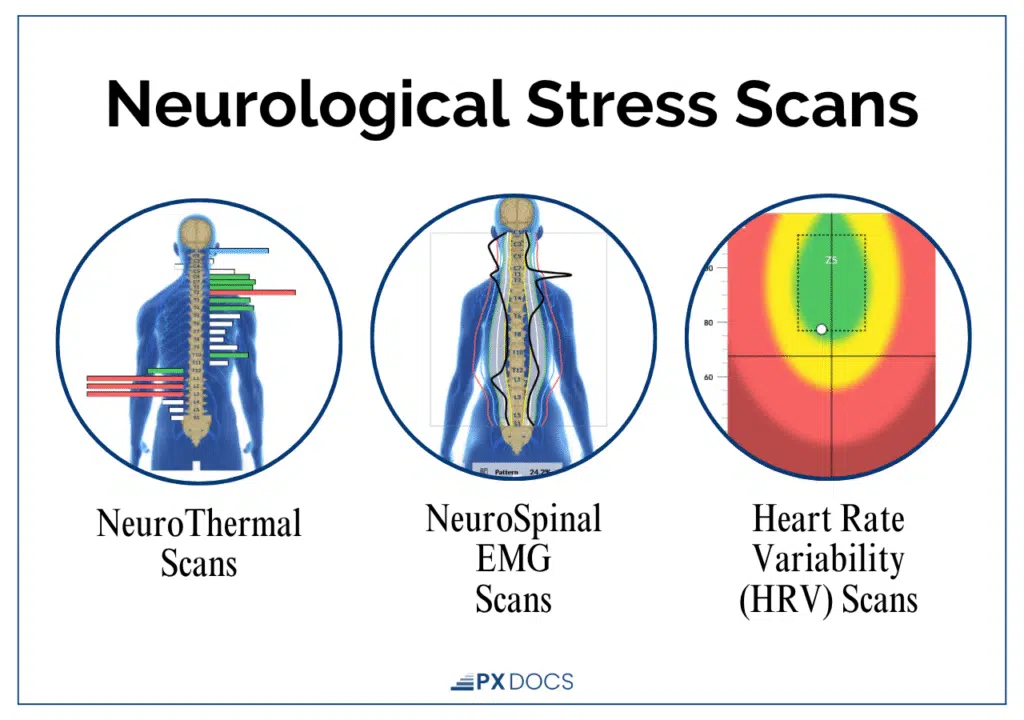
We use INSiGHT scans to objectively assess how much stress and tension is locked in your child’s nervous system and where exactly it’s creating interference. These scans give us a clear picture of Autonomic Nervous System function, showing us patterns of sympathetic dominance and areas where the vagus nerve isn’t communicating properly. Then we can track progress over time with follow-up scans, showing you and your child real, measurable improvement in their nervous system regulation.
There is a coping mechanism to the nervous system, and when there’s interference or what we call subluxation, it gets in the way of quieting the brain, and these kiddos live a life full of this busy brain, wound up, stressed body system.
Subluxation isn’t just a bone out of place—it’s a combination of fixation (stuck joints that don’t move properly), and neurological interference that disrupts the communication between brain and body. They move all the time because it’s calming, so it’s no wonder they don’t sleep very well. They can’t shut their brain or body off. It’s no wonder they don’t handle their emotions very well because they’re idling at 5,000 RPMs.
Neurologically-Focused Chiropractic Care works by removing that interference and restoring proper function to the Parasympathetic Nervous System. When we adjust the upper cervical spine where the vagus nerve is most vulnerable, we’re essentially taking pressure off the brake pedal so it can finally do its job. The gas pedal can relax because the brake is now available.
There are way too many kiddos locked into this busy brain and “Perfect Storm,” and they don’t need to be. Sometimes drugs can come in and blanket the storm artificially and make a kid’s life better for a portion of the day. But that can bring about other negative side effects.
The beauty of addressing the nervous system first is that it makes everything else work better.
If your child is doing occupational therapy, speech therapy, behavioral interventions, or other therapies—that’s wonderful. But when the nervous system is still stuck in fight-or-flight, those therapies are working against a foundational problem. Once we calm the nervous system and restore proper function, suddenly OT can make faster progress, speech therapy clicks better, and behavioral strategies actually stick because your child’s brain finally has the capacity to learn and adapt.
Truthfully, it isn’t about this or that. There’s just such a powerful, unbelievable influence that pediatric, Neurologically-Focused Chiropractors offer through safe, drug-free, gentle adjustments. Imagine what many months’ worth and dozens of adjustments can do to a child’s life. That’s what we get to do.
Next Steps For Parents
If you are a parent who wants to help your child calm their busy brain and lead a calmer, quieter life, or you know one who does, we encourage you to visit our directory to find a PX Doc near you.
While you’re waiting for your first appointment or want to support your child at home, here are some regulation strategies that can help.
Create predictable daily routines and give clear transition warnings so your child knows what to expect. Reduce sensory overload by dimming lights, limiting screens, and keeping spaces quieter when possible. Prioritize sleep and follow the guidelines from the American Academy of Sleep Medicine. Avoid overscheduling by building in downtime between activities, and practice co-regulation—when your child feels overwhelmed, your calm and steady presence helps their nervous system settle and reset.
If you’re an OT, PT, speech therapist, social worker, or developmental therapist, make sure you find someone in your community who is trained and uses the protocols and chiropractic applications we use. When we can go in and quiet a kiddo’s brain, think about how much more impactful their therapy would be. You can explode and increase the quality and quantity of your kiddo’s life.