
Losing patience with your ADHD child doesn’t mean you’re a bad parent. It means you’re exhausted and navigating something far more complex than “behavior problems.” Parenting ADHD is relentless, and most of the advice parents receive barely scratches the surface of what’s actually happening day to day.
Children with ADHD receive an estimated 20,000 more negative messages by age 12 than their peers. That constant correction wears on everyone involved. The frustration, guilt, and burnout aren’t personal failures; they’re signs of a nervous system under chronic strain. ADHD doesn’t just affect your child’s regulation; it affects yours too, and that’s the part most conversations leave out.
Why Parenting a Child with ADHD Feels Different
When your child can’t sit still during dinner, forgets their homework for the third time this week, or melts down over a minor change in routine, it’s not defiance. It’s neurology.
ADHD (Attention-Deficit/Hyperactivity Disorder) affects approximately 7 million children aged 3-17 in the United States. At its core, ADHD involves differences in brain structure and function that affect three main areas: inattention, hyperactivity, and impulsivity.
But here’s what makes it so exhausting to parent: ADHD fundamentally affects executive function, your child’s brain’s management system. Think of executive function as the brain’s CEO. It handles planning, organization, time management, impulse control, and emotional regulation. When that CEO isn’t working efficiently, everything becomes harder.
Your child isn’t choosing to forget their backpack. Their working memory, the mental sticky note system, isn’t holding onto information long enough to follow through. They’re not trying to annoy you by interrupting constantly. Their impulse control mechanism isn’t sending the “wait your turn” signal fast enough. They’re not being dramatic when they have explosive outbursts over small disappointments. Their emotional regulation system is genuinely overwhelmed.
This is why “just try harder” doesn’t work. You can’t willpower your way past neurological differences. And these ADHD behaviors stem from nervous system dysregulation—something we’ll explore in depth.
The Hidden Toll on Parents
Research on parenting stress in families with ADHD children revealed something important: parents experience significant strain across financial, emotional, and family dynamic domains. This wasn’t about parenting skills. It was about the objective reality of dealing with more.
Parents of children with ADHD show higher rates of depression and anxiety compared to parents of neurotypical children. They’re more likely to experience marital stress. They report feeling socially isolated because playdates and family gatherings become sources of stress rather than connection.
Here’s why you feel more exhausted than other parents: you ARE dealing with more. You’re in what’s called the “constant correction” cycle. Your child needs more reminders, more redirections, more emotional support. The typical parenting ratio of positive to negative interactions flips. Instead of catching your child being good, you’re constantly managing what’s going wrong.
The exhaustion you feel isn’t a character flaw. It’s a predictable response to sustained stress. Your nervous system is doing exactly what it’s designed to do—trying to keep you alert and responsive. The problem? That state isn’t meant to be your baseline.
How to Regain Your Patience with Practical Strategies
The first step isn’t managing your child’s behavior. It’s giving yourself permission to feel what you’re feeling without layering shame on top of it.
Start by identifying your specific triggers. Is it the morning rush? Homework battles? Bedtime resistance? Get clear on the moments that drain your patience tank fastest. These aren’t personal failings—they’re data points.
Practice distinguishing between your child’s capacity and your expectations. Your neurotypical 8-year-old neighbor can get ready for school independently. Your 8-year-old with ADHD might genuinely need support with that executive function sequence. That’s not a failure.
Try this: When you feel your patience snapping, pause for three seconds and name what you’re feeling. “I’m frustrated because I’ve repeated myself five times.” “I’m anxious because we’re going to be late again.” Naming the emotion creates space between feeling and reacting.
Here’s what most advice misses: your patience threshold fluctuates based on your own nervous system state. When you’re well-rested and regulated, you can handle more. When you’re depleted and stuck in stress mode, your fuse gets shorter.
Reset in the Moment
When you feel the heat rising, you need an immediate circuit breaker:
- Box Breathing (4-4-4-4): Breathe in for 4 counts, hold for 4, exhale for 4, hold for 4. Repeat three times. This breathing pattern activates your vagus nerve, which signals your nervous system to shift from fight-or-flight into rest-and-digest. It literally changes your neurological state.
- The 5-4-3-2-1 Grounding Technique: Name 5 things you can see, 4 you can touch, 3 you can hear, 2 you can smell, 1 you can taste. This pulls you out of the stress response and back into the present moment.
- The Pause-Before-Reacting Practice: Before responding to frustrating behavior, count to 5. If you can, step away physically. Go to another room for 30 seconds. This isn’t giving up—it’s preventing damage. The pause protects your relationship.
Nervous system states are contagious. When you’re stuck in fight-or-flight mode—that sympathetic overdrive where everything feels like an emergency—your child has no calm anchor point. Think of your nervous system as having a gas pedal (fight-or-flight, go-go-go) and a brake pedal (rest, digest, recover). When your gas pedal is floored, your child’s already-struggling brake pedal has even less chance of engaging.
Shift Your Focus from Perfection to Progress
Traditional parenting advice focuses on compliance and behavior correction. That approach burns you out with ADHD kids because progress isn’t linear.
Celebrate small wins as neurological victories. Did your child remember to hang up their backpack without being asked? That’s their working memory and motor planning systems coordinating. They stopped themselves mid-interruption and said “sorry”? That’s impulse control developing. They calmed down from a meltdown in 10 minutes instead of 30? That’s emotional regulation improving.
Language shifts that reduce power struggles:
- Instead of: “Why can’t you just listen?” Try: “I know it’s hard to switch tasks. Let’s try this together.”
- Instead of: “You’re making us late again!” Try: “Mornings are tough. What can we do differently tomorrow?”
These aren’t just nicer words. They acknowledge the neurological reality your child is facing. They reduce shame. And they preserve the relationship—which is the foundation everything else builds on.
Why Taking Care of Yourself Directly Impacts Your Child’s ADHD
Here’s what conventional ADHD advice gets wrong: it cares for your child’s nervous system as an isolated problem to fix. But nervous systems don’t exist in isolation.
Research on emotional contagion shows that stress, anxiety, and calm states transfer between people, particularly from parent to child. Your child’s developing nervous system is literally using yours as a reference point for how to respond to the world.
If you’re stuck in sympathetic overdrive, constant stress, short fuse, always on edge, your child’s already-dysregulated nervous system has no calm anchor to return to. You’re both in survival mode, each one’s dysregulation feeding the other’s.
When you’re regulated, when your nervous system can shift between activation and rest appropriately, you provide the template your child’s nervous system is trying to learn. Your calm doesn’t just feel better. It creates the neurological environment where your child’s nervous system can start learning to regulate, too.
Non-Negotiable Self-Care Strategies
Self-care isn’t bubble baths and face masks. It’s the neurological basics:
- Exercise: Physical movement releases endorphins, improves mood, reduces cortisol (stress hormone), and literally changes brain chemistry. Even 20 minutes of walking makes a measurable difference. Your body needs to discharge the physical tension that builds up from constant vigilance.
- Sleep hygiene: When you’re sleep-deprived, your prefrontal cortex, the part of your brain responsible for patience, emotional regulation, and rational decision-making, goes offline. You’re parenting with half your brain shut down. Protect your sleep like your family depends on it. Because they do.
- Support systems: Join ADHD parent support groups. Connect with other parents who understand that “just set boundaries” doesn’t work the same way with ADHD kids. You need witnesses to your experience who won’t judge you for the hard days.
- Mental breaks: You need time when no one is asking anything of you. Even 15 minutes of uninterrupted time helps your nervous system reset. This isn’t luxury. It’s system maintenance.
Here’s the permission you might need: taking care of yourself doesn’t make you selfish. It makes you functional. You can’t regulate a dysregulated child when you’re dysregulated yourself.
Why Does My Child Have ADHD?
Conventional medicine acknowledges ADHD’s neurological basis but rarely explains its origins. You’ll hear about genetics and brain chemistry, but genetics alone don’t explain why ADHD rates have skyrocketed. Environmental factors matter enormously—and timing during sensitive developmental windows is critical.
At PX Docs, we call this convergence of factors The “Perfect Storm.”
The Three-Component Model
- Early Exposure to Neurological Stress: This starts before birth. Prenatal stress, fertility struggles, and birth interventions like C-sections, forceps, vacuum extraction, or induction all create early neurological stress. During this sensitive developmental window, the baby’s Autonomic Nervous System—especially the vagus nerve—is incredibly vulnerable. These early stressors can shift the system toward sympathetic dominance from the start.
- Toxic Load & Early Childhood Struggles: Once the child is born, today’s world adds even more strain. Kids face an unprecedented combination of environmental toxins (pesticides, plastics, air pollution, food additives) and medical stressors (frequent antibiotics, reflux medications, aggressive vaccine schedules). For a developing nervous system already on high alert, this creates an overwhelming toxic load.
- The Cascade Effect: These stressors don’t exist in isolation. They accumulate and interact, overwhelming the developing nervous system during critical windows when it’s most vulnerable. The system gets stuck in a pattern of dysregulation, which we see as ADHD signs.
This isn’t about blame. It’s about understanding the root cause. And understanding the root cause opens up different possibilities for healing.
Understanding ADHD Through a Neurological Lens
Think of the nervous system like a car. The Sympathetic Nervous System is the gas pedal—fight-or-flight, go-go-go. The Parasympathetic Nervous System is the brake pedal—rest, digest, recover.
In children with ADHD, the gas pedal is stuck down, and the brake barely works.
This explains specific behaviors:
- Hyperactivity = gas pedal floored
- Can’t wind down = brake not engaging
- Explosive reactions = overreaction to minor bumps
- Difficulty focusing = too much internal noise
Subluxation and Nervous System Interference
When these early stressors accumulate and overload your child’s nervous system, it can cause subluxation—nervous system interference that affects whole-body regulation.
When the upper cervical spine (where the brainstem connects to the spinal cord) is affected by interference, it can especially affect vagus nerve function, which controls digestion, sleep, immune response, and emotional regulation.
How Addressing the Nervous System Changes Everything
Neurologically-Focused Chiropractic Care focuses on nervous system function rather than symptom management.
INSiGHT scanning provides three measurements:
- Heart rate variability (measuring adaptability and stress response)
- Muscle tension patterns (showing where the body stores stress)
- Neurological balance (gas pedal vs. brake activity)
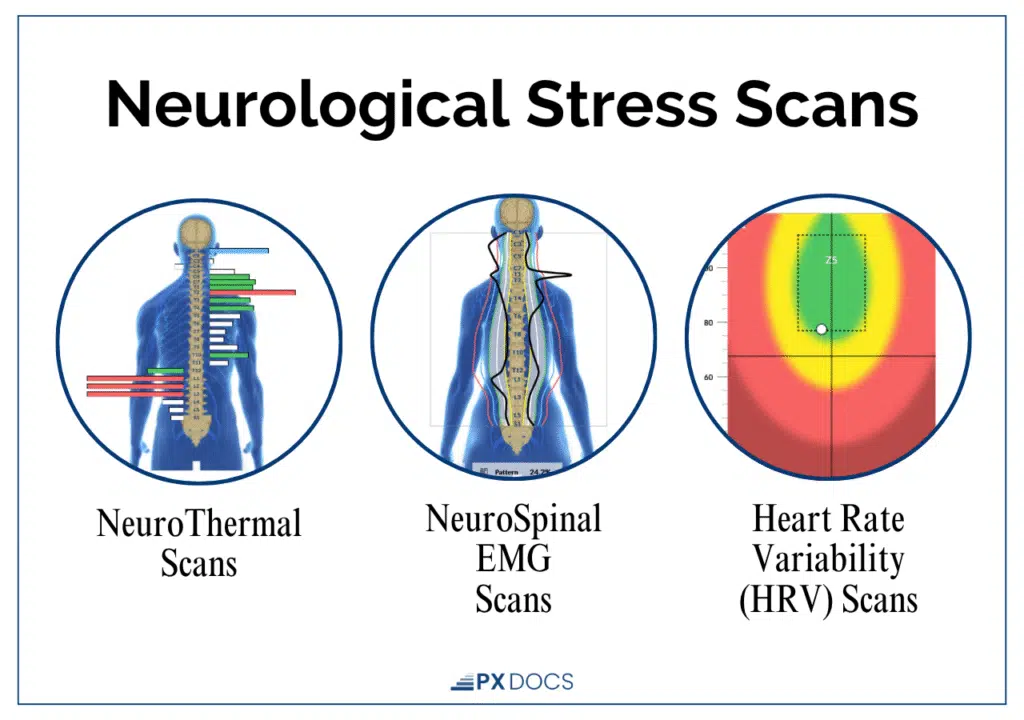
These objective assessments remove the “Is this real?” question. They show exactly where the nervous system is stuck and track progress as care continues.
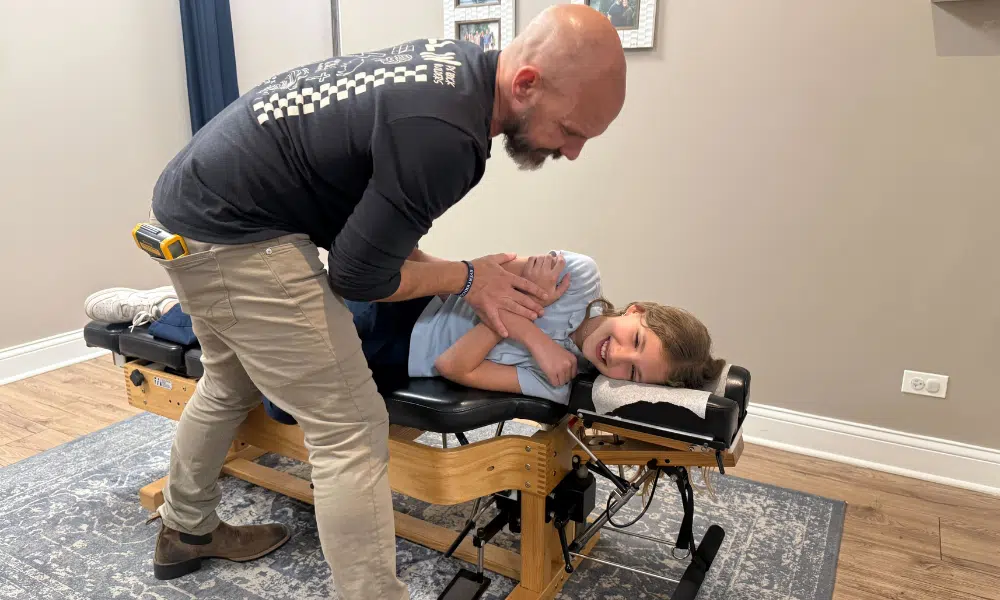
Gentle adjustments remove interference, allowing the nervous system to reorganize and function more efficiently. Benefits extend beyond ADHD symptoms—families often see improvements in sleep, digestion, emotional regulation, and immune function.
This is collaborative care. Neurologically-Focused Chiropractic Care doesn’t replace your child’s therapist or school support. It provides the neurological foundation that makes those interventions more effective. Think of it like repairing a house’s foundation before painting the walls.
We’re not curing ADHD—we’re addressing nervous system dysfunction that contributes to ADHD symptoms. But families like Tristan’s are noticing a major difference in their lives.
Mom says, “After 2 months, we started seeing his posture change. His balance and confidence in Karate were improving. Even his mood was improving. Now, he sleeps better at night, especially on the days he has his adjustments. Our morning routines have become easier. He moves faster and stays on task when getting ready for school. We’re still working with him on improving his ability to focus and reducing his anxiety. However, we can’t help but notice how much he is thriving.”
You Don’t Have to Do This Alone
You started this article at a breaking point—exhausted, guilty, wondering what’s wrong with you.
Here’s what you know now: Nothing is wrong with you. You’re dealing with a child whose nervous system is stuck in a dysregulated pattern. And your nervous system, responding to chronic demand, is stuck right alongside theirs.
The “Perfect Storm” explains why your child’s nervous system struggles—prenatal stress, birth interventions, and early childhood stressors created cumulative overwhelm during critical developmental windows. Understanding this removes blame and opens possibilities.
If you’re ready to explore the neurological root cause of your child’s ADHD symptoms and address the foundation that conventional approaches miss, visit the PX Docs Directory to find a qualified pediatric chiropractor near you.P.S. Parents, this isn’t only about your child. If your own nervous system has been running on stress and survival, this care can help you feel more grounded, regulated, and resilient, too.