

You know you need to start that project. You’ve got the deadline circled on your calendar. You’ve even broken it down into smaller steps. But here you sit—scrolling through your phone, reorganizing your desk for the third time, doing literally anything except the thing you need to do.
And the worst part? You’re frozen. Stuck. Like your brain’s hit an invisible wall, and no amount of willpower can push through it.
This is ADHD paralysis—and if you’ve experienced it, you know it’s more than just “not wanting to do something.” It’s a complete neurological shutdown that can affect work, relationships, and daily life. When you look deeper, ADHD paralysis is actually about how your nervous system got stuck in the first place, not laziness.
What Is ADHD Paralysis?
ADHD paralysis isn’t a formal medical diagnosis, but it’s a very real experience for people with ADHD. It refers to that overwhelming feeling of being mentally stuck—unable to start, continue, or complete tasks even when you desperately want to. Unlike typical procrastination, ADHD paralysis happens involuntarily.
You’re not choosing to put things off; your brain simply won’t cooperate.
Think of it this way: procrastination is deciding to watch one more episode before doing the dishes. ADHD paralysis is sitting on the couch, staring at the dishes, knowing they need to be done, and being physically unable to make yourself get up and do them.
This phenomenon affects people with ADHD differently depending on the situation, but it generally falls into three main categories. Understanding which type you’re dealing with can help you figure out what’s actually going on in your nervous system, and what might help you get unstuck.
The Three Types of ADHD Paralysis
Mental Paralysis: When Your Brain Short-Circuits
Mental paralysis happens when your brain gets overloaded with too many thoughts, emotions, or stimuli all at once. It’s like having fifty browser tabs open in your mind, and your mental processor just… crashes.
You might experience mental paralysis when:
- You’re bombarded with too much information at work or school
- Multiple people are talking to you at once
- You’re trying to process complex instructions
- You’re dealing with sensory overload (loud environments, bright lights, etc.)
When mental paralysis hits, you can’t organize your thoughts. You can’t filter what’s important from what’s not. Your brain feels foggy, and you might completely withdraw or shut down. Parents often describe their kids as “spacing out” or “checking out” during these moments.
From a neurological perspective, this is your brain’s way of protecting itself from overwhelm. But when it happens frequently, it signals that your nervous system is struggling to process and regulate incoming information.
Choice Paralysis: Stuck in the Loop of Overthinking
Choice paralysis, sometimes called decision paralysis or analysis paralysis, happens when you’re faced with too many options and can’t decide what to do. Your brain gets caught in an endless loop of “what if” scenarios, trying to predict every possible outcome.
You might experience choice paralysis when:
- Choosing what to eat for dinner becomes a 45-minute ordeal
- Picking a movie to watch leads to scrolling for hours
- Making work decisions feels impossibly high-stakes
- Simple yes-or-no questions send you spiraling
The fear driving this type of paralysis? Making the “wrong” choice. Your brain tries to protect you by analyzing every angle, but ironically, this prevents you from making any decision at all. Hours pass, the deadline gets closer, and you’re still frozen in indecision.
This isn’t perfectionism in the traditional sense; it’s a nervous system response rooted in fear and uncertainty. When your brain perceives decision-making as a threat, it triggers a freeze response, just as it would in physical danger.
Task Paralysis: When You Can’t Hit “Start”
Task paralysis is probably the most common type of ADHD paralysis. It’s that feeling of being unable to begin a task, even when you know exactly what needs to be done and how to do it.
You might experience task paralysis when:
- The task feels boring or understimulating
- The project seems overwhelmingly large
- You’re worried about doing it “perfectly”
- The task involves multiple steps or unclear instructions
- You’re already mentally exhausted
Here’s what makes task paralysis so frustrating: you can sit there and beat yourself up about not starting, but that doesn’t make your brain any more willing to cooperate. The emotional shame only makes the paralysis worse, creating a vicious cycle.
Task paralysis often has nothing to do with motivation. Your brain might be seeking stimulation that the task doesn’t provide, or it might be protecting you from perceived failure. Either way, the freeze is neurological, not a character flaw.
What Causes ADHD Paralysis? The Nervous System Connection
Most discussions about ADHD paralysis focus on executive dysfunction and dopamine imbalances. While these are absolutely part of the story, there’s a deeper layer that often gets missed: nervous system dysregulation.
The Executive Function Breakdown
Executive function is your brain’s management system, the part that helps you plan, organize, prioritize, start tasks, manage time, and regulate emotions. When you have ADHD, this system doesn’t work as efficiently as it should.
Research shows that the prefrontal cortex, which controls executive function, is underactive in people with ADHD and doesn’t communicate as effectively with other brain regions. This makes it harder to:
- Filter out distractions
- Decide what to focus on
- Initiate tasks without external pressure
- Switch between tasks smoothly
- Manage emotional responses
Imaging studies reveal reduced prefrontal activation during tasks requiring inhibitory control and sustained attention in children with ADHD. When executive function breaks down, your brain struggles to coordinate all the steps needed to get things done. Even “simple” tasks require complex mental choreography, and when that system is overwhelmed, paralysis sets in.
The Dopamine Factor
Dopamine is often called the “motivation molecule,” and research shows that people with ADHD have decreased dopamine receptor and transporter availability in key brain regions involved in reward and motivation—specifically the nucleus accumbens and midbrain.
Here’s the problem: if a task doesn’t provide enough immediate stimulation or reward, your ADHD brain sees no reason to prioritize it. Boring tasks, long-term projects, and anything without instant gratification become neurologically unrewarding. Your brain literally can’t generate the motivation to start.
Studies using positron emission tomography (PET) scans found that lower dopamine function correlates directly with motivation deficits in adults with ADHD. This explains why you can hyperfocus on video games for hours but can’t make yourself respond to a simple email. One provides constant dopamine hits; the other doesn’t.
Your Nervous System Is Stuck in Fight-or-Flight
Here’s where PX Docs’ approach differs from conventional understanding: ADHD paralysis isn’t just about brain chemistry; it’s about your entire nervous system being stuck in a chronic stress state.
Your Autonomic Nervous System has two main modes:
- Sympathetic (“gas pedal”): Fight-or-flight, stress response, high alert
- Parasympathetic (“brake pedal”): Rest, digest, regulate, calm down
Think of it like driving a car. You need the gas pedal to go and the brake pedal to stop. In a healthy nervous system, these two modes balance each other. But those with autonomic dysfunction have difficulty regulating between these states, particularly during tasks requiring sustained attention and response control.
Studies using heart rate variability measurements found that children with ADHD show reduced overall heart rate variability with sympathovagal imbalance, indicating sympathetic dominance. When your nervous system is stuck in sympathetic overdrive, everything feels like a threat, even mundane tasks. Your brain interprets starting a project the same way it would interpret running from danger. So it freezes.
This is called dysautonomia—when your Autonomic Nervous System can’t regulate properly. And it’s controlled largely by the vagus nerve, which runs from your brainstem down through your neck to your heart, lungs, and digestive system.
When the vagus nerve isn’t functioning optimally, you lose your ability to:
- Calm down after stress
- Think clearly under pressure
- Transition between tasks
- Regulate emotions
- Focus your attention
Sound familiar? That’s because vagus nerve dysfunction and ADHD symptoms overlap significantly. The freeze response you experience during ADHD paralysis? That’s your vagus nerve telling your body to shut down in the face of perceived threat.
The “Perfect Storm” and Its Connection to ADHD Paralysis
Most people assume ADHD and its related challenges, like paralysis, are just genetic or “how their brain is wired.” But there’s often a developmental story that begins much earlier than the onset of childhood behavioral symptoms.
At PX Docs, we call this the “Perfect Storm,” a series of early-life stressors that create lasting nervous system dysregulation. And this dysregulation shows up later as ADHD, sensory issues, anxiety, and yes, ADHD paralysis.
- Prenatal Stress: The nervous system begins developing in the womb, and it’s incredibly sensitive to the mother’s stress levels. High cortisol from maternal anxiety, trauma, or challenging pregnancies can affect how the baby’s nervous system forms. This doesn’t mean you did anything wrong. It means that you or your child’s nervous system experienced stress during a critical developmental window.
- Birth Trauma: Birth interventions—C-sections, inductions, epidurals, forceps, vacuum extraction, and more—can create physical trauma to the baby’s delicate brainstem and upper neck. This is where the vagus nerve originates. Even seemingly “smooth” births can create subluxation (neurological interference) in the upper cervical spine. When the brainstem and vagus nerve are compromised, the foundation for nervous system regulation is disrupted from day one.
- Early Childhood Stressors: After birth, the hits keep coming: frequent ear infections, rounds of antibiotics, feeding difficulties, colic, constipation, and sleep struggles. Each of these adds stress to an already compromised nervous system.
By the time the child is in school, their nervous system has been in fight-or-flight mode for years. The brain never learned to downshift into rest-and-regulate mode. Instead, it adapted to chronic stress, and that adaptation looks like ADHD, Sensory Processing Disorder, anxiety, or all of the above.
Conventional Strategies That Help
Before we talk about the nervous system piece, let’s acknowledge strategies that help many people manage ADHD paralysis day-to-day. These won’t fix the underlying dysregulation, but they can help you function better.
- Break It Down Into Micro-Tasks: Large projects overwhelm the ADHD brain. Instead of “clean the kitchen,” try: put away 5 dishes, wipe the counter, take out trash. Celebrate each micro-win; your brain needs those small dopamine hits.
- Use Time Blocks: The Pomodoro Technique (25 minutes work, 5-minute break) can help sustain focus. Some people with ADHD need even shorter intervals, 10 minutes of work, and a 2-minute break. Make the work period feel manageable, not overwhelming.
- Try Body Doubling: Having someone else present (in person or virtually) while you work provides accountability and helps regulate your nervous system through co-regulation. Their calm presence helps your brain stay on track.
- Add Movement Breaks: When paralysis hits, sitting still makes it worse. Stand up, stretch, walk around the block. Physical movement can reset your nervous system and break the freeze response.
- Create External Structure: Your ADHD brain struggles with internal motivation. Add external support: alarms, visual timers, checklists, calendar scheduling, and ADHD time management apps. These tools act as a “borrowed prefrontal cortex.”
- Reward Yourself: Because your brain doesn’t produce dopamine efficiently, hack the system. Build rewards:
- 10 minutes of work → 5 minutes scrolling. Complete a section → watch one episode. Get through boring tasks → treat yourself.
Addressing Nervous System Dysregulation
All those strategies are helpful. But if you’ve tried them and still feel like you’re fighting your nervous system every day, there’s a reason.
You can’t think your way out of a nervous system problem.
No amount of time management hacks will fix a vagus nerve that isn’t functioning properly. No willpower will override a brainstem stuck in fight-or-flight. This is where the PX Docs approach differs; we focus on restoring nervous system function at the source.
At PX Docs, we measure nervous system function using INSiGHT scanning technology. The scans show exactly where your system is dysregulated—how much tension is stuck, whether you’re in sympathetic dominance, and where subluxation is creating interference.
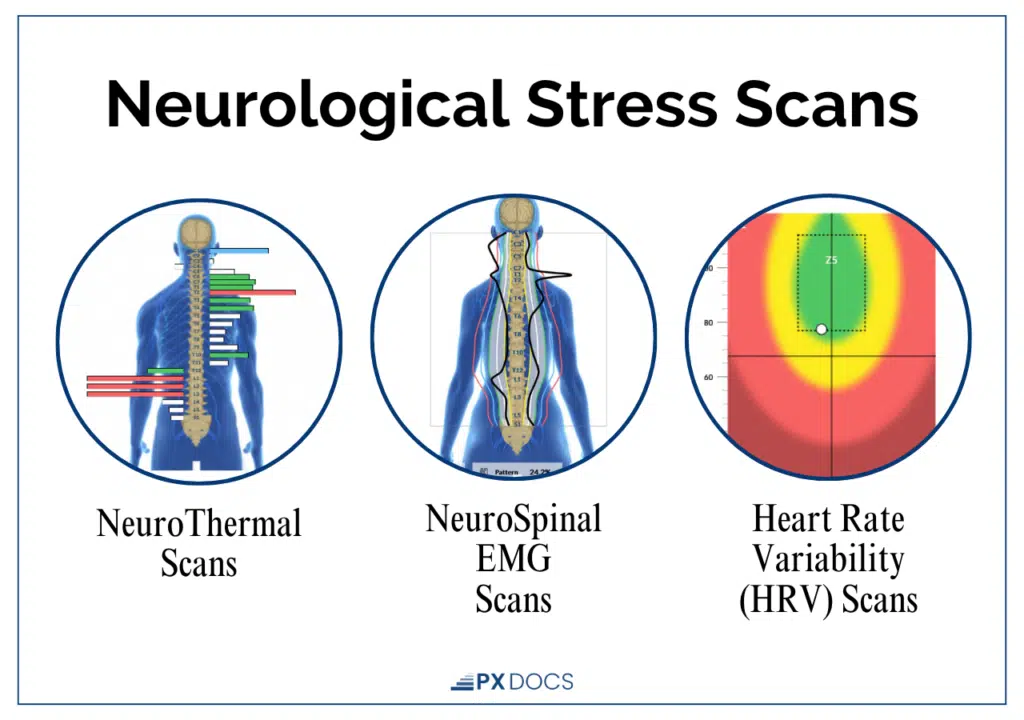
For many parents and adults with ADHD, seeing the dysfunction on a scan is incredibly validating. It proves what you’ve always felt: something really is off.
Neurologically-Focused Chiropractic Care removes neurological interference, allowing your nervous system to function properly. Through gentle adjustments to the neurospinal system, PX Docs chiropractors remove subluxation, restore vagus nerve function, and shift your system out of sympathetic dominance.
When the vagus nerve starts functioning properly, you see better emotional regulation, improved focus, easier task initiation, better sleep, and reduced anxiety. These are neurological changes that occur when your system finally downshifts out of fight-or-flight.
When the nervous system shifts out of chronic fight-or-flight and into a more regulated state, it also begins to properly regulate key neurotransmitters like dopamine, serotonin, and norepinephrine. As mentioned, these brain chemicals play a major role in motivation, focus, mood, and emotional stability.
The nervous system acts as the master controller of how these neurotransmitters are produced, released, and utilized. When the system is stuck in stress mode, those signals can become dysregulated. But as vagus nerve function improves and the nervous system regains balance, these neurotransmitter systems can begin working the way they were designed to — supporting focus, resilience, and emotional regulation.
ADHD Paralysis Isn’t a Life Sentence
ADHD paralysis is real, and it’s not your fault. It’s not a character flaw, a sign of laziness, or proof that you’re not trying hard enough. It’s a neurological response rooted in nervous system dysregulation, often one that started long before you or your child ever showed “ADHD symptoms.”
The good news? Your nervous system isn’t broken forever. It’s stuck. And what’s stuck can be unstuck.
By addressing subluxation, restoring vagus nerve function, and helping your system shift out of chronic fight-or-flight, you can experience real, lasting change. Not just better coping strategies—but actual neurological healing that makes life feel less overwhelming and more manageable. If you’ve been stuck in ADHD paralysis for too long, it’s time to look deeper. Find a PX Docs provider near you through our directory and discover what it feels like when your nervous system finally works with you instead of against you.