
ADHD in women looks completely different from the textbook version. And that textbook? It was written based on hyperactive 8-year-old boys. Research shows men are typically diagnosed between ages 11 and 22, while women don’t receive an accurate diagnosis until ages 16 to 28, if they’re diagnosed at all.
It’s often the case that women with ADHD who’ve reached adulthood have developed elaborate systems just to function. The exhaustion of constantly masking the struggles becomes its own full-time job. Here’s what conventional medicine misses: ADHD doesn’t start in your brain. It starts in your nervous system—often before you were even born.
And this is also an important thing to know: a diagnosis is not a life sentence. Whether you’ve been labeled with ADHD or simply recognize yourself in these patterns, your nervous system is not broken—it’s adaptive. Many women with ADHD are incredibly intuitive, creative, driven, and resilient precisely because of how their nervous systems are wired.
When that system is supported, regulated, and allowed to heal, those same traits can become strengths rather than sources of burnout.
How ADHD Shows Up Differently in Women
ADHD has three types: inattentive, hyperactive-impulsive, and combined. Women with ADHD are far more likely to have the inattentive type, which is almost invisible to others.
Inattentive ADHD shows up as forgetfulness, disorganization, zoning out during conversations, losing track of time, and struggling with follow-through. Teachers didn’t flag you as a problem because you weren’t disrupting class; you were just staring out the window.
Hyperactive-impulsive ADHD in women looks different, too. Instead of bouncing off walls, your hyperactivity is internal. Your mind races constantly. You interrupt people not because you’re rude, but because you’ll forget what you wanted to say if you don’t say it immediately.
But here’s what’s really happening underneath all these symptoms of ADHD: your nervous system is out of balance. Think of your nervous system like a car. The sympathetic side is your gas pedal; it helps you react quickly, focus intensely when something interests you. The parasympathetic side is your brake pedal; it helps you calm down, fall asleep, digest food, and regulate emotions.
In ADHD, the gas pedal is stuck down, and the brakes barely work. This creates emotional dysregulation—you can go from zero to 100 in seconds, or hyper-focus for hours, but can’t transition to the next task. Your nervous system is stuck.
Life Impact
- Work: You’re incredibly capable when a project interests you, but consistent tasks feel impossible. You miss deadlines not because you don’t care, but because time doesn’t feel real until it’s urgent.
- Relationships: Your partner gets frustrated when you zone out during conversations or forget important dates. The emotional dysregulation creates conflict; you may react intensely, then feel guilty afterward.
- Health: You forget appointments, don’t take medications consistently, and can’t build exercise routines. Sleep is often a disaster; your mind won’t shut off at night, but you can’t wake up in the morning.
- Mental Health: Women with ADHD have significantly higher rates of anxiety and depression. When you spend decades thinking you’re failing at tasks that seem easy for everyone else, depression develops. Anxiety becomes your early warning system.
All these symptoms trace back to nervous system dysregulation—not character flaws.
Why Women Get Missed
Cultural expectations for girls differ significantly from those for boys. Girls are supposed to be organized and responsible. When you’re not, people assume you’re not trying hard enough.
Your signs also get dismissed as “just hormonal” or “too emotional.” Doctors care for anxiety or depression instead of recognizing ADHD as the underlying issue.
The high-functioning mask is another problem. You’ve developed such elaborate coping strategies that people don’t realize how hard you’re working just to appear normal. You color-code everything, set seventeen alarms, and still barely keep it together.
What looks like you “growing out of” childhood issues is actually your nervous system adapting—but at a cost. Until the demands exceed your capacity to compensate. That’s usually when diagnosis happens: during college, first job, having kids, or perimenopause.
The Hormone Connection Throughout Life
This is why women with ADHD often feel like they’re going crazy during certain times of their lives.
- Menstrual Cycle: Your symptoms are manageable during the first two weeks (when estrogen is rising), then everything falls apart before your period. Estrogen influences dopamine production; when estrogen drops, so does dopamine availability. Focus, motivation, and emotional regulation all suffer.
- Pregnancy and Postpartum: Some women feel better during pregnancy due to high estrogen. Then postpartum hits, and hormones crash dramatically. The overwhelm of new motherhood, combined with ADHD and plummeting hormones, can be devastating.
- Perimenopause: As estrogen declines, ADHD symptoms that were previously manageable become impossible to ignore. You thought you were developing early dementia. You’re not losing your mind—declining estrogen is unmasking ADHD that was always there.
Here’s the neurological connection most doctors miss: Your nervous system controls your reproductive hormones through two competing systems. The HPA axis (stress response) is your gas pedal system. The HPG axis manages reproductive hormones. You can’t activate both at full capacity simultaneously. When your body is stuck in fight-or-flight, it can’t properly run your reproductive system. This is why stress makes ADHD symptoms worse during hormonal transitions.
What Really Causes ADHD: The “Perfect Storm”
ADHD doesn’t start when symptoms appear. It starts brewing much earlier—often before you were even born. We call this the “Perfect Storm”: when multiple stressors converge during sensitive periods of nervous system development.
- Prenatal Stress: When mom experiences chronic stress during pregnancy, her body produces cortisol and stress hormones. That umbilical cord isn’t just delivering nutrients—it’s transmitting nerve signals. Studies show that when stress hormones are constantly elevated, the baby’s developing nervous system gets programmed to expect a threatening environment. The gas pedal gets set on high alert before birth.
- Birth Trauma & Intervention: C-sections, forceps, vacuum extraction, prolonged labor, induction—interventions like these can create physical stress on the baby’s upper neck and brainstem. The vagus nerve, which controls digestion, sleep, immune function, and emotional regulation, can be affected during birth.
- Early Childhood Stressors: Early childhood stressors continue to shape neurological development in powerful ways. Frequent antibiotic use can disrupt the gut–brain connection, chronic ear infections often require repeated medical intervention, and ongoing emotional stressors can affect how a child’s nervous system learns to feel safe and regulated. Add in environmental toxin exposure and other modern stressors, and the nervous system can remain stuck in a state of dysregulation.
How does this stress show up early on? The baby who had colic, reflux, or chronic constipation? Those weren’t phases. Those were warning signs that the nervous system was stuck in fight-or-flight mode, unable to properly regulate digestion. Chronic ear infections, sensory sensitivities—these all signal a nervous system on high alert.
Here’s the pattern most doctors miss: The colicky/stressed baby at 2 months becomes the sensory-sensitive toddler at 2 years, who becomes the ADHD diagnosis at 7 years. The neurology doesn’t change. Medicine just gives it a different name or label at each stage.
Every child is unique, and their challenges may be slightly different, but over time, this ongoing disrupted nervous system regulation becomes the foundation for many of the diagnoses families eventually receive – ADHD, SPD, anxiety, learning challenges, and more
None of this is your fault. But all of it matters. Understanding the “Perfect Storm” helps explain why conventional approaches often plateau; they’re managing the end result without addressing what created it.
The Nervous System Imbalance Behind ADHD
Your nervous system is like a Ferrari with incredible power and speed. That’s the sympathetic system, the gas pedal. But imagine that Ferrari has 1978 Ford Fiesta brakes with 280,000 miles on them. That’s the parasympathetic system, the brake pedal.
When the gas pedal is stuck down, and the brakes barely work, you get ADHD.
Your Autonomic Nervous System controls all automatic functions. The sympathetic branch is your accelerator—designed for short bursts. In ADHD, this system is chronically activated. You’re stuck in fight-or-flight even when there’s no threat.
This creates racing thoughts, hyperfocus on interesting tasks, difficulty focusing on boring tasks, emotional reactivity, sleep problems, digestive issues, and weakened immune function.
The parasympathetic branch is your brake system. Rest, digest, heal, repair, regulate. When this system is suppressed, you can’t transition between tasks, emotional regulation is impossible, and sustained focus is impossible.
Here’s what changes the conversation: There IS a chemical imbalance. But those chemicals are called neurotransmitters. They transmit messages for the nervous system. If the nervous system is imbalanced first, of course, the chemicals will be imbalanced. Address the nervous system, and the chemicals follow.
This is dysautonomia—nervous system dysfunction.
Measuring What’s Actually Happening: INSiGHT Scans
Unlike traditional ADHD diagnosis, which relies entirely on questionnaires, Neurologically-Focused Chiropractors use objective scanning technology called INSiGHT scans. These computerized scans measure your nervous system function in three ways:
- NeuroThermal patterns showing areas of inflammation and dysautonomia throughout the nervous system, helping us identify where stress is interfering with normal function
- Heart Rate Variability (HRV), showing your body’s ability to adapt to stress
- NeuroSpinal EMG showing neuromuscular tension patterns along the nervous system.
Women with ADHD often show high sympathetic readings throughout the nervous system, exhausted parasympathetic scores, and poor adaptation patterns—particularly in the upper neck and brainstem regions. Similar to this, for example:
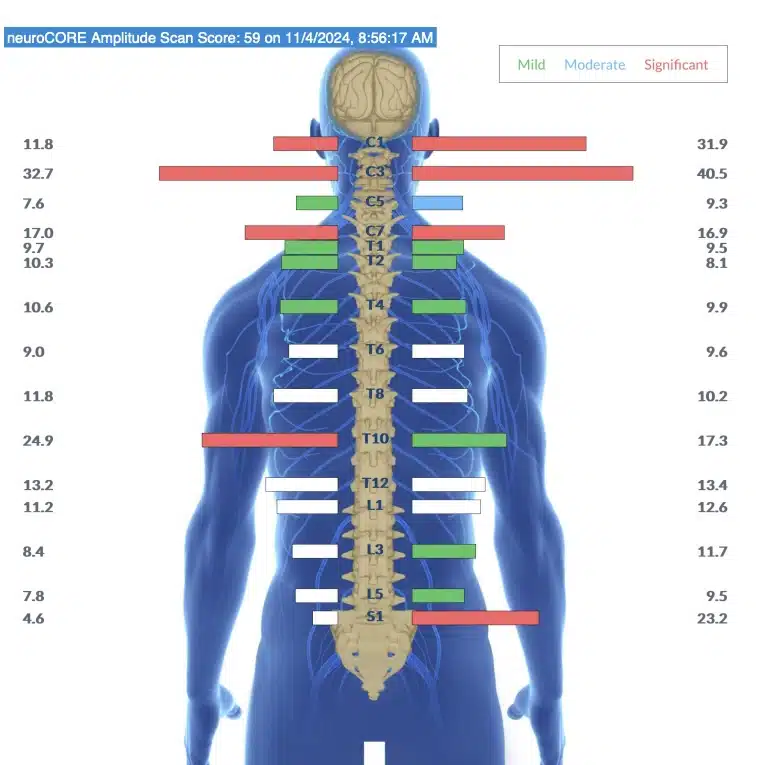
These scans don’t diagnose ADHD. They measure nervous system function and show where interference exists. And they track progress over time, showing when your nervous system is shifting from sympathetic dominance toward better regulation.
Addressing the Root Cause
Here’s where we talk about addressing what created the problem in the first place.
Subluxation isn’t about bones being “out of place.” Subluxation is neurological dysfunction—when physical stress, chemical stress, or emotional stress creates interference in how your nervous system communicates. That interference keeps the gas pedal stuck and the brakes offline.
Neurologically-Focused Chiropractic Care uses gentle, specific adjustments to remove this interference. We’re not curing or treating ADHD. We’re addressing nervous system dysfunction. We’re removing the interference that prevents your body from regulating itself properly or to the best of its ability.
When you remove the interference, the body’s innate healing ability can finally work. Your nervous system can shift from chronic sympathetic dominance toward a more balanced state.
Understanding Changes Everything
ADHD in women isn’t just frustrating symptoms you manage for life. It’s important to look for and address the underlying pattern of nervous system dysregulation.
The truth is simpler and more hopeful: your nervous system is stuck. When the gas pedal is pressed to the floor, and the brakes barely work, of course, focus, emotional regulation, and executive function suffer.
The “Perfect Storm” that created this wasn’t your fault. But understanding it empowers you. When you address the root cause instead of just managing symptoms, real healing becomes possible. Your body knows how to regulate itself better. Sometimes it just needs the interference removed.Visit our directory to find a Neurologically-Focused Chiropractor who uses INSiGHT scanning technology and focuses on nervous system function. At your first visit, expect a thorough consultation about your health history, objective scans, and a clear explanation of what’s happening neurologically.