
Your child jumps off furniture, crashes into walls, chews on everything, and never sits still. Some children crash into everything, seek nonstop movement, chew on objects, and come home from play more dysregulated than before. It’s often brushed off as “high energy” or just how they’re wired, but there’s a deeper pattern underneath it.
These behaviors are known as sensory seeking, and they’re not random. They’re signs of a nervous system struggling to regulate itself.
We’ll explain the root cause, the “Perfect Storm” of prenatal stress, birth trauma, and early childhood stressors. You’ll learn how to identify whether your child is a “true sensory seeker” whose signs get worse with more input, not better. And you’ll get practical strategies to support your child while their nervous system heals.
What is Sensory Seeking?
While other kids sit quietly during story time, others climb the bookshelf. While most children are content with gentle swinging, others demand to be spun in circles. While their peers mind their own space, another child constantly crashes into furniture, walls, and other people.
Sensory seeking happens when a child actively craves sensory input to help regulate their nervous system. Their brain requires more intense stimulation than typical kids just to register that the sensation is happening at all.
In clinical terms, sensory seekers have what’s called a high sensory threshold. This means their nervous system needs stronger, more frequent sensory input before their brain recognizes it. They’re under-responsive to sensory stimulation, so they compensate by seeking it out intensely and constantly.
These often aren’t behavioral choices. Their nervous system is trying to regulate itself the only way it knows how, by seeking the input it desperately needs to function.
In Sensory Processing Disorder terminology, sensory seeking (also called sensory craving) is one of three main subtypes. Some children are over-responsive and avoid sensory input. Others are under-responsive and seek it out. And some show mixed patterns.
But this high sensory threshold isn’t just random brain wiring. It stems from nervous system dysfunction that developed during your child’s earliest months and years. And that dysfunction is addressable.
How Sensory Seeking Shows Up
You learned about the five senses in elementary school. But there are actually eight sensory systems. And for sensory-seeking children, the three “hidden” senses are often the most important.
The traditional five show distinctive patterns: staring at spinning objects (visual), making constant noise (auditory), craving intense flavors (taste), sniffing everything (smell), and constant fidgeting (touch).
But the three additional senses connect most directly to the brainstem—exactly where nervous system dysfunction shows up first.
- Vestibular Seeking: The vestibular system controls balance, movement, and spatial orientation, and connects directly to the brain. These kids need constant movement—spinning until dizzy, jumping off furniture, swinging high and fast, hanging upside down, running instead of walking, climbing everything.
- Proprioceptive Seeking: Proprioception is your sense of body awareness. Sensory seekers crave deep pressure and heavy work; they may crash into walls or people, request tight hugs, push or pull heavy objects, engage in rough physical play, chew on non-food items, prefer weighted blankets, and stomp instead of walking normally.
- Interoceptive Awareness: Interoception is the awareness of internal bodily signals, including hunger, thirst, the need to use the bathroom, and heart rate. Sensory-seeking kids often have poor interoceptive awareness. They don’t recognize hunger until they’re starving, ignore bathroom signals until it’s an emergency, and don’t notice temperature extremes. This signals Autonomic Nervous System dysfunction.
Signs Your Child is a Sensory Seeker
- Infants & Toddlers (0-3 years): Arching during feeding, excessive bouncing or rocking, climbing out of crib early, constant motion, intense mouthing, head banging for input, difficulty settling for sleep, crashing while learning to walk. That colicky, arching baby often becomes the sensory-seeking toddler.
- Preschoolers (3-5 years): Can’t sit during story time, constantly moving during play, seeks messy activities, talks loudly or sings constantly, invades personal space, plays too roughly, chews on everything, endless energy for spinning, swinging, climbing, jumping.
- School-Age Children (6-12 years): Constant fidgeting, chewing on school supplies or clothing, seeks recess but struggles with desk work, takes physical risks, friendship difficulties from rough play, can’t sit still for homework, prefers high-stimulation activities, may need to stand to concentrate.
The nervous system dysfunction that started in infancy now affects learning, social relationships, and daily functioning. Without addressing the root cause, these patterns typically intensify.
Is Your Child a True Sensory Seeker?
Most sensory-seeking kids follow this pattern: they seek intense input, they get that input, and it helps them regulate. Send them outside to jump on the trampoline, and they come back calmer and focused.
True sensory seekers follow a different pattern: they seek intense input, they get that input, and they become MORE dysregulated, not less.
Send them outside to burn off energy? They come back more wound up. Give them proprioceptive input? They escalate instead of settling. Provide movement breaks? They can’t transition back—they want more movement, more intensity, more stimulation.
Dr. Lucy Miller describes this as an extreme overarousal with constant movement. The sensory input that should be organizing their nervous system is pushing them further into dysregulation.
If your child continues to escalate despite getting the input they seek, their nervous system isn’t just hungry for stimulation. It’s stuck in overdrive. The gas pedal is floored, the brake pedal isn’t working, and adding more input is like pushing the accelerator even harder.
So what causes this level of dysregulation?
What Causes Sensory Seeking? The “Perfect Storm”
Here’s what most pediatricians and occupational therapists don’t tell you—or don’t know.
We call this the “Perfect Storm,” a convergence of preconception/prenatal stress, birth interventions, and early childhood stressors that create lasting nervous system vulnerability.
Component 1: Prenatal & Birth Stress
Maternal stress during pregnancy, fertility challenges, medications—all affect your baby’s developing nervous system. Cortisol crosses the placenta and shapes how the stress response system develops.
Then comes birth. C-sections, forceps, vacuum extraction, inductions with Pitocin, epidurals, and other interventions—each can create physical trauma to the upper cervical spine, brainstem, and vagus nerve. These interventions often save lives. But they create forces the infant’s nervous system wasn’t designed to handle, causing Sympathetic dominance from day one.
Component 2: Early Childhood Cascade
That stressed nervous system then faces colic, reflux, and constipation—early red flags of dysfunction. Then comes repeated antibiotics, chronic illness, disrupted gut microbiome, and immune dysfunction. Each stressor compounds nervous system dysfunction.
Looking back, most parents of sensory-seeking kids can trace the pattern to those first months of life.
Component 3: Neurological Dysfunction Locked In
This stress accumulation creates subluxation, which is interference in nervous system function. Subluxation disrupts the body’s internal communication, changing how the brain receives sensory information. When that happens, sensations can feel either overwhelming or not enough for the brain to settle and feel calm.
This leads to dysautonomia, an Autonomic Nervous System imbalance that creates a high sensory threshold. The brain requires excessive input to register sensations because communication pathways aren’t working properly.
We’re not talking about blame. It’s more about understanding the sequence that creates vulnerability.
How Nervous System Dysfunction Creates Sensory Seeking
Your child’s Autonomic Nervous System has two branches. The Sympathetic Nervous System is the gas pedal—energy, alertness, quick responses. The Parasympathetic Nervous System is the brake pedal—calming down, digestion, sleep, and emotional regulation.
Think of your child’s nervous system like a car. Your child has a Ferrari McLaren engine—incredible power. But their brakes? 1978 Ford Fiesta with 280,000 miles. That’s the imbalance we see in sensory-seeking kids.
The gas pedal is stuck down. The brake pedal barely works. And the bigger the gap between gas and brake power, the bigger their struggle.
This creates under-registration. It’s like a dimmer switch stuck too low; sensory signals don’t reach the awareness threshold. The brain needs more intense, more frequent input just to notice something is happening.
So your child crashes, jumps, chews, spins. They’re trying to generate enough input to break through that threshold. The seeking behaviors aren’t the problem—they’re compensation for a nervous system that can’t register typical input.
The vagus nerve runs from the brainstem through the body, controlling digestion, sleep, immune function, and sensory integration. Birth Trauma damages vagus nerve function. Research has shown that poor vagal tone is present in individuals with sensory processing issues. The brake pedal was damaged before your child took their first breath.
Sensory Processing Disorder, ADHD & Autism
Sensory seeking rarely exists in isolation. But these aren’t separate conditions; they’re different expressions of the same nervous system dysfunction.
Up to 66% of kids with ADHD also have sensory processing differences. That gas pedal stuck down creates both the hyperactivity of ADHD and the seeking behaviors. Same root cause, different manifestations.
Sensory seeking is common in children with autism but varies widely (55-95%). Not all sensory seekers have Autism, and not all autistic kids are sensory seekers.
Whether it’s SPD, ADHD, Autism, or a combination, nervous system dysfunction is the common thread. Address that foundation, and everything else works better.
The Limits of Traditional Care
Occupational Therapy provides incredible value. OTs create personalized sensory diets, teach coping strategies, and help kids function better in daily life.
But here’s the limitation: Occupational Therapy manages the signs. It doesn’t address the deeper nervous system component.
You’re filling the sensory bucket with OT strategies—weighted blankets, movement breaks, proprioceptive input. All valuable. But the bucket has a hole in the bottom. The nervous system dysfunction is still there, constantly draining away the regulation you’re building.
This is often why families plateau. They see some improvement, but hit a ceiling. The strategies help, but never quite get their child where they need to be.
The best outcomes happen when OT strategies are paired with neurological care. When you address the nervous system first, sensory strategies are more effective. The skills stick. The progress continues.
OT therapists do what they’re trained to do, and they do it well. The missing piece is addressing WHY the nervous system has such a high threshold.
How We Objectively Identify Patterns
MRIs and blood work look for disease. INSiGHT Scans measure function.
- Heart Rate Variability (HRV) measures the balance between Sympathetic (gas pedal) and Parasympathetic (brake pedal) activity. In sensory seekers, we consistently see sympathetic dominance.
- Thermal Scanning uses infrared sensors to detect temperature differences along the spine, showing exactly where the nervous system is out of balance.
- Surface EMG measures electrical activity in the neurospinal muscles, showing neuromuscular tension and energy drain from compensation.
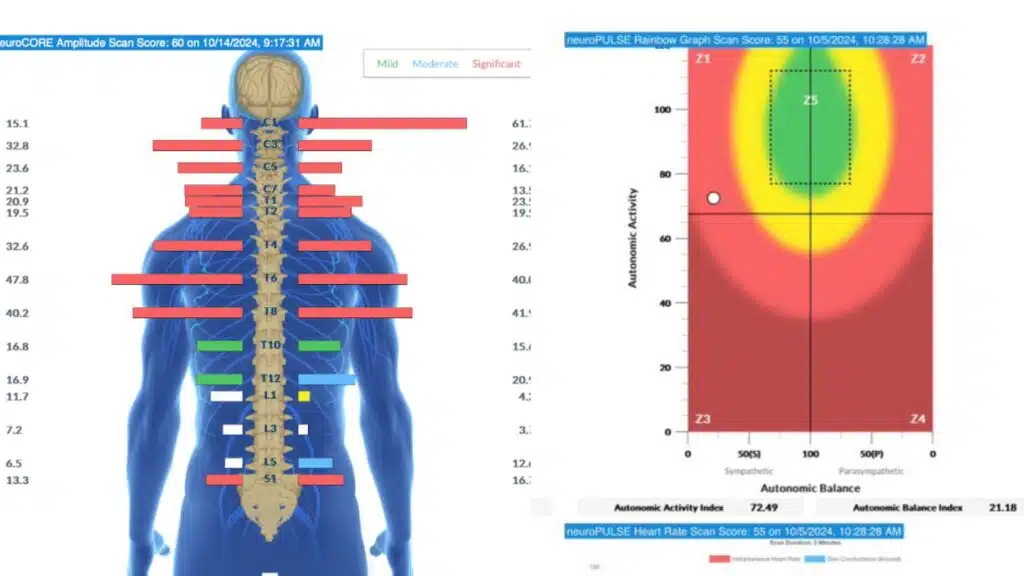
A typical scan for a sensory-seeking child shows way too much sympathetic dominance, all sorts of color indicating dysfunction, asymmetry showing where the nervous system is struggling.
As care progresses, scans begin to clear, calm, regulate, and reorganize. Parents report improvements in sleep, easier transitions, improved digestion, and eventually decreased sensory seeking intensity.
Joseph’s journey is a great example of how improvements in sensory processing and proprioception can ripple across many areas of a child’s life — from posture and body awareness to increased confidence and social engagement. As his nervous system became more regulated, he became happier and more relaxed, and he began engaging in activities he had never considered before.
Supporting Your Sensory-Seeking Child
While the nervous system heals, these strategies help meet needs and prevent dysregulation:
- Movement: Swinging (linear for calming), obstacle courses, animal walks, bike riding
- Proprioceptive: Weighted blankets or vests, tight hugs, heavy work (carrying groceries, pushing cart), crash pads, wall pushes
- Oral: Chewable jewelry, crunchy foods (carrots, apples), chewy foods (bagels, dried fruit), thick straws
- Tactile: Sensory bins (rice, beans, kinetic sand), messy play, fidget toys
- Structure: Movement breaks every 20-30 minutes, visual timers with clear start/stop, goal-directed activities
Sensory seekers can keep going like Energizer bunnies. Provide activities with clear start and stop points. Pair sensory input with functional tasks. Make movement purposeful.
These are supports during healing. As the nervous system regulates, your child will often need these less and less.
Getting the Right Support
Don’t wait for them to “grow out of it.”
If sensory seeking impacts safety, learning, or social relationships, get help. The earlier you address nervous system dysfunction, the better.
The most effective approach: A Neurologically-Focused Chiropractor addressing root cause, an Occupational Therapist teaching strategies, and other providers as needed.
Address the nervous system foundation first for the best outcomes.
Your Child’s Nervous System Can Heal
Sensory seeking isn’t a life sentence. The root cause, nervous system dysfunction created by the “Perfect Storm,” is addressable. When you remove Subluxation, restore vagus nerve function, and shift the Autonomic Nervous System back into balance, the high sensory threshold normalizes. Your child just needs a little nervous system support to function properly; they’re not broken.
Real healing takes time and requires addressing the foundation. But it is possible.
Find a PX Docs provider near you. Your child’s journey toward nervous system healing can start today.