
If you’ve noticed your child’s scans continue to highlight the same region or segment — particularly areas such as the upper cervical (namely C2 is known for this), brainstem, and transitional zone regions — even though they’re being adjusted regularly, you’re not alone.
This is one of the most common (and important) questions parents ask during neurological healing and restoration.
The good news? This usually isn’t a sign that care isn’t working.
In fact, it often means we’ve identified the main stress point in your child’s nervous system and are helping it heal at the deepest level.
Let’s explain what’s really happening.
📊 What Our Scans Are Actually Showing
Our neurological scans don’t just look for bones that are “out of place” — so it doesn’t mean that the particular segment or region is staying misaligned and that the adjustments aren’t “holding” in that sense.
Instead, our INSiGHT Scans measure things like:
📊 nervous system stress + dysfunction
📊 neuromuscular tension + asymmetry patterns
📊 how the brain regulates the body
📊 areas of overload and compensation
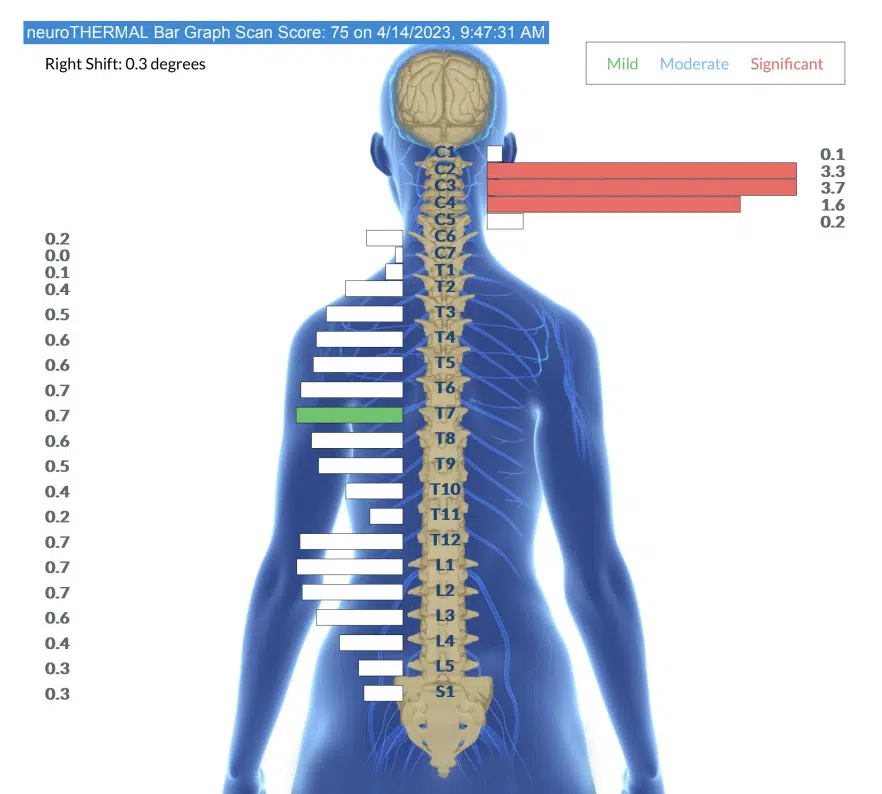
When the same area shows up consistently — like the upper cervical or brainstem region — it’s telling us:
👉 This is where your child’s nervous system holds stress the most.
It’s the body’s main “default” protection zone.
Have you ever noticed that when you’re stressed, tired, or overwhelmed, your body always tightens up in the same spot — usually your neck or shoulders?
Even if you stretch it out or get a massage and it feels better for a while, the next stressful day… that same spot tightens right back up again.
Not because the massage didn’t work — but because that’s your body’s default stress-holding zone.
Your nervous system has learned, “When stress hits, protect here first.”
In your child’s body, the upper neck and brainstem area is the same stress zone.
When their nervous system feels overloaded — from sleep changes, illness, growth spurts, or sensory overwhelm — the brain reflexively tightens and guards that area again.
Digging deeper, factors such as mold toxicity, viral stress, and secondary infections often affect the weakest or most sensitive parts of the nervous system first. Our scans continue to identify those areas, guiding us to focus care there and steadily build strength and stability over time.
Over time, as the nervous system heals and gets stronger, it stops needing to go there as a protection pattern. We’re working toward that goal in a major way through the current care plan, adjusting protocols, and supportive measures (PT, namely).
🧠 Why the Brainstem (and C2) Is So Important
The brainstem and upper cervical region is a major communication highway between the brain and the body. We often refer to it as “Air Traffic Control,” or the main “Operating System” that keeps all other major systems of the body connected and coordinated.
It plays a huge role in:
- sleep regulation
- regulating stress + sensory input
- balance + coordination
- eye + head movement
- muscle tone + posture
- digestive system control + function
- immune system control + function (including modulation of inflammation)
- calming + regulating the nervous system overall
As a result, when the nervous system is overwhelmed — by poor sleep, illness, growth spurts, emotional stress, or sensory overload — the brain often tightens and guards this area first.
Think of it as your child’s “stress hotspot.”
While the upper cervical and C2 regions are by far the most common subluxation pattern to continually present in this manner, the transitional zones are often not far behind in Perfect Storm patients.
These areas of the neurospinal region have struggled with asymmetry and exhaustion for so long that when growth spurts or additional stressors hit the body, they tend to get worn out pretty easily.
This is why we not only continue to adjust in those areas with our Neuro-Tonal approach, but also, once the first phases of neurological stability are in play, we often engage collaborative care with a Neuro-Focused PT expert like Beth and her team at Dream Riders.
🔁 Why It Can Reappear Even After Great Adjustments
Early in the healing process:
✔ we correct the subluxation
🚨 but the nervous system is still learning how to hold regulation
So when stress shows up, the brain sometimes slips back into its old protective pattern.
This doesn’t mean progress is lost.
It means the nervous system is still rebuilding strength and stability.
Over time, as regulation improves:
💪 the body holds adjustments longer
💪 rebounds faster after stress
💪 shows less tension on scans
💪 eventually stops defaulting to that area altogether
This is what true neurological healing looks like.
📈 Consistency Is Actually a Good Sign
When the same area shows up repeatedly, it tells us:
✅ we’ve found the root stress +dysfunction pattern
✅ care is targeted and specific
✅ the nervous system isn’t bouncing randomly (it’s actually quite predictable)
Random patterns would be far more concerning.
Consistent patterns = clear healing focus and care plan.
🔋 A Helpful Way to Think About It
Imagine rehabbing a weak knee.
At first, every time you walk too far, it flares back up. Not because therapy isn’t working — but because it’s still rebuilding strength.
As it heals:
➡️ it tolerates more stress
➡️ recovers faster
➡️ eventually feels stable again
The nervous system heals in the same layered way.
⏳ Why More Severe “Perfect Storm” Cases Take Longer (And Why That’s Normal)
It’s also important to understand that not all nervous systems heal on the same timeline.
Children who experienced more significant birth trauma, longer periods of neurological stress, toxic overload (like mold, heavy metals, or chronic infections), or what we often call a more intense “Perfect Storm” pattern typically have deeper and more layered nervous system exhaustion.
In these cases, the primary stress pattern — such as the upper cervical or transitional zone region — may occur more frequently and over a longer period early in care.
Not because healing isn’t happening. But because the nervous system has been under stress for much longer and is rebuilding regulation in deeper layers.
Think of it like this:
A mild ankle sprain heals fairly quickly, but a major ligament tear takes time, repetition, and progressive strengthening.
Both heal — but on very different timelines.
With more complex neurological cases, the brain may return to that same protection pattern more frequently at first as it relearns how to regulate, adapt, and feel safe again.
Over time, as resilience improves:
✔️ the pattern appears less intensely
✔️ it takes more stress to trigger it
✔️ recovery happens faster
✔️ and eventually it no longer becomes the default response
This slower, layered progress is actually a sign of deep neurological rebuilding — not stagnation.
❤️ The Big Picture
Seeing the same upper neck pattern early in care usually means:
☑️ we’ve identified the main neurological issue
☑️ your child’s body is healing in layers
☑️ regulation is improving over time
This is how long-term stability, development, and resilience are built.
And it’s exactly why we track functional changes and progress — not just symptoms.
Progress isn’t measured by how fast patterns disappear — it’s measured by how strong and adaptable the nervous system becomes.
Each phase of care builds more regulation, more stability, and more resilience.
Over time, the body holds changes longer, handles stress better, and no longer defaults into old protection patterns.
This is the foundation of true healing — and it’s exactly what we’re working toward together!