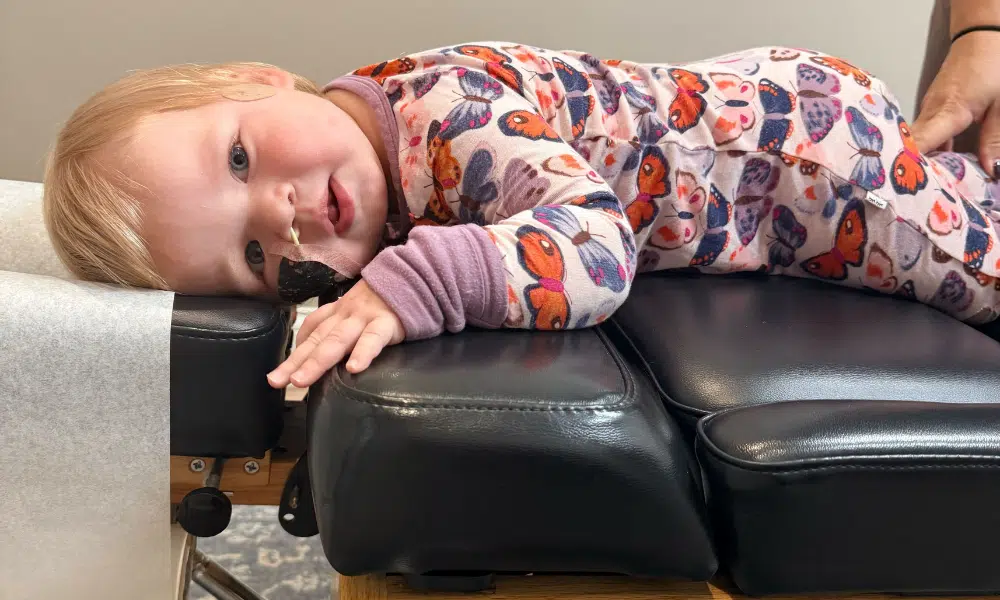

They say “motion is life” – and that is most positively true for a developing child. As parents, we celebrate every one of these milestones in a major way, getting so excited when they can first hold their head up, roll over, sit up, start crawling, and begin to walk!
And we should absolutely celebrate each of those motor milestones in a major way, because they’re not just cute and fun to watch – they are absolutely essential for your child’s brain and overall nervous system development. Everything downstream from cognition to speech and communication is dependent on the brain and nervous system developing properly, which is why when a child has motor planning difficulties and struggles with motor function even in the slightest bit, it can show up later in life as all sorts of brain-based challenges.
These challenges can take many forms, such as your child appearing clumsy, having difficulty following multi-step instructions, or requiring more time than their peers to learn new skills. These challenges may be signs of motor planning difficulties, a neurological issue that affects many children but is often misunderstood or overlooked.
Motor planning, or praxis, is the ability to conceive, plan, and execute skilled motor actions in the correct sequence. This skill is crucial for a child’s academic performance, social interactions, and self-esteem. Difficulties with motor planning, known as Developmental Coordination Disorder (DCD), affect an estimated 4-9% of school-aged children and can lead to frustration, anxiety, and behavioral issues.
And those are just the documented numbers in research, when we look deeper – far more children are struggling with motor planning and it’s strongly correlated to exploding conditions such as Sensory Processing Disorder, Autism Spectrum Disorder, ADHD, and even Anxiety – all of which are neurodevelopmental and brain-based challenges that are often diagnosed later in life after a child has struggled with motor tone and coordination for years on end.
In this article, we’ll explore the signs of motor planning difficulties, the neurological basis behind these challenges, and the limitations of traditional medical approaches. Most importantly, we will introduce you to a groundbreaking care option offered by PX Docs: Neurologically Focused Chiropractic Care that addresses the root cause of motor planning difficulties and unlocks your child’s true potential.
Get ready to discover a path to help your child thrive and experience the joy of mastering new skills with confidence.
What is Motor Planning?
Motor planning, or praxis, is the complex process of conceiving, planning, and executing a skilled movement. It involves the ability to imagine a task, break it down into steps, and then coordinate the necessary body movements to complete the task successfully. Motor planning is a vital skill that we use throughout our lives, from the moment we learn to grasp a toy as infants to the time we learn to drive a car as teenagers.
There are three main stages of motor planning:
- Ideation (Input/Perception): This is the “thinking” stage, where the brain generates an idea or goal for a specific movement or action.
- Organization (Integration/Processing): In this stage, the brain maps out the steps needed to complete the task and the order in which they should be performed.
- Execution (Action/Output): This final stage involves actually carrying out the planned movement and coordinating the muscles and body parts needed to complete the task.
Motor planning is closely linked to the development of both gross motor skills and fine motor skills, as well as overall sensory processing and integration. Gross motor skills involve the large muscles of the body and enable activities like walking, running, jumping, and climbing. Fine motor skills, on the other hand, involve the small muscles of the hands, fingers, and wrists, allowing for precise movements such as writing, drawing, and fastening buttons. Studies have found that around 6-13% of all school-age children experience poor motor coordination.
Some everyday examples of tasks that require motor planning skills include:
- Getting dressed: Motor planning enables a child to sequence the steps needed to put on clothes in the correct order and manipulate fasteners, such as buttons and zippers.
- Handwriting: Effective motor planning enables a child to coordinate the small muscles in their hand and fingers, allowing them to grasp a pencil and form letters and words on paper.
- Playing sports: Motor planning is essential for activities like kicking a ball, swinging a bat, or swimming, which require coordinated, sequential movements of various body parts.
When a child struggles with motor planning, these everyday tasks can become challenging, leading to frustration and difficulties in both home and school environments. By understanding the intricacies of motor planning and its role in child development, parents and caregivers can better recognize and address any difficulties their child may be experiencing.
5 Signs of Motor Planning Difficulties in Children
As a parent, you may notice that your child struggles with certain tasks or seems to develop skills more slowly than their peers. While every child develops at their own pace, consistent difficulties with motor planning can lead to frustration and challenges in various areas of life. Here are some common signs that may indicate motor planning difficulties in children:
1. Difficulty learning new tasks
- Struggles to follow multi-step instructions
- Appears overwhelmed or frustrated when presented with a new activity
- Requires more practice than peers to master a new skill
2. Clumsiness and poor coordination
- Frequently bumps into objects or people
- Has trouble with balance and may fall often
- Struggles with activities that require hand-eye coordination, like catching a ball
3. Slow execution of seemingly simple tasks
- Takes longer than expected to complete everyday activities, such as getting dressed or tying shoes
- May appear to be “stuck” or unsure of how to proceed with a task
- Requires frequent prompts or assistance to complete tasks
4. Handwriting problems and difficulty with spatial organization
- Has trouble forming letters and numbers correctly
- Struggles to write within lines or maintain consistent spacing between words
- May have difficulty organizing objects or materials in a logical manner
5. Challenges with timing, rhythm, and ideation in play and social interactions
- May have trouble coming up with ideas for play or adapting to changes in play scenarios
- Struggles to keep up with the pace of conversations or group activities
- May have difficulty with turn-taking or understanding social cues
These difficulties can have a significant impact on a child’s daily life, affecting their performance in school, their ability to engage in play and social interactions, and their overall self-esteem. Children with motor planning difficulties may become frustrated or anxious when faced with new challenges, which can lead to avoidance behaviors or emotional outbursts.
It is important to note that not all children with motor planning difficulties will exhibit all of these signs, and the severity of the challenges may vary from child to child. If you consistently notice several of these signs in your child and are concerned about their development, it may be helpful to consult with a pediatric occupational therapist or a Neurologically-Focused Chiropractor who can assess your child’s specific needs and provide appropriate interventions to support their growth and development.
The Neurological Basis of Motor Planning Difficulties
To fully understand motor planning difficulties, it is essential to explore the underlying neurological factors that contribute to these challenges. At the heart of motor planning is the nervous system, which plays a crucial role in transmitting signals between the brain and the rest of the body.
When the nervous system is functioning optimally, it allows for smooth communication and coordination between the brain and the muscles, enabling a child to plan and execute movements effectively and efficiently (smoothly). However, when there are disruptions or imbalances in the nervous system, such as subluxation or nervous system dysregulation, motor planning difficulties can arise.
Subluxation occurs when there is both misalignment and fixation, or disruption and distortion of the proper range of motion within the neurospinal system. These disruptions can lead to decreased proprioception (the body’s ability to sense its position in space) and altered sensory input, making it more challenging for a child to plan and execute coordinated movements. Simply put, subluxation equals neurological interference, and it primarily sets up shop within the sensorimotor system, making it a major factor in motor planning difficulties.
Nervous system dysregulation disrupts the flow of sensory input and motor output between the brain and body, making it difficult for the brain to accurately plan, sequence, and execute movements. This disorganized communication – especially when subluxation interferes with proprioception and brainstem regulation – leads to delayed or clumsy motor planning in children.
Limitations of Traditional Therapies
Traditional movement-based therapies, such as physical therapy (PT) and occupational therapy (OT), are often designed to improve strength, mobility, coordination, and sensory integration through repetitive exercises, stretches, and tasks. While these modalities can offer benefits, they rely heavily on a child’s nervous system being capable of accurately perceiving and integrating sensory input and translating that into coordinated motor output.
If subluxation and nervous system dysregulation are present—especially in the brainstem, vagus nerve, or sensorimotor integration pathways—then the foundational communication between brain and body is distorted from the start. It’s like trying to build your house upon the sand instead of the rock – the foundation just isn’t there for the results to take root and last.
Subluxation introduces both dysafferentation (distorted or diminished sensory input to the brain) and dyskinesia (abnormal motor control output), meaning that the very system PT and OT are trying to work with is miswired or misfiring. This creates a mismatch between what therapists are asking a child’s body to do and what their nervous system is actually capable of organizing and executing. Even the most well-designed motor or sensory activity won’t “stick” if the brain can’t properly receive, process, and respond to it in real time. This leads to frustration, stagnation, or even regression in therapy progress—especially when a child appears unmotivated, uncoordinated, or “plateaus” despite consistent participation.
Furthermore, when a child’s autonomic nervous system is in a chronic state of sympathetic dominance (fight-or-flight), they’re neurologically wired for protection, not performance. This defensive state reduces access to the prefrontal cortex and higher-level motor planning centers, impairing coordination, balance, and learning. Until that stress response is down-regulated and vagus nerve tone is restored, many children simply can’t access the calm, regulated state required for neuroplasticity and motor learning to take hold.
In contrast, Neurologically-Focused Chiropractic Care helps clear the interference at the root or foundation of the system – restoring normal sensory afferent input, improving brainstem regulation, balancing the autonomic nervous system, and laying the groundwork for therapies like PT and OT to finally work more efficiently and effectively. When the “foundation” is functioning properly, the therapeutic interventions can finally lead to long-term developmental gains instead of short-lived or stalled results.
The PX Docs Approach: Neurologically-Focused Chiropractic Care
At PX Docs, we offer a unique and comprehensive approach to addressing motor planning difficulties in children. Our Neurologically-Focused Chiropractic Care is designed to identify and care for the underlying root causes of these challenges, rather than simply managing signs.
Central to our approach is the understanding that subluxation and nervous system dysfunction play a significant role in the development of motor planning difficulties. Our chiropractors are specially trained to detect and address these neurological imbalances using gentle, precise adjustments that are tailored to each child’s unique needs.
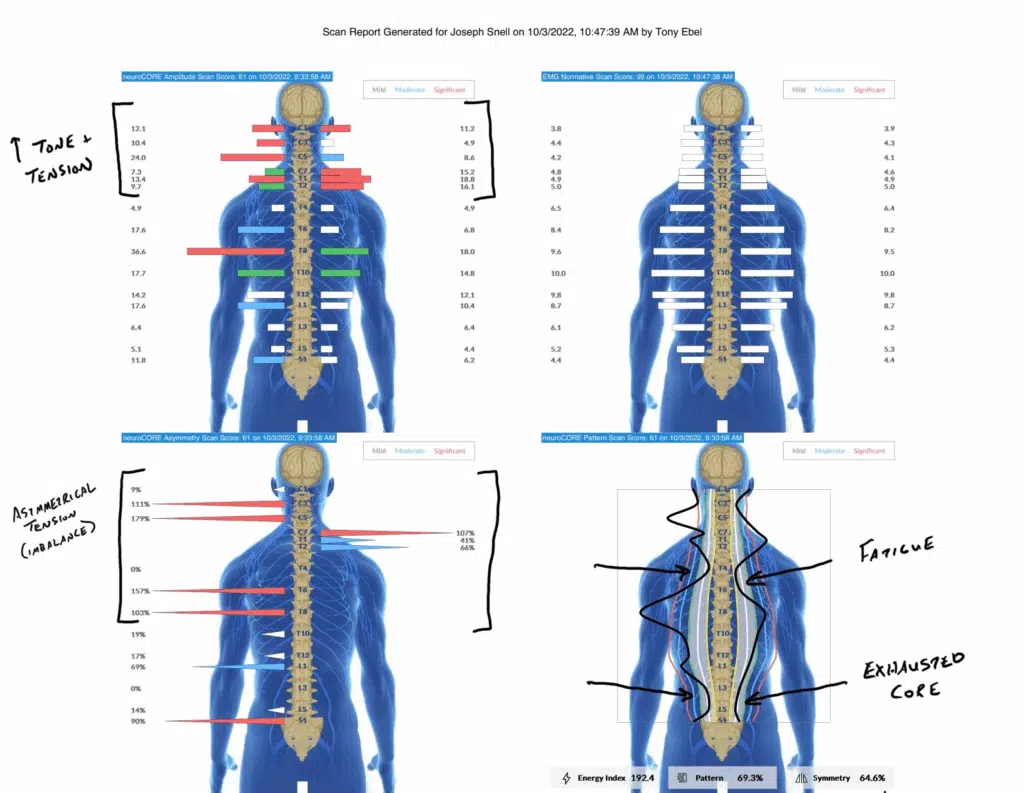
To accurately assess a child’s neurological function, we utilize state-of-the-art technology called INSiGHT scans. These non-invasive scans provide us with a detailed picture of a child’s nervous system, allowing us to pinpoint areas of dysfunction and create a personalized care plan that targets these specific challenges.
Below is a set of initial EMG Scans on Joseph, an incredible child who was struggling significantly with autism, dyspraxia, low muscle tone, and motor planning difficulties. His scans show the “triple combination” of significant tension, asymmetry, and neuromuscular exhaustion, which are commonly associated with those exact challenges. The good news for Joseph – within just a few days of getting adjusted, his gross motor planning improved so much that he asked his mom to go to the gym and start working out, and he hasn’t looked back since!
See more of Joseph’s incredible story here.
Supporting Motor Planning Development at Home
In addition to the care provided by our chiropractors, parents can support their child’s motor planning development in several ways at home. Some of these strategies include:
- Engaging in motor planning activities that promote gross and fine motor skill development, such as playing catch, completing puzzles, or working on arts and crafts projects
- Providing a sensory-friendly environment that minimizes distractions and offers a variety of tactile experiences
- Encouraging play and social interactions that foster ideation, adaptability, and turn-taking skills
- Breaking down complex tasks into smaller, more manageable steps and providing visual cues or demonstrations as needed
- Collaborating with professionals and utilizing occupational therapy to ensure a comprehensive and cohesive approach to supporting your child’s development
The Importance of Early Intervention and a Drug-Free Approach
When it comes to addressing motor planning difficulties, early intervention is crucial. Research indicates that early intervention services for infants and children up to three years old can reduce and frequently prevent the long-term impacts of developmental delays. By identifying and addressing these challenges early on, children can develop the foundational skills necessary for success in various areas of life, from academics to social interactions.
We believe in a drug-free approach that considers the whole child and their unique circumstances. By combining Neurologically-Focused Chiropractic Care with other supportive therapies and interventions, we aim to provide children with the comprehensive support they need to thrive.
Empowering Children to Reach Their Full Potential
Motor planning difficulties can present significant challenges for children and their families, but with the right support and interventions, these obstacles can be overcome. By understanding the neurological basis of motor planning difficulties and seeking out the expertise of PX Docs practitioners, parents can help their children develop the skills and confidence necessary to reach their full potential.
If you suspect that your child may be experiencing difficulties with motor planning, we encourage you to visit the PX Docs Directory and find a qualified practitioner in your area. Our team of dedicated and compassionate chiropractors is here to support you and your child every step of the way on your journey toward optimal neurological function and overall well-being!