
High-functioning ADHD can feel like a double-edged sword. On the surface, some may appear to have it all together: a successful career, impressive credentials, and polished appearance. However, inside, they face constant exhaustion, a racing mind, and the ongoing effort to appear organized. What seems effortless often requires double the work.
For women, high-functioning ADHD isn’t just about mild distraction; it often involves navigating a mind on overdrive. You might excel at work while struggling to manage daily tasks or get caught in perfectionism fueled by anxiety. Many women face overlapping issues like anxiety and focus struggles, often seeing them as separate problems when they’re interconnected.
Interestingly, women tend to be diagnosed with ADHD much later than men, typically 4 years later, due to the compensatory strategies they develop. As these resources dwindle with age, symptoms become harder to conceal, revealing the internal challenges behind an outwardly successful facade.
What Is High-Functioning ADHD in Women?
“High-functioning ADHD” isn’t a formal diagnosis. It describes women who meet ADHD criteria but maintain external success through intense internal compensation. Your doctor sees achievements, not the energy expenditure that’s often two to three times what others use.
High-compensation ADHD is more accurate—because you’re not necessarily functioning better, you’re hiding the struggle better. Every compensation strategy activates your Sympathetic Nervous System. That’s your body’s “gas pedal,” designed for short-term stress response, not constant activation.
When your nervous system runs in perpetual stress mode, something eventually gives. For many women, that tipping point hits during major transitions: career advancement, motherhood, and perimenopause. What conventional medicine calls “high-functioning” is actually your Autonomic Nervous System stuck in sympathetic dominance—gas pedal down, brake pedal barely functional.
This explains why you can excel professionally but forget to eat lunch. Why you’re capable of complex problem-solving but can’t decide what to wear. Success doesn’t disprove ADHD; it proves how hard your brain has been working to overcome neurological challenges.
Why ADHD Looks Different in Girls and Women
Women get diagnosed 4 years later than men, despite experiencing symptoms just as severely. Research shows females with ADHD are predominantly the inattentive type. While it’s more common for boys to display external hyperactivity that disrupts classrooms, girls show internal hyperactivity, racing thoughts, daydreaming, and mental restlessness that goes unnoticed.
When your nervous system is already running hot from early neurodevelopmental stressors—what we call the “Perfect Storm” —your brain develops hypersensitivity to social feedback. For girls, this neurological sensitivity translates into people-pleasing, perfectionism, and masking behaviors. It’s your Sympathetic Nervous System driving survival behaviors in response to perceived social threats.
Think about it: when a boy can’t sit still, everyone notices. When a girl appears calm but is mentally composing fantasy worlds or analyzing every social interaction, no one recognizes it as hyperactivity. Her body is calm. Her brain is running at 180 miles per hour with no brakes.
Hormonal fluctuations compound this. Estrogen influences dopamine and norepinephrine, the same neurotransmitters affected by ADHD. During your menstrual cycle, pregnancy, postpartum, and perimenopause, dropping estrogen levels unmask symptoms you’ve been compensating for.
The Hidden Symptoms of High-Functioning ADHD in Females
The disconnect between internal experience and external appearance defines high-functioning ADHD. They’ve mastered looking competent while their Autonomic Nervous System stays locked in sympathetic activation.
- Mental hyperactivity without physical restlessness. Thoughts race constantly, but because they’re not physically hyperactive, nobody recognizes this as ADHD. Some might spend entire meetings conducting internal conversations, then panic because they absorbed nothing.
- Time blindness. You genuinely cannot estimate how long tasks take. What you think is 15 minutes becomes 2 hours. You’re perpetually late despite trying desperately to be on time—because your brain can’t track time passage accurately when prefrontal cortex function is compromised.
- Working memory failures. You walk into rooms and forget why. You lose your phone while talking on it. This isn’t forgetfulness—it’s executive dysfunction, where your brain can’t hold and manipulate information in real time.
- Rejection Sensitive Dysphoria. Small criticisms feel devastating. Perceived disapproval triggers reactions far exceeding actual threat. That’s dysautonomia affecting emotional regulation. When your nervous system runs in chronic stress mode, your threat detection becomes hypervigilant.
- Perfectionism as terror. You’re not striving for excellence—you’re terrified of your brain’s unreliability being discovered. This perfectionism exhausts your nervous system because it requires constant sympathetic activation.
- Analysis paralysis. Your prefrontal cortex is underperforming. When you add decision-making to that load, the system freezes. You can analyze seventeen options, but can’t pick one—because executive function capacity is just not there.
- Physical manifestations. Chronic exhaustion that sleep doesn’t fix. Tension headaches. Digestive issues. Sleep disruption. Your vagus nerve, connecting the brain to the gut, requires balanced autonomic function. When you’re stuck in sympathetic dominance, everything suffers.
How Women Compensate (And Why It Fails)
You’ve built elaborate systems: excessive planning, list-making, crisis-mode productivity, staying up until 2 AM when your brain “finally cooperates,” saying yes to everything because disappointing others feels catastrophic.
Every compensation strategy activates your Sympathetic Nervous System. You’re running on adrenaline and cortisol to maintain baseline competence. This works until your nervous system hits a wall—maybe during marriage, motherhood, career advancement, or perimenopause.
Whatever the trigger, strategies that worked for twenty years suddenly fail. Not because you’re broken—because you’ve depleted autonomic reserves. You can’t willpower your way out of a nervous system problem. When your gas pedal is stuck, and your brake doesn’t work, trying harder just exhausts you faster.
This is why high-functioning women with ADHD experience burnout that looks like depression. They’re autonomically exhausted. And conventional medicine treats the exhaustion rather than recognizing it as the consequence of years spent in sympathetic overdrive.
What Causes High-Functioning ADHD? The Perfect Storm
Most doctors stop at genetics and brain chemistry. That misses the developmental timeline that programmed the nervous system for dysautonomia before ADHD symptoms appeared.
Stage 1: Prenatal Stress. When your mother experienced stress during pregnancy, her elevated cortisol crossed the placenta and could have programmed your developing nervous system for heightened reactivity. Research shows prenatal stress exposure alters autonomic development, creating a foundation for sympathetic dominance.
Stage 2: Birth Trauma & Interventions. C-sections, forceps, vacuum extraction, manual assistance etc., —physical forces on your vulnerable neck and brainstem contribute to subluxation. An interference with communication between the brain and body that keeps your nervous system in a stress response.
Your brainstem sits where the skull meets the spine—the control center for autonomic function. When subluxation creates interference here, it disrupts signals that should balance your gas pedal and brake pedal. This is why ADHD, digestive issues, sleep problems, and anxiety cluster—they’re manifestations of the same autonomic dysfunction.
Stage 3: Early Childhood Stressors. Infections requiring antibiotics could have disrupted your gut microbiome—bacteria that produce neurotransmitters and communicate with your brain through the vagus nerve. Emotional stress, dietary challenges, toxins—each can add to the neurological burden.
For girls, the cumulative effect stays hidden longer because of compensation strategies. Your nervous system worked overtime from infancy, but ADHD symptoms didn’t become obvious until demands exceeded compensation capacity.
This explains why symptoms emerge or worsen during hormonal transitions. Puberty, pregnancy, and perimenopause—these aren’t causing ADHD. They’re removing hormonal support that helped your nervous system compensate. When estrogen drops, it takes dopamine and norepinephrine regulation with it.
Why Diagnosis Takes Decades
Your achievements work against you. Diagnostic criteria were developed by studying hyperactive boys. Assessment tools catch external symptoms, such as fidgeting, impulsivity, and classroom disruption. They weren’t designed to detect internal hyperactivity, sophisticated masking, or high-compensation presentations.
You tend to score too high to meet the criteria. Your compensation strategies invalidate your experience. The result: misdiagnosis. Your anxiety gets cared for as primary when it’s actually your nervous system’s response to sympathetic dominance. Your depression gets medicated when it’s autonomic exhaustion.
Common misdiagnoses include generalized anxiety, depression, and bipolar disorder. These aren’t wrong—many women develop these conditions. But they’re often downstream effects of unrecognized ADHD and autonomic dysfunction, not the root cause.
What conventional medicine lacks: objective measurement tools for nervous system dysfunction. They have questionnaires and symptom checklists—but nothing that measures whether your Autonomic Nervous System functions properly.
And whether you receive a formal diagnosis or not isn’t necessarily the most important factor. What truly matters is looking beneath the surface to uncover the root cause of your struggles.
Too often, conventional treatment focuses on the symptoms—anxiety, depression, irritability—without addressing the underlying neurological and autonomic processes driving them. When you understand that these challenges often stem from your nervous system’s balance, not a flaw in your character or even just neurotransmitter imbalance, you open the door to more effective, lasting strategies. Healing isn’t about fitting into diagnostic boxes; it’s about identifying the ways your body and nervous system have adapted, compensating for overactivity or exhaustion, and supporting them to function more efficiently.
Objective Measurement: INSiGHT Neurological Scanning
INSiGHT scans measure three aspects of nervous system function that correlate with ADHD symptoms. These aren’t diagnostic tools for ADHD; they’re objective assessments of autonomic dysfunction.
- Heart Rate Variability (HRV) shows whether you’re stuck in sympathetic overdrive. Your heart rate should vary naturally with breathing. When HRV is low, your Autonomic Nervous System lacks flexibility—you’re stuck with the gas pedal down, unable to shift into rest mode.
- Surface EMG (sEMG) reveals neuromuscular tension patterns in your nervous system. When subluxation creates interference, muscles respond with abnormal activation or lack of. The energy your body expends compensating for these imbalances takes resources away from other essential functions.
- Thermal scanning detects temperature differences along your neurospinal system, indicating dysautonomia. When nerve function is compromised, temperature regulation becomes asymmetric—one side runs hot while the other runs cold.

These three scans create an objective picture of nervous system function, detecting dysfunction before symptoms improve. For women who’ve been dismissed and told their struggles aren’t real, these scans provide validation.
Important disclaimer: These scans are not diagnostic tools for ADHD but measure neurological function that often correlates with ADHD symptoms.
Addressing the Root Cause: Neurologically-Focused Care
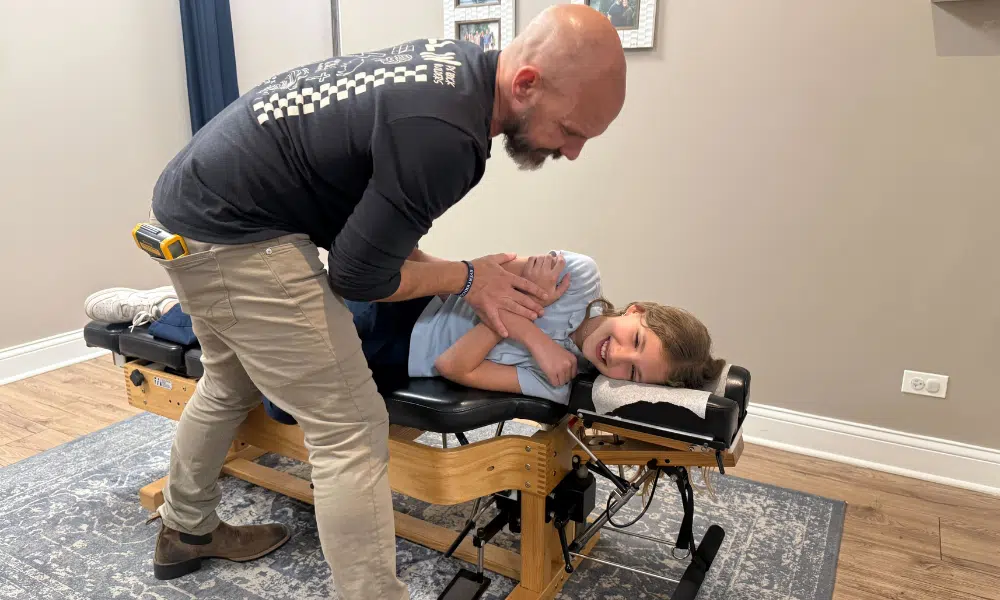
Neurologically-Focused Chiropractic Care doesn’t treat ADHD directly—we don’t diagnose or cure ADHD. What we do is correct subluxation interfering with nervous system communication, allowing your Autonomic Nervous System to function properly.
When subluxation is corrected, your nervous system can shift out of constant survival mode. That doesn’t mean ADHD symptoms vanish overnight—it means your nervous system gains capacity to regulate itself instead of relying on constant compensation.
When your gas pedal and brake pedal work properly, your brain doesn’t have to work as hard to maintain basic regulation. Energy spent on compensation becomes available for actual executive function. The sympathetic overdrive, causing anxiety, digestive issues, and sleep problems, starts to resolve.
The vagus nerve connection explains why ADHD, anxiety, and digestive issues cluster. Your vagus nerve runs from the brainstem through your neck (where subluxation often occurs) to your digestive system. Your gut microbiome produces 90% of your body’s serotonin and influences dopamine—the same neurotransmitters affected by ADHD.
Restoring vagus nerve function helps your gut-brain axis communicate properly. This is why women notice digestive improvements, better sleep, and reduced anxiety alongside ADHD symptom changes—they’re connected through autonomic function.
We see thousands of women reclaim their lives through this process. Women who were once stuck in a rut of exhaustion, constantly fighting to keep up, begin to feel grounded, focused, and energized. They learn to harness their ADHD not as a limitation, but as a unique strength—turning creativity, hyperfocus, and drive into tools for real success.
This isn’t about “fixing” ADHD; it’s about giving your nervous system the freedom and capacity to support your life, so you can finally move forward with clarity, confidence, and control.
Finding Specialized Care for High-Functioning ADHD in Females
The PX Docs provider directory connects you with chiropractors trained specifically in Neurologically-Focused Chiropractic Care for autonomic dysfunction. These specialists understand the Perfect Storm framework and how to address it systematically.
Your initial visit includes a comprehensive neurological history, INSiGHT scanning to measure current nervous system function, and a detailed explanation of findings showing exactly where dysfunction exists. You’ll see your own scan results, objective evidence of what you’ve been feeling subjectively.
Care looks different for every person. Some women notice changes within weeks. Others require months to restore function compromised for decades. This isn’t just about choosing between conventional care plans and neurological care; it’s about addressing the foundation while continuing approaches that help you function.
The goal isn’t to make you “normal.” It’s to give your nervous system the capacity to regulate itself so you’re not constantly compensating just to survive. When your gas pedal and brake pedal work properly, everything becomes more manageable, including the high-functioning ADHD symptoms in females you’ve been battling your entire life.